




About Arcuz Treasure Hunters
Most browser games open with a Play button and begin the second you press it. This one opens with a notice board, asks whether you would like an account or a guest slot, loads twice behind a progress bar, hands you over to a guardian elf for a speech, and only then puts you on a patch of grass. That is not a complaint. It is the tell: Arcuz Treasure Hunters is a phone role-playing game that walked into a browser tab with every piece of its furniture still strapped to its back.
The furniture is most of what you get in the first few minutes, so it is worth describing. By the time we stood in a field, the game had given us a character name nobody chose, a swordsman with a combat power of 1000, and a town square ringed with tabs: Hero, Inventory, Treasure, Quest, Daily challenge, Rank, Store, Lottery, Arena, a tower, a mine. Down the left edge sat Mail, Chat and Social. Over on the right, a Team Setup panel with six slots and one of them filled.
What the game is actually about lives behind two screens. The first is a world map, Auguz Continental, whose regions run off both edges of the frame: Sakara plain, The lost forest, Keel mountains, Desert of death, Mines of gero, Island of curse, Island of captivity and Treasure Island are the ones we could read in full, and exactly one of them is lit, marked with a burning torch. The second screen is what opens underneath it: a row of numbered dungeons, 1_1 to 1_5, chained left to right by arrows, each with three empty stars under its name, and above them Hard and Nightmare, both padlocked.
It is by Arcuz Games Studio, and it was published in February 2026. Now the honest part. Our session ran about four minutes, and the overwhelming majority of it went on the notice board, the sign-in choice, loading bars, a tutorial we tried and failed to skip, and the two map screens. We reached one grass field, one dialogue in a lava cavern, one unlit campfire and one battle screen that we never saw resolve. So this page is about the shape of the thing and the first dungeon's own small print, not about the ending.
The three stars and the button that plays the dungeon for you
The dungeon panel for the very first stage is the most informative screen in the game, and almost nobody reads it. It lists a recommended combat power of 1000, which is exactly what a brand-new character has, to the number, and a required squad level of one. The first dungeon is not a test; it is a fitting.
It also lists the price and the payout. Four stamina to go in. A hundred gold to come out. And experience, of which it offers none at all. The opening dungeon of a role-playing game that hands out no experience is a deliberate choice, and it says where the progression actually lives: not in the character sheet, in the drops.
Underneath, a row of eight slots shows what can fall out of the stage, six filled with item icons and two still dark. Along the bottom runs a star track, starting at 0 of 24, with chests fixed at 6, 18.
That track is what the three stars under each dungeon are for. They are not a difficulty rating and they are not a review score — they are a completion currency, pooled across every dungeon in the region and cashed in at those three chests. The game then prints the other half of the deal in plain words at the bottom of the screen: finish a dungeon with three stars and you unlock the ability to sweep it. Sweeping is the buttons on the right, one marked for a single run and one for ten: you get the dungeon's output without playing the dungeon.
It sounds like a cheat, and it is the most honest mechanic on the screen. A game of this shape knows you will want a stage's drops long after the stage itself stops being interesting, and that the alternative is walking the same corridor forty times. So it sells you the result, and the price is proving once that you could have done it yourself. Three stars is the receipt.
Stamina, action points, and the two counters that are not the same thing
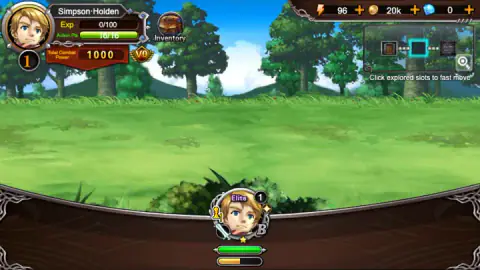
Two numbers in the corner look alike and are not. A lightning bolt reads 96. A bar in the character panel reads Action Pts 16 of 16. The dungeon panel asks for stamina to enter and separately gives a suggested figure for action points, which for the first stage is zero.
Our best reading is that one is the fuel for entering stages and the other is the fuel for doing things inside them, and that is as far as we will go, because we never played long enough to drain either. If the lightning bolt is the stamina pool, a new account carries roughly two dozen runs of the first dungeon before it has to wait. Beside them sit gold, reading twenty thousand, and gems, reading zero — the familiar pairing of the currency a game gives away and the one it does not.
None of it blocked us, and nothing asked us to pay. What it tells you is the kind of game you are in: one built in sessions, designed around coming back tomorrow, rather than one you finish in an afternoon.
What we reached, and what we did not
We never cleared a dungeon, so we will not describe one. We never saw a battle resolve: our last clear look at the game was a character card marked Elite, level 1, grade B, sitting under a green bar and an amber one in an empty field. We never hired a second party member, so the five empty squad slots are a promise we are reporting, not a feature we tested. We never opened the Store, the Lottery, the Arena, the Eternal Tower or the mine.
One small thing we did see all the way through: the translation wobbles. The guardian elf is spelled Culigli when she talks to you in the hub and Kulili when she gives instructions inside a stage, and the continent is Auguz while the game is Arcuz. It is the ordinary texture of a game that was written somewhere else and brought over, and it never once got in the way of knowing what to press.
More parties to build and dungeons to walk
MiniMight: Fantasy RPG is the closest match in our catalogue: the same business of hiring a team and taking it down through floors of monsters, with far less ceremony before the first fight. Heroes of the Dungeons keeps the party and the dungeon and swaps the walking for matching tiles. Wasteland Hunter does something stranger with the same bones, fighting its turn-based battles with falling blocks. And Idle Warrior Tales takes the idea behind the sweep button and builds the whole game out of it. The rest are in adventure games.
Screenshots
How to play Arcuz Treasure Hunters
- Get through the front door. A notice board covers the title screen; dismiss it. The game then offers signing in or continuing as a guest. Guest works, and puts you straight into the hub town.
- Click the carriage. The hub drops a hint over a horse and cart reading "Click the carriage to continue the adventure", and that cart is the door to the world map. The label underneath it is Main Stage.
- Pick the lit region, then pick a dungeon. Only one region on the map is available at the start. Clicking it opens the chain of numbered dungeons; clicking a dungeon fills in a panel at the bottom, and Start Exploration on the right begins it.
- Move by dragging, not by pressing keys. The tutorial's wording is "scroll your finger on the screen to the left or right to move in stages". On a desktop that is a click and a drag. The one letter key we tried on its own did nothing at all.
- Use the mini-map to go back. The strip in the top right corner shows the squares of the stage you are in, with the one you are heading for picked out. Its caption, "Click explored slots to fast move", is the whole instruction.
What our run taught us:
- Read the dungeon panel before you press Start Exploration. It is the only place the game tells you what a run costs and what it pays, and it is easy to skip past on the way to the button.
- The skip button does not skip. Pressing it raises a box warning that new players who skip the guide may lose key information, with Confirm and Cancel. Pressing Enter on that box does nothing; you have to click one of the two.
- Let the dialogue finish typing. Text appears letter by letter, and two of our captures caught a sentence still half-written. More than once we clicked, watched nothing change, and had to click again.
- Watch for the small arrow. A dialogue box that is waiting for you shows a thin white triangle in its lower corner. When it is missing, the game is still talking.
Controls
| Drag left or right (swipe on a touch screen) | Move your character through a stage. This is the game's own instruction, printed in the tutorial as 'Scroll your finger on screen to left or right to move in stages' |
|---|---|
| Click a lit slot on the mini-map | Travel straight to a square you have already explored. The mini-map sits top right with the caption 'Click explored slots to fast move' |
| Click | Advance dialogue, confirm a menu, pick a region, pick a dungeon. Nearly everything outside a stage is a click on a button |
| skip | Skips the guided introduction. It is a small red button in a corner, and it answers with a confirmation box rather than skipping straight away |
| Enter | Did nothing we could see. We pressed it on the Confirm/Cancel box that guards the tutorial and the screen did not change; the buttons themselves had to be clicked |
Features
- A world map called Auguz Continental whose regions run off both edges of the screen — Sakara plain, The lost forest, Keel mountains, Desert of death, Mines of gero, Island of curse, Island of captivity and Treasure Island are the ones we could read in full — of which only Sakara plain is lit at the start
- Each region is a chain of numbered dungeons, 1_1 through 1_5 on Normal, with Hard and Nightmare sitting behind padlocks
- Three stars to earn on every dungeon, collected on a track across the bottom of the screen with chests waiting at 6, 18 and 24
- A Sweep button that replays a dungeon without playing it, unlocked by the game's own rule: finish a dungeon with three stars to sweep it
- A Team Setup panel with six squad slots, one of them filled by the character you start with
- A hub town ringed with tabs — Hero, Inventory, Treasure, Inherit, Quest, Daily challenge, Rank, Store, Lottery, Arena, Eternal Tower, a mine — plus Mail, Chat and Social down the left edge
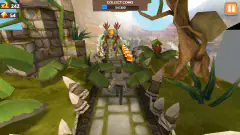
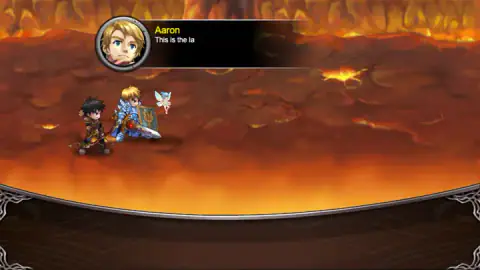
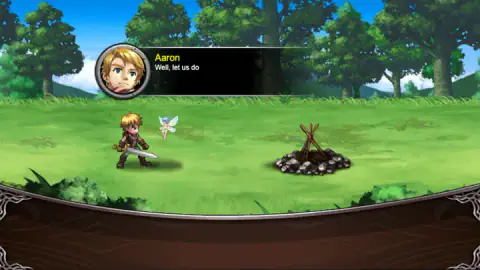
- Dialogue that types itself out letter by letter over hand-drawn scenes, from a lava cavern to a grass clearing with an unlit campfire
- It was published in February 2026
Game details
- Developer
- Arcuz Games Studio
- Release date
- February 2026
- Last updated
- August 10, 2026
- Added here
- December 2025
- Technology
- HTML5
- Platforms
- Browser (desktop), Browser (mobile & tablet, touch)
- Saved progress
- Saving, when available, is managed by this game. Mava cannot confirm your level.
FAQ
What is Arcuz Treasure Hunters?
It is a fantasy role-playing game you play in a browser. You lead a small party across a world map called Auguz Continental, pick a dungeon out of a numbered chain, and explore it square by square while a story plays out in dialogue boxes. Each dungeon is scored out of three stars, and the stars feed a reward track. The game is free and was made by Arcuz Games Studio.
How do you move in Arcuz Treasure Hunters?
Inside a stage you drag left or right rather than press arrow keys. The tutorial says it plainly: scroll your finger on the screen to the left or right to move. Everything else is clicks — dialogue, menus, the map, the dungeon list. There is also a mini-map in the top right corner, and clicking a square you have already explored moves you straight back to it.
What do the three stars on each dungeon mean?
Every dungeon shows three stars, and they are the game's currency of completion rather than a difficulty rating. They collect on a track along the bottom of the dungeon screen, which has chests marked at 6, 18 and 24 stars. The screen also spells out what full marks buy you: finish a dungeon with all three stars and you can sweep it afterwards. We never cleared one, so we cannot tell you what each individual star is awarded for.
What does the Sweep button do?
It replays a dungeon you have already beaten without making you walk through it again, in one go or ten at a time. Games built this way expect you to want the drops from a stage long after the stage itself has stopped being interesting, so they sell you the result and skip the trip. It stays greyed out until a dungeon has been finished with three stars.
What is stamina for in Arcuz Treasure Hunters?
Entering a dungeon costs it. The panel for the first dungeon asks for four stamina, and a lightning-bolt counter in the top corner of the hub read 96 when we looked. If those two are the same pool, a fresh account is carrying roughly two dozen runs before it has to wait. That is the oldest pacing device in phone role-playing games, and it came across to the browser untouched.
Does Arcuz Treasure Hunters cost money?
It is free to play. The hub does carry a Store, a Lottery and a tab labelled 1stRecharge, which is the usual sign of a game that sells something, and our account started with twenty thousand gold and zero gems — two currencies, of which only one was full. In the part we played nothing asked us to pay, and the first dungeon is calibrated to exactly the strength a new character already has.
Do you need an account to play Arcuz Treasure Hunters?
No. The title screen offers signing in or carrying on as a guest, and we took the guest route; by the time we were back at the title screen it was showing Play and Sign out, so a guest session counts as being signed in. We did not close the tab and come back, so we cannot tell you whether guest progress survives that.
Who made Arcuz Treasure Hunters and when?
Arcuz Games Studio. It was published on 16 February 2026 and last modified in August of that year. The title screen carries a Korean subtitle under the logo, which is the only clue the game itself gives about where it comes from.