


How this list is put together
Who made 2048, and the rules it really uses
Gabriele Cirulli, a 19-year-old Italian web developer, built 2048 over a weekend and put it online on 9 March 2014. He gave it away under an open licence. It drew more than four million visitors in under a week. He called it close to Threes, an iPhone puzzle released a month earlier. That free licence is why dozens of games carry the number.
The small print matters for strategy. The new tile is a 2 nine times in ten, and a 4 otherwise. Your score rises by the value of each tile you make. A tile that has just merged cannot merge again in the same move. And the game does not stop at 2048: you can keep going.
From a 2, the 2048 tile is ten doublings away. In tiles, that is 1,024 twos.
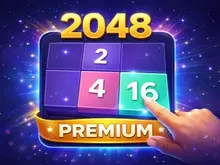
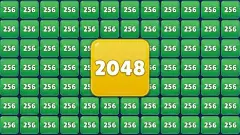
The classic on this page is 2048 Premium. According to its description it offers 4x4, 5x5 and 6x6 boards, plus undo, swap and delete buttons.
The corner strategy, and where it stops working
Every guide agrees on the method. Pick a corner and keep your biggest tile there. Line the next biggest along the same edge, in falling order. Almost never press the key that would pull the big one out. A large tile stranded among small ones is how most games end. Luck still decides part of it, because you never know where the next tile lands.
The idea travels beyond the original board.
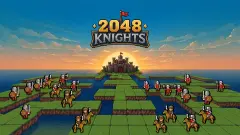
- In 2048 Knights the whole board slides too, but no new tiles ever arrive. The pair nearest the wall merges first, so the key you press chooses which two join. Each stage has a par, the fewest moves, and several early ones fall in two.
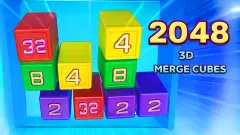
- In 2048 3D: Merge Cubes the corner becomes the floor. Keep the big cubes low and to one side: a big number in the middle splits the glass in two.
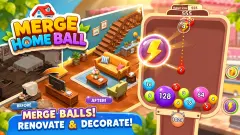
- In Merge Home Ball 2048 the falling-order edge returns as a row of balls. A heap reading 8, 16, 32 is one drop from a chain. Two drops turned our 16, 32 and 64 into a single 128.
- In 248 Scribble the trick is useless. You drag one counter onto its neighbour and nothing else moves, so there is nothing to protect.
Which 2048 to play: one gesture per version
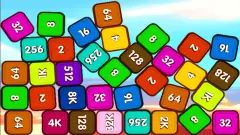
Tap a group. 2048 Merge Blocks fills a 5x7 board and merges every equal tile touching the one you tap. The size of the group sets the jump: three equal tiles make four times their value, and seven 2s gave us a 32 in one tap. There is no clock.
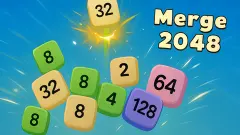
Drop into a jar. Merge 2048 adds gravity and a red line. It also skips the slow start: our second tile was already a 32.
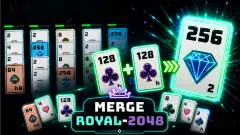
Read cards. Merge Royal 2048 prints the numbers on playing cards in four overlapping columns. No clock again; you lose when one column fills.
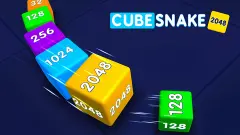
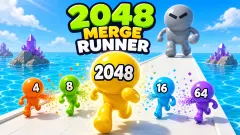
Use your reflexes. Cube Snake 2048 puts the doubling on a snake's back: you eat cubes equal to or lower than your head. In 2048 Merge Runner the green x2 gate is a free merge and the red ÷2 takes one away.
Not a maths game, and lighter than most
You never add anything in 2048. You only spot two equal numbers, and the board would work the same with colours. That is why sums, times tables and sudoku live on number games, and this page keeps only games built on the 2048 rule.
One thing in its favour: most of the classic boards we measured weigh less than a megabyte, less than a photo from your phone. The 3D cube versions weigh several times more. More in puzzle games.