


About SlowMo Sniper
Most sniper games hand you all the time in the world and then dare you to waste it. SlowMo Sniper hands you the length of a fall.
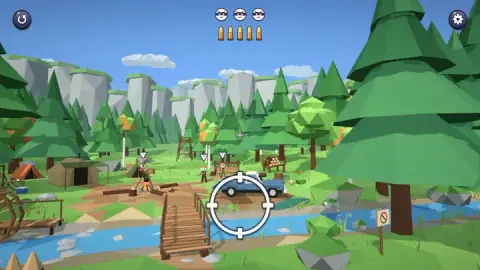
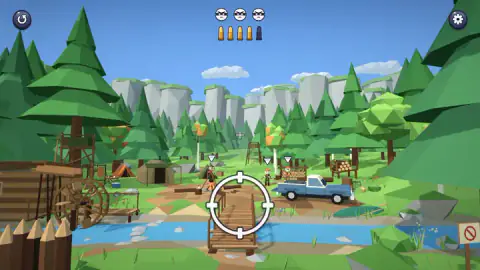
The top of the screen tells you the deal before you have moved anything. A row of three round white faces in black eye masks, and underneath them five brass bullets standing upright like a little fence. Three figures down in the valley have a white triangle hovering over their heads, and the two numbers match. That is the level: three to take out of the picture, five shots, two spare. Fire one and the round does not disappear from the bar — it turns navy and stays in the row, which is a quietly unkind way of keeping score.
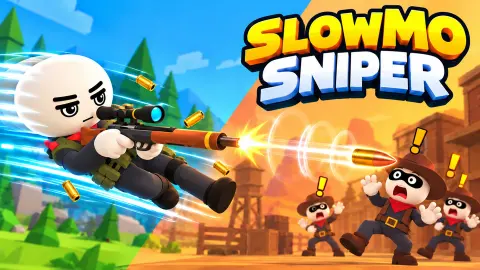
The level itself is a logging camp, built out of the big flat triangles that make a forest look like folded paper. A water wheel turns on the left bank. A wooden footbridge with railings crosses a blue river down the middle. There is an orange tent and a khaki one, a campfire, a blue pickup with logs stacked in the back, and a red no-entry sign at the treeline as though any of this were a matter for signage. Your own shooter is the one with the enormous white egg of a head, crouched behind a palisade of sharpened stakes with a rifle on his shoulder.
One thing before the rest, because it colours everything below. We played for about ten minutes and never finished the first level. The row of faces still read three in every screenshot we kept, the coin counter never moved off zero, and four separate times the picture dimmed to a white skull over two words we came to know well: "You hit the ground!"
Three faces and five bullets: the level is written on the bar
It is worth saying plainly how little this game hides. No mission briefing, no objective text, no arrow pointing anywhere. There is a row of faces and a row of bullets, and between them they state the problem and the budget.
What makes that elegant rather than thin is the ratio. One bullet per target would be a precision test and nothing else. Ten would be a shooting gallery. Five for three is a nerve test: you can afford to be wrong twice, and knowing exactly how wrong you can afford to be is what changes the way you play the third shot.
We never got to feel the good side of that, and the bar is why we know it. The three faces stayed three. We burned rounds, watched them go navy one at a time, met the red badge announcing the last one, and lost anyway. Note what the game does with that: the skull card has a single yellow button on it, it says Retry, and it drops you back at the start of the same level with everything restored.
The sideways dive in slow motion has a date
The move at the centre of this game — leap out of cover, time crawls, shoot everybody before you land — is not a generic action-film idea. It was invented twice, and you can put years on both.
The first was a photographic trick. In 1878, at a track in California, Eadweard Muybridge lined up a row of still cameras and rigged them to fire one after another as a horse galloped past, to settle a bet about whether all four hooves ever leave the ground at once. They do. What he had built without meaning to was a way of walking around a frozen instant: photographs taken from different places at almost the same moment. That is the trick that gave The Matrix its camera orbit around a bullet, and gave the effect the name everybody uses for it now.
The second invention is the part that matters here. Two years after that film, Remedy's Max Payne turned the effect into something you do rather than something you watch, by attaching it to a sideways dive — you throw your character through the air, time thickens, and the airtime becomes the window in which you aim. That is precisely the verb SlowMo Sniper is built on, stripped down to a browser and one jump per level.
There is also a sound reason the trick suits a sniper. A rifle bullet leaves the barrel at roughly twice the speed of sound, so a few hundred metres of flight is over in about a third of a second — and a person needs a quarter of a second just to react to something appearing. At real speed a long shot is not a choice; it is a reflex you committed to beforehand. Slow the world down and the same shot becomes a decision you get to make. That is also why the fall is the right clock: gravity is the one thing in the scene that cannot be talked out of its schedule.
Losing has nothing to do with being shot at
Most games in this shape kill you with return fire. This one does not appear to.
The failure card is a white skull on a dimmed scene, and the line under it reads "You hit the ground!" Your shooter lies face down on the dirt path with his rifle beside him, and a gold coin counter sits at zero in the corner. There is no health bar anywhere on screen, we were never hit by anything, and nothing we saw suggests the figures below ever shoot back. The game's listing adds a second way to lose — running out of bullets — which fits the same logic: both failures are a clock running out, one measured in metres of fall and the other in brass.
That choice is doing more work than it looks. The tension is entirely self-inflicted. Nobody is hunting you; you are spending a visible resource against an invisible one, and the invisible one is the floor.
What the listing promises, and what we never saw
Honest ledger, because the difference matters. Everything above is what the screen showed us. This paragraph is the game's own description talking.
It says the campaign runs on a world map of contracts, from city streets to snowy bases, western towns, highways and a skydive full of parachuting enemies, with new levels still arriving after it ends. It says every third mission takes the rifle away and gives you dual pistols, a bazooka or a minigun. It says red barrels clear whole groups, that ropes can be cut to drop heavy cargo, and that a helmet comes off after the first hit, so a helmeted figure wants two rounds. It says cash buys upgrades to Damage, Zoom, Bullets and Reload, and that you can dress your shooter in hats and outfits and put skins on the rifle. We saw none of it: we never left the logging camp, never earned a coin, never held anything but the rifle. Treat it as a brochure until somebody gets further than we did.
More to line up
If the appeal here is the single considered shot, Hidden Sniper: Camo Hunter 3D is the patient version of the same idea and Agent Sniper City moves it into a town. Quick Draw Cowboys keeps the one-shot tension but swaps slow motion for reaction time — the same bet played the other way round — and Red and Blue Snipers turns it into a puzzle for two. The rest are under shooting games.
Screenshots
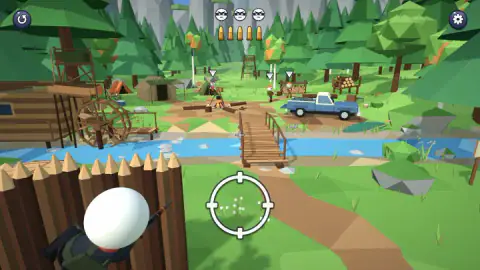
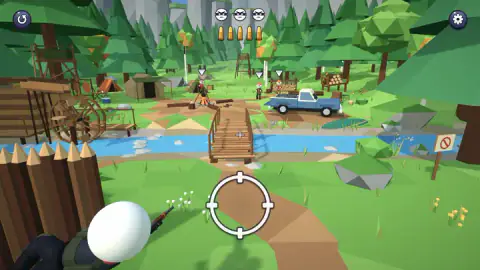
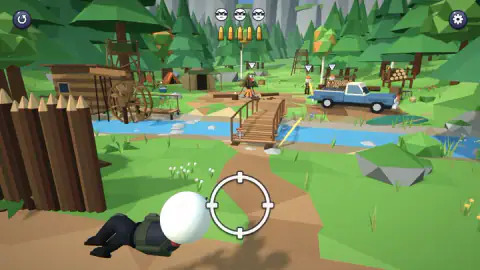
How to play SlowMo Sniper
- Start the level. It waits on a card that says Tap to start, and nothing happens until you click or tap it.
- Hold the mouse button down inside the white circle near the bottom of the screen. The game draws a hand inside that circle and prints its instruction beside it: "Hold the circle to aim, release to shoot."
- Move the mouse while you hold. The sight travels with it.
- Let go to fire. Watch the bar: one bullet goes dark, and the faces only change if you were right.
- Drag from outside the circle to swing the camera. The card's second line is "Drag outside it to turn the camera."
What only sitting in front of it teaches:
- The circle is not the sight. Two white marks share the screen and they do different jobs. The ringed circle sits about a quarter of the screen below the middle; the thin cross sits at the exact centre and never moved off it in any frame we looked at. The circle is the pad your finger lives on. The cross is where the bullet goes.
- Look before you leap, literally. Every one of our failures was the same mistake: still swinging the camera when the ground arrived. The drag is slow and the fall is not.
- The spare bullets are not spare. Two misses is the whole budget, and the game warns you when it is nearly gone by dropping a red badge across the top that reads "LAST BULLET!"
- Failure costs nothing but the attempt. A yellow Retry button puts the level back at its Tap to start card with the bar refilled. Nothing is deducted or unwound.
- Aim high. The game's own tips say a headshot takes down any enemy in one and that the rifle reloads while the bullet camera plays, making the head both the cheap shot and the fast one. That is its advice, not our finding.
Controls
| Left mouse button, held inside the white circle (or Space, held) | Starts you aiming. The game prints this itself on a card that reads, in its own words, "Hold the circle to aim, release to shoot" |
|---|---|
| The mouse, while the button is down | Moves the sight. The small cross at the dead centre of the screen is where the shot goes, not the circle you are holding |
| Releasing the button | Fires. One bullet goes dark on the top bar and stays there |
| A drag that starts outside the circle | Turns the camera. The game's second line of instruction is "Drag outside it to turn the camera" |
| Touch — hold inside the circle, drag to aim, release | The same three jobs on a phone or tablet, per the game's own listing; a white hand is drawn inside the circle even on a computer |
Features
- The top bar states the whole level before you move: three masked faces for the three figures wearing white markers, and five bullets underneath them, so the margin is two misses
- A spent round does not vanish from the bar — it turns navy and stays in the row as a reminder of what you did with it
- Down to the last gold bullet, a red badge drops across the top of the screen reading "LAST BULLET!"
- Two white marks share the screen and only one of them is the sight: the circle you hold sits about a quarter of the screen below the small cross, which never leaves the exact centre of the frame
- Losing has nothing to do with being shot. The screen dims to a white skull over the words "You hit the ground!" and a yellow Retry button
- Level one is a logging camp in low-poly woodland: a turning water wheel, a footbridge over a river, two tents, a campfire and a blue pickup stacked with cut timber
- Nothing is taken from you when you fail — Retry puts the level straight back to its "Tap to start" card with the bar full again
Game details
- Developer
- Partner studio
- Release date
- October 2026
- Last updated
- October 25, 2026
- Added here
- October 2026
- Technology
- HTML5 (3D)
- Platforms
- Browser (desktop), Browser (mobile & tablet, touch)
- Saved progress
- Saving, when available, is managed by this game. Mava cannot confirm your level.
FAQ
How do you play SlowMo Sniper?
Your shooter breaks cover and leaps sideways, time slows almost to a stop, and you have until he lands to take down every figure wearing a white marker. You aim by holding the mouse button inside the white circle on screen and moving the mouse, and you fire by letting go. The top bar shows how many targets are left and how many bullets you have. The game's own instruction card says it in one line — "Hold the circle to aim, release to shoot."
What do the three faces at the top of SlowMo Sniper mean?
They are a count, and they match the number of figures in the level wearing a white triangle over their heads. Under them sits a row of five bullets, which is your ammunition for that level. Three and five is the arithmetic of the opening level — three to take down, five shots to do it, two of them spare. We never changed the first number, so we cannot show you what a face looks like once it is gone.
Why do you keep losing in SlowMo Sniper?
Almost certainly because you are still turning the camera when the fall ends. The failure card does not mention being shot at all — it shows a white skull and the words "You hit the ground!", which means the clock you are playing against is gravity rather than return fire. The game's own listing adds that running out of bullets loses the level too. Deciding where to look before you jump is worth more than aiming quickly once you are in the air.
Where do you actually aim in SlowMo Sniper?
At the small cross, not at the big circle. There are two white marks on screen — a ringed circle sitting roughly a quarter of the screen below centre, and a thin cross pinned to the exact middle of the frame. The circle is the pad you hold and drag — the game draws a hand inside it. The cross is where the bullet goes, and it does not move from the centre pixel.
Is SlowMo Sniper free to play in a browser?
Yes. It runs in a browser window with nothing to download or install, and it is free to play. The game is built to the usual widescreen shape and carries a touch control on screen, so it is meant for a phone as much as for a computer. We played it with a mouse and keyboard.
How many levels does SlowMo Sniper have?
More than we saw. The game's own description sets out a campaign of contracts chosen from a world map, running through city streets, snowy bases, western towns, highways and a skydive, and says new levels keep coming after the campaign ends. Our session never got past the first one, a logging camp in a pine forest, so everything beyond it is the game's claim rather than our report.
Can you upgrade your rifle in SlowMo Sniper?
The game's listing says you can, naming four things to spend cash on — Damage, Zoom, Bullets and Reload — plus hats, faces, outfits and rifle skins to dress your shooter in. We never got to test any of it. The coin counter in the corner of our failure screen read zero, so there was never anything to spend.
Who made SlowMo Sniper, and when did it come out?
The studio behind it is not recorded anywhere we can check, so this sheet names no author rather than guessing one. What we can date is its arrival here, because it reached our catalogue on 24 October 2026, which makes it a new title at the time of writing rather than something from the back catalogue.