





About Park Tycoon
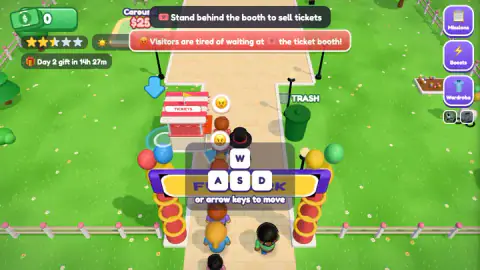
Five pictures of the same park, and in every one of them the money counter reads zero. A dark band sits across the top of the screen with the same sentence it has carried since the game loaded: stand behind the booth to sell tickets. In the first picture a red banner has pushed in underneath it — "Visitors are tired of waiting at the ticket booth!" — and above two of the people in the queue float little red faces, scowling. A few steps away sits an empty plot with a price label reading Carousel $25. We never bought it. We never had a cent.
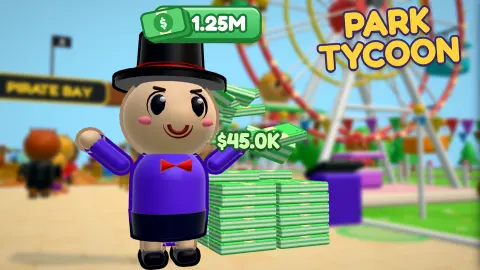
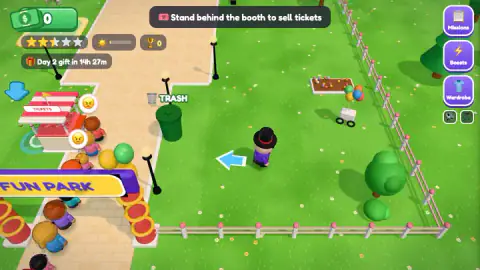
This is a tycoon game that does not open by letting you build anything. It opens by making you the cashier. You steer a small figure in a black top hat around a cartoon park with W, A, S and D or the arrow keys — the game puts the four key caps on screen as its very first lesson — and there is no build menu anywhere. Everything is a place. Stand behind the counter and you sell. Stand on a marked plot and you build. Walk over money and you pick it up. A blue arrow lies flat on the grass pointing wherever the game wants you next, and in four of our five captures that arrow is pointing back the way we came, towards the booth.
The read-outs along the top left tell you the rest of the story. A row of five stars, two and a half of them gold, is the park's rating. A sun sitting on a bar is the daylight you have left. A small trophy next to a zero is whatever trophies turn out to be, and a line underneath counts down to the next daily gift: Day 2 gift in 14h 27m. None of those numbers moved for us except the sun, which emptied.
So here is the honest shape of this page. Our run lasted about ten minutes. We circled the booth from every side, followed the arrows, walked to a padlocked gate marked PIRATE BAY, got stuck there badly enough that we reloaded, and watched the park go dark. We never sold a ticket, never built a ride, never hired anyone, and the Daily Missions panel we opened still read "Build your first ride to unlock daily missions!" when we closed it. Everything beyond the booth is the game's own account of itself, labelled as such every time.
The first job in this park is not building. It is standing in the right place
Most games of this shape hand you a grid, a budget and a menu, and the skill is choosing. This one hands you a pair of legs. The booth is a solid object with a front and a back, the queue is a line of people who each have their own patience, and the only thing between the two is where your character happens to be. That one decision — the counter needs a body behind it — turns a management game into a game about walking.
It also makes the opening unforgiving, and we can say that with some authority, because we failed it. There is no idle income at the start to bail you out: the money counter stays at zero for exactly as long as nobody is serving.
Real parks measure the queue, not the ride, and this one puts the complaint on screen
That red banner is not filler. It is the theme park industry's central problem, printed in a game before you own a single attraction.
Queueing is, statistically, what a visit to an amusement park mostly consists of. A 2023 review of theme-park queue management published in the journal Heliyon, by Jing Li and Qiang Li, puts the split plainly: visitors spend roughly a fifth of their time actually experiencing an attraction, and more than half of it waiting to. In a park carrying over forty attractions, the same paper reports, the average visitor gets round about ten of them. The authors describe the waiting as the single biggest source of dissatisfaction with theme parks — ahead of price, ahead of the rides.
What the industry learned, and what this game has quietly borrowed, is that the felt length of a wait is not its measured length. The reference point is a short paper from 1985 by David Maister, The Psychology of Waiting Lines, still quoted in operations teaching four decades later. Its eight propositions are about perception rather than minutes: "Occupied time feels shorter than unoccupied time", anxiety stretches a wait, and an unexplained wait feels longer than an explained one.
Now put that beside what is happening on your screen. The game does not let the queue wait quietly. It gives individual visitors visible tempers, and it names the exact bottleneck in red. And the design consequence is the part that makes it a game rather than a lesson: there is no automatic cashier at the beginning, so the queue grows at precisely the rate at which you are somewhere else. The park's worst problem is not a missing ride. It is you, standing in the wrong field.
Night comes on a timer, and the park dims around you while it does
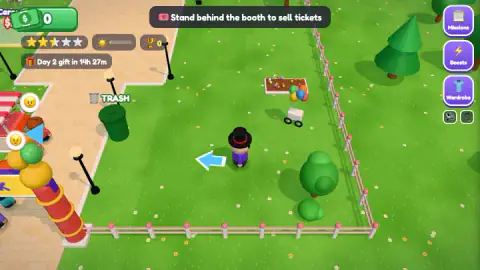
The sun on the bar is a clock, and it is the one read-out that moved during our session. Our captures catch the whole turn. In the earliest of them the lawn is a vivid green and the lamp post beside the path is a plain dark pole. By the last one the grass has gone to a dull olive, the tiled path has greyed over, and both lamps are burning with a warm halo around them. The sun meter, which still keeps a sliver of yellow in the earlier shots, has none left in the final one.
It is a nice piece of pressure, because nothing pauses. The queue is still there in the dark. One band went past pricing night tickets at two dollars, which we saw once and never got to test, having sold nothing in daylight either. The daily gift counter keeps its own, much slower clock alongside: still fourteen hours out when we stopped.
What is behind the padlock, in the game's own words
We walked to the Pirate Bay gate and found a padlock, so everything here belongs to the game rather than to us. Its own listing says the plots you stand on open new rides and that those rides upgrade up to level five. It says you can hire cashiers, operators, vendors, cleaners and technicians until the park runs itself, which is the escape route from the problem above. It says stars are earned by keeping visitors happy, clearing litter and repairing breakdowns, and that stars are what open Pirate Bay — where, it says, you will find a swinging ship, a log flume and a pirate coaster. It also promises daily missions and earnings that continue while you are away.
We saw the gate, and we saw the star row sitting at two and a half. We did not see any of the rest, and this page will not pretend otherwise.
More parks, counters and empires to run
If the walking-and-collecting part is what appeals, Scoop Empire is the closest thing we have: a 3D shop you run on foot, serving customers and opening new rooms as you go. Farm Care Tycoon builds the same way, a plot at a time, with customers queueing at the shop end of it. For the visitor-attraction side without the legwork, Idle Zoo Tycoon keeps its guests happy for you, and Idle Cinema Tycoon runs on ticket sales the way this park's booth does. The rest are in strategy games.
Screenshots
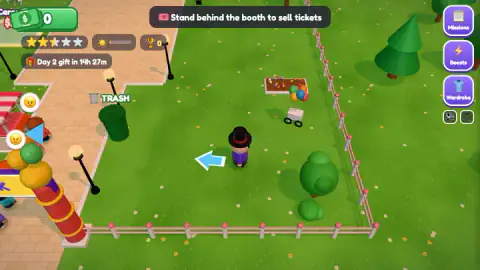
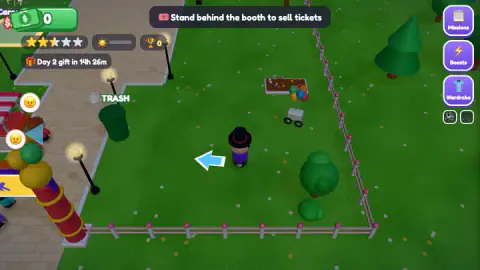
How to play Park Tycoon
- Walk with W, A, S and D, or with the arrow keys. Both worked for us; the game lists clicking and dragging as a third option, and that one never moved our character at all.
- Follow the blue arrow on the ground. It is not a direction to hold down — it is a spot to reach, and it re-points itself the moment you arrive.
- Go round the back of the ticket booth, not up to the window. The queue stands at the front; your place is on the empty side of the counter.
- Once money starts arriving, stand on a marked plot to build. The cheapest one near the entrance is tagged at twenty-five for a carousel.
- Keep an eye on the sun meter. When it runs out the lights come on, and the park keeps running through the dark.
What only walking around it teaches:
- "Behind" is a position, not a proximity. We spent most of the session a metre from the counter wondering why nothing happened. Being near the booth is not the same as being on the staff side of it.
- The angry faces are a timer you can read. They appear over individual people in the queue, not over the park as a whole, so you can see which customer is about to give up rather than only learning that somebody did.
- Panels stop you dead. While the Daily Missions box was open, our key presses did nothing at all. Close it first, then move.
- The park has no map. The arrow on the grass is the whole navigation system, which is how we ended up at a locked gate on the far side of the park.
Controls
| W, A, S and D | Walks your character around the park. The game puts these four key caps on screen as its first lesson |
|---|---|
| Arrow keys | The same walk. We used both sets interchangeably and the character moved either way |
| Click and drag | Listed by the game as the desktop alternative to the keyboard. We tried it several times and the character did not move for us |
| Touch and drag anywhere | The mobile control, per the game's own listing. We played with a keyboard and mouse, so this is the listing's claim rather than ours |
| Stand behind the ticket booth | Sells tickets to the queue. The band across the top of the screen asks for this and never stops asking until it is done |
| Stand on a marked plot | Builds or upgrades whatever the plot is priced for. The plot nearest the entrance is labelled Carousel 25 dollars |
| Walk over money on the ground | Picks it up, per the game's own instructions. Nothing ever dropped for us, because we never made a sale |
Features
- The park is run on foot: there is no build menu to open, and every action is a patch of ground you have to walk to and stand on
- A dark band across the top repeats the current job without pause, and a red banner under it names the problem — ours read that visitors were tired of waiting at the ticket booth
- Blue arrows lie flat on the grass and point at wherever the game wants you next, which is the only navigation aid in a park with no map
- Your park carries a rating out of five stars; ours sat at two and a half in every capture, and the game's own listing says those stars are what opens the second area
- A sun meter counts the daylight down. Across our captures the grass dims, the path greys over and the lamp posts light up
- A counter in the corner reads Day 2 gift in 14h 27m, so the rewards run on the calendar rather than on the run you are playing
- The cheapest plot of land sits a few steps from the entrance with a price label reading Carousel 25 dollars
Game details
- Developer
- Partner studio
- Release date
- October 2026
- Last updated
- October 25, 2026
- Added here
- October 2026
- Technology
- HTML5 (3D)
- Platforms
- Browser (desktop), Browser (mobile & tablet, touch)
- Classification
- 3D , Arcade , Clicker , Simulation , Strategy
- Saved progress
- Saving, when available, is managed by this game. Mava cannot confirm your level.
FAQ
How do you play Park Tycoon?
You walk a single character around a small 3D amusement park with WASD or the arrow keys, and everything you do is done by standing in the right place. Standing behind the ticket booth sells tickets to the queue, standing on a marked plot of land builds what that plot is priced for, and walking over dropped money picks it up. There is no menu to build from.
Why does Park Tycoon keep saying Stand behind the booth to sell tickets?
Because at the start there is nobody working the booth except you, and the queue does not move until someone is behind the counter. The instruction stays on screen until the sale happens, which is why it is the most persistent line in the game. Behind means literally behind: standing in front of the counter, where the customers are, is not the same spot.
How do you make money in Park Tycoon?
Ticket sales at the booth are the first and, at the beginning, the only source. Visitors queue, you serve them from behind the counter, and the money counter in the top left corner climbs. The game's own listing says visitors also drop cash around the park for you to walk over and collect once rides are running, and that hired staff eventually keep the money coming without you.
What are the stars in Park Tycoon?
They are your park's rating, shown as a row of five above the money counter. Ours stayed at two and a half out of five for the whole session, because we never served anybody. According to the game's own listing, stars come from keeping visitors happy, clearing litter and fixing breakdowns, and they are what unlocks the second area of the park.
What is Pirate Bay in Park Tycoon?
It is the second area of the park, reached through a gate that was padlocked for us throughout our session. The game's own description says it holds a swinging ship, a log flume and a pirate coaster, and that stars are what open it. We walked up to the gate, could not pass, and never saw anything behind it, so that list is the game's word rather than ours.
Does Park Tycoon have a day and night cycle?
Yes, and it runs while you play rather than between sessions. A sun meter in the top left drains as the day goes on, and across our screenshots the grass darkens, the path turns grey and the lamp posts come on one by one. A band also went past once pricing night tickets at two dollars, which we saw but never got the chance to test.
Can you play Park Tycoon on a phone?
The game's own instructions say yes, and that on mobile you touch and drag anywhere on the screen to move rather than using keys. Our session was played with a keyboard and mouse on a desktop browser, so we can vouch for the keyboard controls and not for the touch ones. Nothing has to be installed either way.
Is Park Tycoon free, and who made it?
It is free and it runs in a browser tab with nothing to download. The studio behind it is not recorded anywhere we can check, so this sheet names no author rather than guessing at one. It reached our catalogue on 25 October 2026, which makes it new rather than a back-catalogue title, and no studio release date is known.