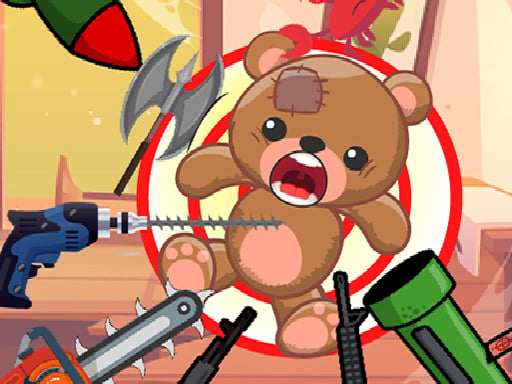
About Kick The Teddy Bear
Most games in this family give you a doll that lies where it falls. Kick The Teddy Bear gives you one that gets up. Hit it, then take your hand off the mouse and count: after five seconds the bear stops sprawling, a torque winds it back upright, and its face switches to an animation the developers named laugh. It is sitting in the same spot it started, looking pleased with itself, and the only thing that has changed is that you now have some coins.
That loop is the whole design. The bear is a physics ragdoll — head, arms and legs on jointed hinges — so nothing that happens to it is scripted. Grab it by a limb, swing it, drive it into the barn wall, and it lands however the physics decides. Each landing is worth a point of damage and a coin or two, and the level ends when the damage reaches the bear's health. At level one that is sixty, and your bare hand does one. Sixty clicks. It is as tedious as it sounds, and it is deliberate, because there is a shop of twenty weapons and you start with nothing. Every slot is padlocked, you have no coins, and the cheapest thing on sale is a bottle at fifty.
It was built in Construct 2 and published on 8 September 2020 by JulGames, a brand of the Romanian studio Freeze Nova — which is why the distributor credits the same game to a different name and the Android port carried a third. The idea is older than the game. Despicable Bear put the same teddy in the same position in 2016, and Kick the Buddy made it enormous a year later. This is that, in a browser tab, without the store or the account.
Twenty weapons, 13,780 coins, and a price list that argues with itself
The shop is a market stall you scroll with an arrow, and the prices are not a curve — they are a list somebody wrote once and never balanced. What each family does:
| Family | Items | Cheapest | Dearest | What separates them |
|---|---|---|---|---|
| Guns | pistol, AK-47, M6A4 rifle, launcher | 200 | 1,250 | rate of fire, not damage |
| Held tools | sword, axe, drill, chainsaw | 150 | 1,000 | whether they cut on a swing or continuously |
| Throwables | bottle, knife, ninja star, axe | 50 | 500 | reload time and coins per hit |
| Draggables | box, chair, ladder, oil drum | 90 | 260 | how many impacts before they break |
| Automatic | crab, cannon, arrow rain, rockets | 650 | 5,000 | whether you aim them or not |
Owning everything costs 13,780 coins, and the grind does not reward itself in order. The rifle at 800 is the fastest killer in the game, three damage every tenth of a second. The launcher at 1,250 hits for ten but only twice a second, so it is slower while looking far more impressive. The rocket strike at 5,000 — more than a third of the entire shop — is slower still.
What the expensive end buys instead is coins and spectacle: the rockets and the cannon pay five coins a hit against the rifle's one, and the launcher throws the bear across the barn in a way a rifle never will. Buy cheap and shoot fast if you are optimising. If you came to watch a teddy cartwheel into a hay bale, the prices make more sense.
What sixty years of experiments say about hitting things
Games like this one sell an idea: that anger is a pressure and letting it out lowers it. The idea has a long pedigree and almost no evidence. It rests on one unexplained word in Aristotle — who was writing about pity and fear at the theatre, not anger — read medically in the nineteenth century and then built into Freud and Breuer's picture of emotion as something that discharges. Punching a pillow followed from that picture, not from any result.
Psychologists have been testing it since the fifties and it keeps failing. Insulted volunteers made to pound nails for ten minutes came out more hostile than those who did nothing. In a much larger study, six hundred angry students either hit a punching bag while picturing the person who had insulted them, hit it while thinking about exercise, or sat quietly. The quiet group ended up calmest and least aggressive, and the venting did not even lift anyone's mood. The author's own summary was that doing nothing beat venting.
The most recent review pooled 154 studies and 10,189 people: calming activities cut anger substantially, arousing ones did nothing measurable either way, and hitting or kicking an object came out flat. None of that is a reason to skip a game about clobbering a teddy bear — the fun here is slapstick physics, the same fun as a cartoon anvil. It is only worth knowing that the bear getting up and laughing is closer to the evidence than the pitch on the box.
It gets shelved with the idle games, and it is not one
Search for idle games unblocked and this sort of title comes back, because it has coins, upgrades and a number that goes up. It has none of what defines an idle game. Nothing accrues while you are away. No production rate, no offline earnings, no reason to leave the tab open — shut it and the coin count is where you left it. Every coin has to be knocked out of the bear by hand.
That makes it a clicker in the strict sense. If you want a number that grows overnight, this is not it. If you want four minutes between two other things, the flat hundred a level is a clean unit of progress.
Playing Kick The Teddy Bear unblocked, and where your progress lives
Why it turns up on unblocked lists is unremarkable: one page drawing into a canvas, no plugin, no installer, no login, no server call for anything but the ads. A school Chromebook runs it as happily as a desktop, and since everything is a tap, a trackpad is no handicap.
The part nobody mentions is where the save lives. Your coins, your level and all twenty unlock flags go into your own browser's storage on that one machine, never to an account. On a personal laptop that is fine. On a shared school computer that wipes profiles between sessions, or in a private window, it is not — you return to level one with nothing bought and the whole shop to earn again. Grind it somewhere that keeps its cookies.
The part that cannot be worked around: a filter blocks an address, not a piece of software. Every copy on the web is this same build at a different address, so none behaves differently once the page opens, and whether ours opens is a decision your school made about domains. If it does not, the moves that work are asking a teacher whether the site can be allowed, or playing at home. As for interruptions, expect one ad when you press play and one between levels, and none while a level is running.
More things to hit in the same corner
Rabbit Punch strips the same reflex to ninety seconds and a boxing glove. Slap The Rat swaps the bear for a mallet and a timer. Drunken Slap Wars keeps the ragdoll physics but lets the other side hit back. And Pop It Now is this idea with the violence taken out, which for some moods is the better answer. The rest of the shelf is in clicker games.
How to play Kick The Teddy Bear
- Press play, sit out the ad, then click the bear. Nothing is unlocked yet and nothing needs to be. Every click on any part of it counts.
- Grab it and throw it. Hold down on a limb and drag; the bear comes with you and goes limp when you let go. Driving it into a wall pays double what a click does.
- Watch the bar at the bottom. It fills as damage builds rather than draining, and the level ends the moment it is full.
- Buy from the tabs along the top. Five tabs, four slots each. Tapping a locked slot opens the market stall and shows the price; tapping an owned one equips it.
- Take the hundred coins and go again. Each cleared level pays a flat bonus and starts a slightly tougher bear.
Four things worth knowing before you spend anything:
- Buy the bottle before the pistol. At fifty coins it is the cheapest thing here and it throws three damage every fifth of a second — more per second than the drill costing fifteen times as much.
- The furniture is priced backwards. All four draggable objects hit for the same, and what separates them is how many impacts they survive. The ladder takes forty and costs 130; the oil drum takes twenty and costs 260.
- Only head impacts count when you swing furniture. A chair through the bear's legs does nothing at all; the collision has to land on the head, and hard.
- The bear's face is your progress bar. It changes at every quarter of its health, so a bandaged, black-eyed bear means you are nearly there without your having to look down.
Controls
| Click or tap the bear | A bare-handed hit. One point of damage, one coin, and one of four smack sounds |
|---|---|
| Click and hold, then drag | Pick the bear up and swing it. Slamming it into a wall costs it a point of damage and pays two coins |
| Quick tap on the bear | Lets go and flings it across the barn at random. The grab is disabled for a second afterwards |
| The five tabs along the top | Switch weapon family — guns, held tools, throwables, draggable furniture, automatic attacks |
| The red X, top row | Puts every weapon away and gives you your hands back |
| The blood drop button | Turns the red splatter off and on. The damage still counts either way |
| Hold C and numpad 0, then press numpad 1 | A debug shortcut the studio left in the public build. Adds 1,000 coins |
Features
- Twenty weapons in five families, from a 50-coin bottle to a 5,000-coin rocket strike, and the whole shelf costs 13,780 coins
- Nothing is unlocked at the start and you begin with no money, so your first level is sixty bare-handed clicks
- The bear is a physics ragdoll with jointed head, arms and legs — it flops, it slides, and nothing about a fall is animated in advance
- Left alone for five seconds it rights itself and switches to a laughing face
- Its face changes at each quarter of its health, ending with a bandage and a black eye
- Every cleared level pays a flat 100 coins on top of whatever the hits dropped
- Difficulty climbs to level 680 and then stops for good — there is no ending
- One ad when you press play and one between levels, and none at all during a level
Game details
- Developer
- JulGames
- Release date
- September 2020
- Last updated
- September 7, 2026
- Added here
- June 2022
- Technology
- HTML5 (Construct 2, Box2D ragdoll, landscape)
- Platforms
- Browser (desktop), Browser (mobile & tablet, touch), Chromebook
FAQ
Who made Kick The Teddy Bear?
JulGames, which is a brand of the Romanian studio Freeze Nova SRL — its logo is on the title screen and its address is written into the build. GameMonetize credits the same studio's other publishing account, OnlineGames.io, and the Android port was published under the FreezeNova name. Three labels, one operator.
How do you get coins in Kick The Teddy Bear?
Two ways, and neither of them is waiting. Every hit that lands knocks a physical coin out of the bear, worth one each, and finishing a level pays a flat hundred. You start with nothing at all, so the first stretch is bare-handed clicking.
What is the best weapon in Kick The Teddy Bear?
The M6A4 rifle at 800 coins, on raw speed — three damage every tenth of a second, faster than anything else in the shop. The 5,000-coin rocket strike lands ten damage every six-tenths of a second, so it looks far more dramatic and kills far more slowly. For coins rather than damage, the thrown axe at 500 pays five per hit.
Does Kick The Teddy Bear have an ending?
No. The bear starts with sixty points of health and gains ten per level for the first thirty levels, then one per level after that, until it caps at a thousand at level 680. From there the game repeats the same fight forever with the level counter still going up.
How do you turn off the blood in Kick The Teddy Bear?
There is a blood-drop button in the top right of the play screen, next to the mute. One press stops the red splatter appearing. It only changes what is drawn — hits still register and still pay coins.
Is Kick The Teddy Bear an idle game?
No, although it is often listed next to them. Nothing accumulates while the tab is shut, there is no production rate and no offline earnings. Every coin has to be knocked out of the bear by hand, which makes it a clicker in the literal sense rather than an idle one.
Does Kick The Teddy Bear save your progress?
Your coins, your level and every weapon you own are written into your own browser's storage, not to any account or server. That means progress follows the browser rather than you — a different machine, a private window or a cleared profile all start again from level one with nothing bought.
Can you play Kick The Teddy Bear on a phone?
Yes. The whole game is built around a single touch — tapping, holding and dragging do everything, and there is no keyboard input anywhere except the studio's leftover debug shortcuts. It is designed for a landscape screen, so turn the phone sideways.