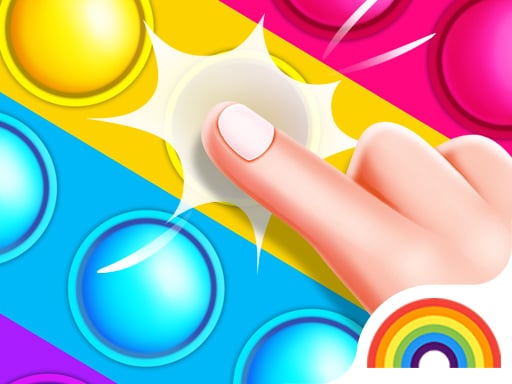
About Pop It Now
The toy this game copies spent about thirty years in a drawer. It was designed in 1975 and no manufacturer would touch it, because in rubber it cost too much to make. When it finally reached shops it was not sold as a stress toy at all — it was sold as a two-player strategy game. Pop It Now keeps the bubbles and throws the game away.
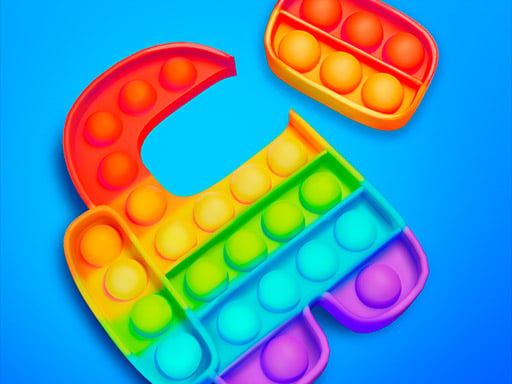
What is left is deliberately small. Thirty boards, one shape each, and a rule you already know: press every bubble down. Each bubble is a two-frame sprite, and once it is down it stays down, so a board only ever moves in one direction. There is no clock, no score, no combo meter and no way to fail. The only thing watching you is a bar across the top that advances by exactly one bubble's worth per press — a 271-pixel track divided by however many bubbles that board holds.
The one mechanic worth knowing is not on the instructions screen. Every bubble listens for a drag as well as a click, so sweeping the cursor along a row with the button held puts the whole row under in one pass. That is the difference between thirty clicks and one gesture, and it is what makes a board feel like the toy rather than like a form.
It was built by cutedressup, the browser-games label of Fabbox Studios in Chennai, India — the game is called Pop It Master inside its own code. Its art files went up on 17 May 2022, the first public copy of the page was archived two days later, and the JavaScript that still runs today is dated 2 June 2022. It has almost no votes anywhere, and the large numbers you find under the name Pop It Master belong to a different game entirely.
Thirty boards, 852 bubbles, and four runs the game never names
Counted out of the game's own files, the thirty boards hold 852 bubbles — 47 on the rainbow, the most, down to 16 on the whale tail. Nothing is shuffled or generated: each board is a fixed piece of artwork with the bubbles placed by hand, which is why the counts are so uneven.
| Boards | Theme | Shapes |
|---|---|---|
| 1–12 | Food | Ice lolly, drinks cup, cupcake, doughnut, fries, pineapple, bananas, watermelon, carrot, grapes, apple, strawberry |
| 13–18 | Objects | Christmas tree, two eared phone cases, a bear holding one, jigsaw piece, crown |
| 19–24 | Sky and fantasy | Heart, rainbow, rain cloud, unicorn, bee, gummy bear |
| 25–30 | Sea, plus one butterfly | Octopus, butterfly, lobster, whale tail, shell, fish |
Most boards use five or six colours in bands. Two break the pattern deliberately: the heart on board 19 is a single flat blue, and the octopus on board 25 is entirely red. After eighteen rainbows in a row, a monochrome board lands differently — and that is the only difficulty curve this game has.
The bananas on board 7 are the oddity in the code. Instead of six colour bands reused across 32 positions, that board loads 32 separate bubble images, one per bubble, and it is the only board drawn that way.
The pop it was designed in 1975, and nobody would make it
The toy is not a 2021 invention. It was designed by Theo and Ora Coster, an Israeli couple who put out more than 150 games through their company Theora Design — including Guess Who?, which most people have played without knowing who made it. The idea came to Ora in a dream in 1974, the year her sister died of breast cancer; their son Boaz has described her asking Theo to build a field of soft domes you could press. The design followed in 1975, and then it stopped, because moulding it in rubber was far too expensive to sell at toy prices.
The Montreal company FoxMind Games eventually solved that by switching the material to silicone, and sold it quietly for years — first as the two-player game "Last One Lost", then as the "Go Pop!" line. In 2019 FoxMind partnered with Buffalo Games and the toy reached Target stores in the United States as "Pop It!". Then in 2020 a TikTok video of a monkey called Gaitlyn playing with one went around, the 2021 lockdowns did the rest, and pop-it clips passed 12 billion views on TikTok. FoxMind sold roughly 7 million units in eighteen months, against 700,000 in the whole of 2019.
Theo Coster died in April 2019, months before any of it; Ora died in 2021 and did see it. He had been a classmate of Anne Frank in Amsterdam and survived the war hidden with a non-Jewish family.
The original pop it is a two-player game, and this one is not
Pop It Now has no two-player mode, no turns and no opponent. The toy it is drawn from does, and the rules are worth knowing because you can play them on any physical pop it.
In Last One Lost, players alternate. On your turn you choose one row and press down as many bubbles in it as you like — one, several, or all of them. Then your opponent does the same on a row of their choice. Whoever is left to press the final bubble on the board loses.
That is the mathematical game of Nim, in what mathematicians call misère play, where taking the last object loses instead of wins. Charles Bouton of Harvard published its complete theory in 1901, in the Annals of Mathematics. Misère differs from normal Nim only right at the end: once a single row still holds two or more bubbles, leave an odd number of rows holding exactly one.
None of that survives here. Pop It Now is the toy with the game removed — which is, in fairness, how most people actually use a pop it.
What the research actually says about fidget toys
Pop it toys were sold through the pandemic as concentration aids, and plenty of game pages repeat the claim. The evidence is thinner than the packaging. The strongest finding points at movement, not objects: work from Julie Schweitzer's lab at UC Davis found that children with ADHD who moved more during a cognitively demanding task performed better on it. The step from "moving helps" to "this object in your hand helps" has not been made.
Where a specific object has been measured, the results have not been kind. A 2018 study in the Journal of Attention Disorders by Graziano, Garcia and Landis put accelerometers on 60 children with ADHD, average age under five, and filmed them in class. Fidget spinners lowered their physical activity and made their attention worse, even inside a behavioural programme that was otherwise working. A 2023 study in Contemporary Educational Psychology found a robust negative effect on academic performance, with or without ADHD symptoms.
The distinction therapists draw is about the eyes. Putty and a stress ball can be worked without looking at them; a spinner cannot. A pop it on a screen sits at the far end of that scale, because the hit areas are pixel-perfect and it takes your eyes completely. So this is not a background fidget you keep going while concentrating on something else. It is the thing you are doing — which is a reasonable thing to want, and not a medical claim.
Playing Pop It Now unblocked at school
There is nothing to install, no plugin and no sign-up: one HTML page, the Phaser 3 engine and a folder of PNGs, running in 480×854 portrait and scaled to fit whatever window it lands in. It is 2D with no WebGL requirement and no physics, which is why it turns up on so many school unblocked lists. Two caveats, though: a closed tab costs you every unlocked board, and thirty boards is one sitting, after which the only thing left is to play them again.
More relaxing games
cutedressup put out a long run of these browser games, and the studio's own settings panel points at several of them. Two are here: Celebrity Foodie Style and Burger Mania.
If it is the popping you came for, Relaxing Mini Fun Games is the closest neighbour, Antistress relaxation toys gives you a whole shelf of 3D fidget objects rather than one, and Pop the Bubbles: Relaxing swaps the fixed boards for endless colour groups. The rest sit in the girls category.
How to play Pop It Now
- Press Play and start on board one. Boards unlock in order — the forward arrow only appears once you have cleared the current one, so there is no skipping ahead.
- Click a bubble to push it down. It sinks into the base and cannot come back up.
- Hold and drag instead of clicking. Sweep the cursor, or a fingertip, across a row. Everything the pointer crosses while the button is held goes down.
- Clear all of them. When the last one drops, a chime plays, confetti fires and a panel offers Replay or Next.
- Use the back arrow to revisit a board. Old boards reset completely, so any of the thirty can be replayed from full.
Four things the instructions do not tell you:
- The hit areas are pixel-perfect. Every bubble uses pixel-perfect hit testing, not a rectangle. Drag along the middle of a row rather than clipping the edges, or the sweep skips bubbles and you spend the end of the board hunting for the two you missed.
- The progress bar is your checklist. Popped bubbles only change shade, so a nearly finished board is hard to read. The bar is exact — if it is not touching the end, something is still up.
- The pop and the music mute separately. The gear icon opens both. For the sound of the toy without the backing track, turn off only the music. The game already helps here: the music drops to a fifth of its volume the moment a board opens, so the pop sits on top.
- Nothing is saved. There is no cookie and no local storage anywhere in the build. Reload and you are back on board one with all thirty locked again.
Controls
| Left click | Press a bubble down. It stays down for the rest of the board |
|---|---|
| Click and drag | Hold the button and sweep across a row to pop everything the cursor crosses |
| Touch and drag | On a phone or tablet, drag a fingertip over the bubbles instead of tapping each one |
| Arrows at the bottom | Move to the next board, or back to one you have already cleared |
| Gear icon | Opens settings, with separate mute switches for the music and for the popping sound |
Features
- Thirty hand-drawn boards, from a 16-bubble whale tail to a 47-bubble rainbow
- 852 bubbles in total, each one a two-frame sprite that stays pressed once you push it
- Four themed runs — food, objects, sky and sea — that the game never labels but plainly follows
- No timer, no score, no lives and no fail state; the only feedback is a bar that fills
- Click-and-drag popping, so a row can go down in one sweep instead of thirty clicks
- Music and pop sound muted independently, and the music ducks once a board opens
- Portrait 480×854, Phaser 3 with a Canvas fallback, no install and no account
Game details
- Developer
- cutedressup
- Release date
- May 2022
- Last updated
- June 2, 2022
- Added here
- March 2023
- Technology
- HTML5 (Phaser 3.21, 480×854 portrait)
- Platforms
- Browser (desktop), Browser (mobile & tablet, touch), Chromebook
FAQ
How many levels does Pop It Now have?
Thirty. They run in a fixed order and unlock one at a time, so you reach board 30 only by clearing the 29 before it. Between them they hold 852 bubbles, from 16 on the whale tail up to 47 on the rainbow.
Is there a timer in Pop It Now?
No. There is no clock, no score, no combo counter and no way to fail. The only thing tracking you is a progress bar that advances by one bubble's worth each time you press one down.
Does Pop It Now save my progress?
No. The game keeps the unlocked level in memory only, so reloading the page or closing the tab puts you back at board one. Thirty boards take roughly fifteen minutes, so it is built to be finished in a sitting.
Can you play Pop It Now with two players?
Not in this game — there are no turns and no opponent. The physical toy it copies does have one, sold by FoxMind as "Last One Lost". You pick one row, press down as many bubbles in it as you like, then your opponent does the same on a row of their choice, and whoever is forced to press the final bubble on the board loses.
Who made Pop It Now?
cutedressup, the browser-games label of Fabbox Studios, a studio based in Chennai, India. The game is titled Pop It Master inside its own code and is published on the studio's own portals, playcutegames.com and cutedressup.com.
What rating does Pop It Now have?
It has no reliable public rating. The portals carrying this exact build have collected a handful of votes between them, and the large vote counts you find under the name Pop It Master belong to a different, unrelated 3D game by Rad Brothers.
Who invented the pop it toy?
Theo and Ora Coster, an Israeli couple who designed more than 150 games together, including Guess Who? and Zingo. Ora had the idea in 1974 after her sister died of breast cancer, and the mechanical design dates from 1975. It went unmanufactured for decades because rubber made it too expensive to mass-produce.
Do fidget toys actually help you concentrate?
The evidence is thinner than the marketing. Research from UC Davis found that children with ADHD who moved more performed better on a demanding attention task, but that is movement in general, not a toy in your hand. A 2018 classroom study of 60 children found fidget spinners lowered activity yet made attention worse.