



How this list is put together
How to play Minesweeper
The board is a grid of covered squares, and some of them hide mines. You win by opening every square that is not a mine. In the classic game there is no score, only a clock.
- Left-click a square to open it.
- Read the number. It counts the mines among the squares touching it: above, below, both sides and the four diagonal corners. The corners are the ones beginners forget. A square on the edge of the board has only five neighbours, and a corner square three.
- A blank square is good news. It has no mines around it, so the game opens all its neighbours for you. That is why one click sometimes clears half the board.
- Right-click to plant a flag on a square you know is a mine. Flags are notes to yourself: on Hex Mine 2D we finished the first level without placing one.
- Click a number whose mines are all flagged and, in many versions, its other neighbours open at once.
How to beat Minesweeper: three rules and two patterns
Everything good players do comes from three rules.
- Count the covered squares. If a 2 touches exactly two covered squares, both are mines.
- Count the mines already found. If a 1 already touches a flagged mine, every other covered square around it is safe.
- Compare two numbers. Say a 1 touches covered squares A and B, and the 2 beside it touches A, B and C. The 1 says one mine hides in A or B. The 2 needs two, so its second mine must be C.
Two patterns come straight out of the third rule. Picture a straight row of numbers with covered squares above it and nothing else around.
- 1-2-1: the mines are opposite the two 1s, and the square opposite the 2 is safe. If the mine were opposite the 2, both 1s would already be satisfied, and the 2 would have nowhere to put its second mine.
- 1-2-2-1: the mines are opposite the two 2s, and the squares opposite the 1s are safe.
Both can be checked with a pencil: a pattern is not a trick to memorise but a small proof.
Where to click first, and when you have to guess
On a new random board the first click is blind. Many versions forgive it: some promise that the first square is never a mine, and some also clear the squares around it. On Hex Mine 3D the first tap opened a patch on at least eight fresh boards in a row.
Can you always win? No. Some boards end with two covered squares, one mine and no number that tells them apart, and then it is a coin toss. The classic sizes show why harder levels guess more often. Beginner is 9 by 9 with 10 mines, about one square in eight. Intermediate is 16 by 16 with 40, about one in six. Expert is 30 by 16 with 99, about one in five.
There is real mathematics behind that. In 2000 the mathematician Richard Kaye proved that Minesweeper is NP-complete. In plain words, checking whether a big board can make sense belongs to a famous family of problems that nobody knows how to solve quickly.
No-guess Minesweeper: the best place to learn
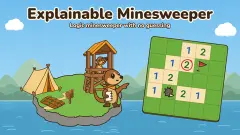
If coin tosses spoil it for you, start here. Explainable Minesweeper says every board can be solved with logic. Hedgehogs take the place of mines, and its hint does more than point at a safe square: it shows which numbers prove it, including the "compare two numbers" kind from the section above. Its description lists sixteen board sizes, from 5 by 5 to 20 by 20, and a new board every day.
Hex Mine 2D removes the blind first click another way. Both boards we played opened with some tiles already numbered, and those numbers were enough to know where to tap. There is no clock.
Minesweeper on hexagons and on a globe
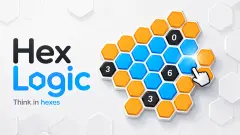
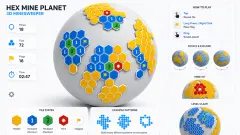
A hexagon touches six others, not eight, and none of them meet it at a corner. Each number covers a smaller patch, so clues pin things down sooner. On Pop It! our first board had one bomb and two 1s, and only one hexagon touched both numbers. That was the bomb. We tapped it anyway and lost. The rule: when two numbers share one neighbour and there is one bomb, the bomb is in the overlap. Hex Mine 3D wraps the same rules around a globe, and the mines move every time you retry.
Classic squares, endless fields and other themes
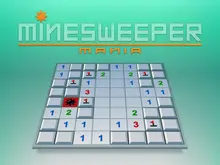
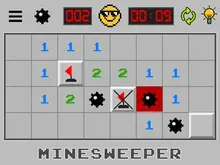
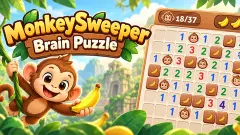
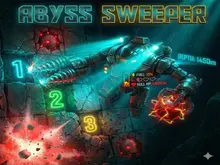
For the grey grid of the old desktop game, Minesweeper Mania has difficulty levels, custom boards, themes and hints, according to its description. Minesweeper Infinite adds an Endless mode to the classic one. MineSweeper New and Minesweeper: Find Bombs keep the plain rules. MonkeySweeper swaps mines for monkeys, and Abyss Sweeper turns the idea around: you dig down through an endless grid and harvest the mines for fuel.
Liked reading the numbers? Try Lanternward, where numbered roofs count the lanterns beside them, the sudoku and logic games, the number games and the Google games. Other pencil-and-paper classics: tic tac toe and word search games.