







How this list is put together
The rules fit in one line, and perfect play is a draw
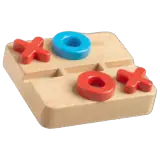
You take turns marking an empty square, and by custom X goes first. The first to get three marks in a row, a column or a diagonal wins. If all nine squares fill up with no line, nobody wins.
Because X starts, X can put down at most five marks and O at most four. The game is solved: if neither side makes a mistake, it ends level every time, whoever starts. You win only when the other player slips.
Boards for three in a row were scratched into Egyptian roof tiles around 1300 BC, and the Romans played terni lapilli with only three pieces each, so once those were down they had to be moved. In Britain it is still noughts and crosses; the American name took over in the twentieth century.
How to win at tic tac toe: the order that never loses
On every turn, do the first thing on this list that you can. It comes from a program written in 1972 by Allen Newell and Herbert Simon, and a player who follows it never loses.
- Win, if you have two in a line and the third square is free.
- Block, if the other player has two in a line.
- Fork: make a move that opens two threats at once. They can only stop one.
- Stop their fork before they make it.
- Take the centre. It sits on four of the board's eight lines; a corner sits on three and an edge square on two.
- Take a corner, the one opposite your opponent's if you can, and leave the edges for last.
Two replies to learn by heart. If your opponent opens in a corner, answer in the centre: any other square loses against someone who knows the game. If they open in the centre, answer in a corner. And if they hold two opposite corners while you hold the centre, play an edge, not a corner. A corner there forces you to block, and the block hands them a fork.
Tic tac toe against the computer: choose by level
A computer that plays perfectly never loses, and that is nothing new. OXO, written by Sandy Douglas in 1952 for the EDSAC computer at Cambridge University, already played without mistakes. Against a rival like that, a draw is a good result.
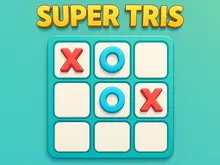
Learning? Start with Super Tris Tic Tac Toe: its description lists easy, medium and hard, with tougher opponents unlocked as you win. Magical Tic Tac Toe promises several levels, plus coins to earn and themes to unlock. Neon Saga Tic Tac Toe: 69 Level War lines up 69 computer opponents, each harder than the last.
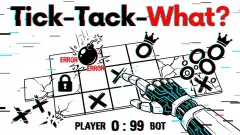
Then there is the computer that does not play fair. Tick-Tack-What? starts on the usual square, but every time the computer wins a round the board is redrawn: ten squares under three black blocks like ears, then a tall grid on a stand. Its description says the computer erases your X's and locks squares. We lost 0 : 3 in ten minutes without catching a single trick, only clicks that did nothing. Our advice from that run: wait a second after each move, and if a click is refused, try a different square.
Two player tic tac toe on one screen
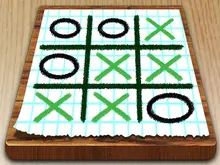
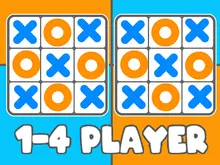
For two at one computer, Tic Tac Toe: Paper Note has a Player vs Player option in its instructions, and Magical Tic Tac Toe lets a friend play on the same device. XO With Buddy is the plain game with nothing added. Tic Tac Toe 1-4 Player, its description says, takes from one to four players.
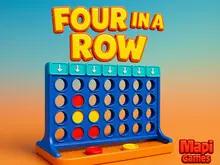
When both players know the list above, the draws come fast. Then try Four in a Row: the discs drop to the bottom of each column, you need four, and its description offers both a local two-player mode and a computer that gets harder.
Bigger boards and five in a row: where the draw ends
Make the board bigger and the sums change. In Supa Tic Tac Toe the grid is five by five and you need five in a row, so a single X anywhere in a line kills it. Both sides hold one-use cards that add a row, swap lines or wipe marks, and playing a card does not cost you your move. We lost every game we finished against Sir Wobbles, always with good cards in hand. The skill is knowing when to play them.
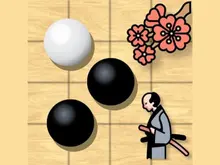
The older version of that idea is gomoku: five stones in a row on a fifteen by fifteen board, as in Gomoku: Five Stones in a Row. There the draw disappears. With perfect play, the player who starts wins.
Playing alone? Rings and Dot! keeps the nine squares but drops the rival. Rings of different sizes nest in the same square, and three of one colour in a line clear. The centre, on four lines, can hold two colours at once.
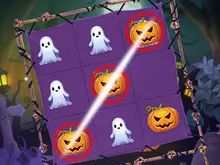
The seasonal versions keep the rules and change the look: snowmen against Christmas trees, ghosts and pumpkins for Halloween, eggs and bunnies for Easter, and hearts for Valentine’s Day. With nine moves at most, they suit a young child.
More paper classics: minesweeper games, ludo games and word search games. Other boards: chess and draughts, card and board games for two and all our board games.