


How this list is put together
How to play ludo: the rules that matter
You move clockwise round the track and then up the column of your own colour into the centre. Standard ludo, as the encyclopedias describe it, comes down to five rules:
- A six to come out. No token leaves the yard on anything else.
- A six rolls again. Three sixes in a row, though, and you lose the move.
- Land on a rival to send it home. It has to wait for another six to come back.
- Your colour column is yours. Nobody else can enter it.
- An exact roll to finish. The first player with four tokens home wins.
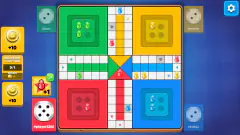
Ludo World plays it straight. A six brought a token out and gave another roll. Every token knocked off sent the rival home and gave us one more roll, and a token two squares into the red column went home on an exact four. Two things change the race. The coloured stars are safe squares, and two rival tokens standing together could not be knocked off: we landed on a pair and all three tokens stayed put.
Where you are safe, and how to win more often
Ludo is luck plus a decision every turn: which token to move. A few habits make that decision for you.
- Look behind before you stop. One die can hit anything one to six squares away. A rival three squares back hits you with one number in six. Stop on a star or a safe square when you can.
- Hunt the lone token. If a rival token stands alone exactly your roll away, take it. That rival loses a whole lap and you roll again.
- Do not leave everything in the yard. More tokens out means more ways to use each roll. It also means more targets, so bring them out when the squares ahead are quiet.
- Split your finishers. With an exact finish, a token four squares from home only goes in on a four. Two tokens at different distances give you two numbers that work.
Ludo Scramble: our own game, with three rule sets
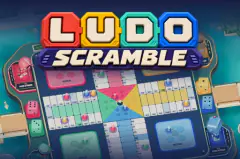
Ludo Scramble is made by Mava Games and is in beta. Its default mode, Scramble, drops the turns: every colour rolls and moves at the same time, so you can roll while the player beside you is still choosing. A five brings a piece out, a capture gives you 20 squares to move and a piece reaching the centre gives another piece 10.
If your family plays by the book, pick Classic for turns. Under Rule set you choose Ludo (one die, a six to enter, a 52-square track), Spanish Parchís or Parcheesi, the two-dice version where one five or a total of five brings a piece out. House rules let you change safe squares, blocks and the exact finish. Three one-move puzzles under Challenges teach a capture, a safe landing and an exact finish without a full race.
Ludo against the computer and with friends
For a quick game alone, Ludo Scramble seats computer rivals on the other colours. Ludo Online and Ludo Wizard also list a mode against the computer in their descriptions, and Ludo Legend says you can play alone. Ludo World gives you three named rivals and never says whether they are people, so treat it as a solo game.
For two to four people at home, use Ludo Scramble's Local play: each colour gets its own buttons on the same screen. Ludo Legend's description says you just pass the device on, and Ludo Wars has a local two-player mode with trap squares on the board. To play friends who are somewhere else, Ludo Online and Ludo Wizard have a private room you join by sharing a code. More games for a full table are in three and four player games, and for two in card and board games for two.
Ludo, pachisi and parcheesi: one family
Ludo is a simpler form of pachisi, a race game from India played on a cross embroidered on cloth, with cowrie shells instead of a die. Its twelve castle squares protected any piece standing on them; the stars on a ludo board do the same job. The name means twenty-five, the best throw of the shells. Ludo was sold under that name in England in 1896.
Other branches kept more of the old game. Spanish parchís enters on a five and pays 20 squares for a capture. The American version uses two dice. Ludo Scramble lets you try all three on one board.
If you like turns and a board, try dominoes, chess and draughts or the pencil-and-paper classics, tic-tac-toe and minesweeper. Everything else is in card and board games.