







About Raven Estate
A line runs along the bottom of the screen where you set your weapon up, and it is the whole game folded into one sentence: the gun cannot be rotated after being set. Not reloaded. Not swapped. Rotated. You choose which way the barrel points, you lock it there, and that is where it points from then on.
So the crow you are playing does not aim. You walk a dark house carrying a revolver welded at roughly four o'clock, and the only way to put a shot where something is standing is to move yourself until that something is at four o'clock from you. Aiming turns into walking. It sounds like a restriction, and it is, but it is also a very old idea with a serious history behind it, and we get to that further down.
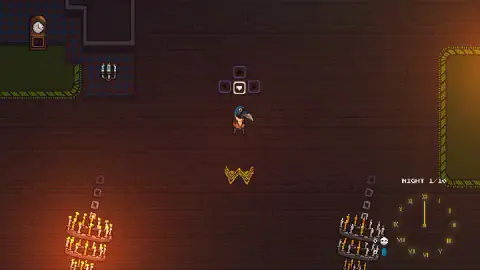
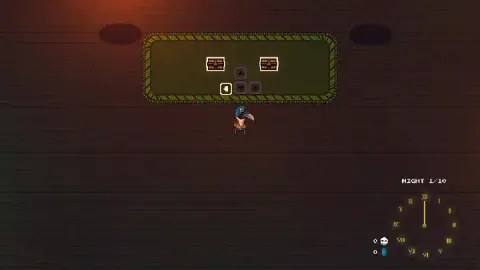
Everything around that idea is a haunted house seen from straight overhead. Brick floors the colour of dried blood, racks of candles throwing orange pools across them, a green rug with two closed chests on it, and through a doorway in one corner a room with blue diamond wallpaper and a pendulum clock. The game keeps its own clock too, bottom right: a ring of roman numerals with a single hand, and above it the words NIGHT 1/10.
The game is credited to Gearhead Games. It went up in May 2025, was last updated in August 2026.
A warning about the limits of what follows. We played on a desktop for about four minutes, walked the first night, reached the weapon screen and took the first gun. Then we got stuck on the screen that sets the angle, and the run ended there. We never met a monster, never finished a night, and never locked a weapon. What we can tell you is what the first night looks like, how the game explains itself, and why we failed — which is the most useful thing in here.
The gun cannot turn, so you turn
Weapons that will not point where you are looking sound like a design mistake. They are closer to a design tradition.
For the first few decades of air combat, a fighter's guns were bolted to the airframe facing dead ahead, timed to fire through the arc of the spinning propeller. The pilot did not aim the guns. The sight sat on the nose, the guns pointed where the nose pointed, and aiming meant flying the whole aeroplane until the other aircraft sat in the middle of the glass.
The same trade turns up on the ground. Turretless assault guns — the German Sturmgeschütz III is the one everybody has heard of — carried their main weapon in a fixed box on the hull instead of a rotating turret, with only a few degrees of side-to-side play. To aim properly, the driver turned the vehicle. The payoff was a machine cheaper to build and much lower to the ground than a tank with a turret on top.
In both cases the bargain is the one Raven Estate hands you at the start of every run. Give up the ability to point the weapon on its own, and the skill moves off the trigger and onto the steering. A fixed gun does not make you worse. It makes a different thing matter: where you put yourself, in what order, and which way you were already facing when the room filled up. A game that let you re-angle a weapon at will would be a game about reactions. This one wants commitment, and it has to take the undo button away to get it.
The clock in the corner writes four as IIII
Look closely at the dial under the night counter. Twelve at the top, with the hand pointing straight up at it, then one, two, three around the right side — and at the four o'clock position the game does not write IV. It writes IIII, four plain strokes in a row.
That is not a spelling mistake. It is how clock dials have written four for centuries: longcase clocks in hallways, church faces, pocket watches, the lot. Nobody has ever settled on why. The explanation you hear most is balance, because the numeral sitting directly opposite is VIII, a wide heavy block, and four strokes answer it better than a slim IV does. The other common one is practical: a dial using IIII needs twenty ones, four fives and four tens, a set that can be cast from a single mould. There is also a popular story that Louis XIV demanded it, which historians throw out, partly because dials with IIII are older than he is. The famous exception is Big Ben, which uses IV.
For a game that hangs a pendulum clock on one wall and makes a clock face out of its own scoreboard, that is a small, unshowy piece of care — the kind nobody would notice if it were wrong.
What the first night actually puts in front of you
Very little, on purpose. There is no health bar, no ammunition count, no score, no pause button on screen and no written objective anywhere. The corner holds the night counter, the dial, a skull with a number beside it and a small blue vial with a number beside it. Both of ours stayed at zero all run and the hand never moved, so we genuinely cannot tell you what any of them measure. We would rather say that than guess.
The house gives you more than the display does. Chests sit closed on rugs, the universal signal that something here is worth opening, and a gold double-wing mark is painted on the floor. The second weapon card was greyed out with no numbers beside it, which usually means something has to be earned first.
And then there is the thing that is not there: an enemy. For a game billed as a bullet-hell, our first night was an empty candlelit house with a bird in a coat walking through it. Whether that is the opening calm or just how slowly it starts, we did not get far enough to say.
More games where standing in the right place is the aiming
Archer: Trial by Fate is the closest relative on our shelf: a top-down run through room after room where your bow is only as good as your footwork. Pixel Hero Survivor removes aiming altogether, so the waves become a problem of where you stand. 12 minutes to survive runs the clock idea the other way round, with a timer counting down instead of a night to fill. Loopvival builds a survival game out of repeating cycles and one source of light. And Ghost Guard is the stripped-back version of shooting things in a haunted place, with directions instead of a cursor. The rest is in adventure games.
Screenshots
How to play Raven Estate
- Follow the floating keys. A cluster of four arrow keys hovers above the crow's head, three in a row with one on top, and the direction the game wants is lit white while the others stay dark. That cluster is the entire tutorial. There is no text anywhere.
- Walk the house. The first night is a set of rooms rather than a corridor, lit in patches by candle racks. Rugs with chests on them are the things that look deliberate.
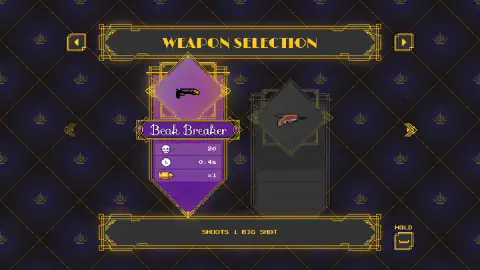
- Read the weapon card before you take one. Each gun is a card with three numbers: damage beside a skull, a delay in seconds beside a clock, shots per pull beside a bullet. The first one offered, Beak Breaker, reads 20, four tenths of a second and one shot — a single big shot, as the banner puts it.
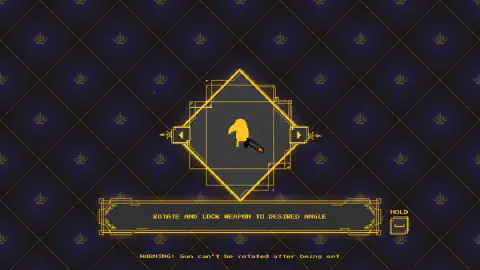
- Set the angle while you still can. The next screen puts your crow in a gold frame with the gun on it and asks you to rotate and lock it. Left and right swing it round. The warning at the foot of the screen is not decorative.
- Hold the key. Do not tap it. Both weapon screens carry a HOLD label over a spacebar-shaped icon in the corner. That word is doing real work.
What our run actually taught us:
- Tapping is not holding, and the game will not tell you twice. We spent well over a minute on the lock screen pressing the arrows and clicking the buttons beside the frame, and the picture never changed by a pixel. The one word we did not act on was the one printed on the button.
- The angle is a route decision, not a combat decision. Before you commit, think about which way you expect to be walking when things get busy. A barrel aimed behind your usual direction of travel means backing into every fight.
- Your crow is already holding its gun at the locked angle. Look at the little figure in the house and the revolver is there in its hands, pointing down and to the right, the same way the setup screen left it. The sprite is an honest readout.
- Nothing hurries you on the first night. The single hand on the corner dial sat at twelve the whole time we played, and no enemy arrived. Use that to look around rather than to rush.
Controls
| Arrow keys | Move the crow. The game's only tutorial is a cluster of four arrow keys that floats over its head with the direction it wants lit up in white |
|---|---|
| Left and right | On the weapon screens, move between the cards and swing the gun round to the angle you want |
| Hold the spacebar | Confirm. Both weapon screens carry a HOLD label over a spacebar-shaped key icon in the bottom-right corner. Holding, rather than tapping, is the thing we never managed |
Features
- Every gun keeps the angle you give it. The setup screen warns in as many words that it cannot be rotated once set, so your aim is one decision rather than a thousand small ones
- A clock instead of a dashboard: the corner holds a roman-numeral dial with a single hand, and the counter above it reads NIGHT 1/10
- The dial writes four the way real clock dials write it, as IIII rather than IV
- Weapons arrive as cards with three numbers. Beak Breaker does 20, fires every 0.4 seconds, and sends one shot per pull, which the card sums up as SHOOTS 1 BIG SHOT
- No written tutorial anywhere. Four floating keys above your head, one of them lit, and that is the whole lesson
- A haunted house drawn from directly overhead: brick floors, racks of lit candles, rugs with closed chests on them, a pendulum clock on the wall of the next room
- Made by Gearhead Games
Game details
- Developer
- Gearhead Games
- Release date
- May 2025
- Last updated
- August 10, 2026
- Added here
- May 2025
- Technology
- HTML5 (GameMaker)
- Platforms
- Browser (desktop, keyboard)
- Saved progress
- Saving, when available, is managed by this game. Mava cannot confirm your level.
FAQ
How do you play Raven Estate?
You play a crow walking a haunted house from directly overhead, one night at a time, and the counter in the corner says there are ten of them. Guns are the interesting part: each one is set to a firing angle before you use it, and the game warns that the angle cannot be changed afterwards. Because the barrel is fixed, you aim by moving your body until the target lines up with it.
What are the controls in Raven Estate?
The arrow keys move the crow, and the game prompts you with a cluster of four arrow keys that floats above its head with the one it wants lit up in white. On the weapon screens the left and right directions move between cards and swing the gun round. Confirming is done by holding the spacebar, which both screens show as a HOLD label over a key icon.
What does the warning about rotating the gun mean?
Before a weapon is usable, Raven Estate shows it inside a gold frame with the line ROTATE AND LOCK WEAPON TO DESIRED ANGLE, and underneath it a warning that the gun cannot be rotated after being set. You choose which way the barrel points, lock it, and it stays there. From then on the only way to put a shot somewhere is to stand where that angle covers it.
What is Beak Breaker in Raven Estate?
It is the weapon the selection screen offers first, a revolver on a purple card. Its three numbers are 20 beside a skull, 0.4 seconds beside a clock and one shot per pull beside a bullet, and the banner under the card reads SHOOTS 1 BIG SHOT. The card beside it was greyed out and showed no numbers at all during our run, so we cannot tell you what it is.
How many nights does Raven Estate have?
The counter in the bottom-right corner reads NIGHT 1/10 on every screen we recorded, which puts the run at ten nights. We never finished the first one, so we cannot tell you what ends a night, what the next one changes, or what waits at the tenth. The dial under that counter had a single hand that never moved off twelve for us.
Is Raven Estate scary?
Not in the jump-scare sense, at least not in the part we played. It is a candlelit house drawn in pixel art and seen from above, with chests on rugs and a pendulum clock on the wall, and the mood comes from the lighting rather than from anything leaping at the screen. No monster appeared at all in our first night, though the game is billed as a bullet-hell, so quiet is clearly not the plan for long.
Can you play Raven Estate on a phone?
It is listed for desktop and PC only, with no Android or iOS entry, and our own catalogue has no mobile flag on it either. It is a landscape game built around the arrow keys and a held spacebar, so a touchscreen would have nothing obvious to press. We played it on a desktop with a keyboard.
Who made Raven Estate?
Gearhead Games, according to the game's listing. It was published in May 2025 and last updated in August 2026. We found no studio website and no second listing to check the name against, so the credit rests.