








About DUNJUN
Most dungeon crawlers let you walk. You take a step, look around, take another. DUNJUN takes that away. Press a direction and the hero goes, in a straight line, until a wall stops him. There is no half step and no brake, which turns every room into a question you have to answer before you touch the keys: which wall do I want to end up against?
That one rule changes what the dungeon is made of. A corridor is not a path any more, it is a single move. A wall is not an obstacle, it is the only place you can stand still. And the things in the room, the swords hanging in the air, the skeleton pacing the side passage, the heart lying on the floor, are only reachable if a wall happens to be in the right place behind them.
The goal, as the game frames it, is to get through 60 rooms of a cursed dungeon and recover the 12 Relics of Power hidden in it. The first line of the story, shown under the hero as you arrive, sets the tone: "This is it. I'm finally here."
DUNJUN is made by Gruffazilla, a small developer whose page on an indie-games site also lists two browser games, Jetpack Fury and Sworn Delivery. It came out in August 2026 and was updated in October.
The slide-to-the-wall rule, and why it is a puzzle
Ice floors have been a staple of puzzle rooms in role-playing games for decades for the same reason DUNJUN uses the rule everywhere. Once a character cannot stop at will, the map becomes a set of fixed stopping points, and getting from A to B means finding a chain of slides between them. A room has far fewer of those points than squares, so the number of real choices drops, and each one matters more.
The best-known version on phones is Tomb of the Mask, released by Happymagenta for iOS in 2016, which built a whole game around one-swipe dashes through a maze. DUNJUN takes the same movement and puts it inside a classic dungeon: coffins, crates, chests, blue lanterns, skeletons, and a counter that reads the room you are in rather than a score.
The practical result is that DUNJUN rewards looking more than reflexes. A slide is fast, but deciding which slide to make is where the time goes. The game's own description adds a clock to that, saying you race against it. We did not see a timer we could identify in the first room, only a short bar above the counter whose meaning we never worked out.
What is in the first room
Room 1 is built around a central corridor with a carved stone floor, crates stacked down its right side and a blue chest near the bottom where the hero starts. Two blue lanterns stand at each end. To the right, a long passage holds a pale skeleton and a couple of golden staffs on the floor. To the left, a side room is lined with coffins, crates and a row of coloured chests: red, green and yellow.
Some creatures carry a small number above their heads. The skeleton had one, and a green creature in the top right corner showed a 2. We never learned what those numbers count. It could be health, a turn counter or something else, and the first room gave us no answer.
What we saw, and what we did not
We played one session of about ten minutes on a computer, and we did not get out of the first room. Our first slide took the hero from the bottom of the central corridor to its top wall, and he stayed there for the rest of the session. The counter in the corner read 1/60 from start to finish, and the skull counter stayed at zero. We cannot say whether we had slid into a dead end the room is designed to punish, or whether the game had stopped taking our keys.
So this page does not describe the other 59 rooms, the relics, the clock, what happens when you lose your last heart, or the ending. Everything we say about those comes from the game's own description and is worded that way. What we can say is that the first room is not a corridor with an exit at the end. It is a small puzzle, and it deserves a minute of looking before the first slide.
Similar games to try
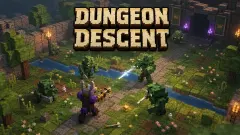
If the slide rule is what you like, Ice Slide uses the same idea on a board you have to fill, and Amaze has you paint every square of a maze with a moving ball. For a dungeon where you can walk and fight freely, Dungeon Descent is a voxel crawler with three hearts, a sword and a crossbow. More in our adventure games.
Screenshots
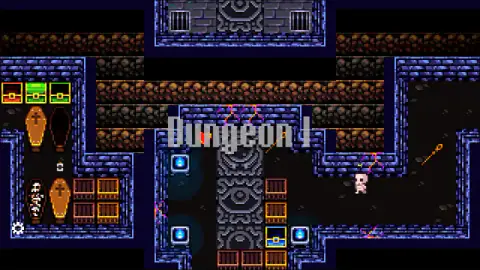
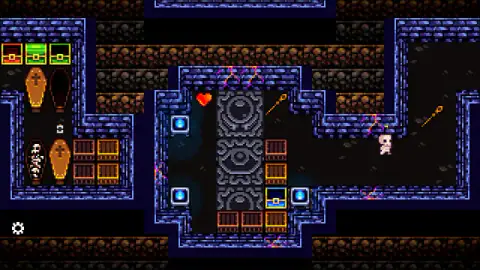
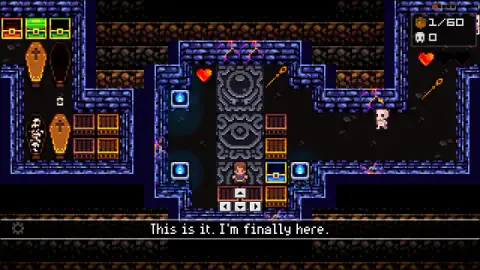
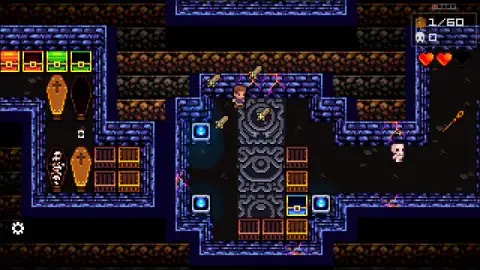
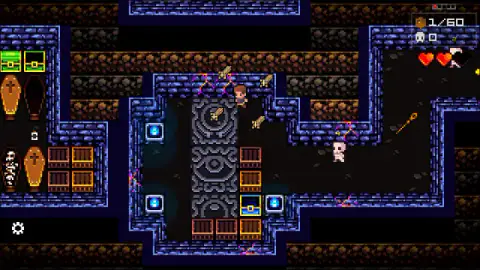
Taken by opening the game ourselves and letting it run — not supplied by the publisher, and not the same picture every other site shows.
How to play DUNJUN
- Pick a language. The first screen offers seven, under the DUNJUN and Relics of Power logo.
- Read the room before you move. Each room opens with its name, Dungeon I for the first, and a small four-arrow hint under the hero.
- Slide. Press W, A, S or D, or an arrow key, or swipe on a phone. The hero slides until something solid stops him.
- Mind the corner. The box in the top right shows your room out of 60 and a skull counter, with your hearts below it.
- Find the way through. The game says you avoid the traps and enemies, collect what you can and move on, room by room, to the end of the 60.
Tips from our run:
- Plan from wall to wall. Before you press anything, trace the slide in your head to where it ends. If the end is next to a sword or an enemy, that is where you will be standing.
- Use dead ends as resting points. The top of the first room's central corridor is a wall you can slide into from the start. It is a safe place to stop and look, but it is also easy to get stuck in, as we found.
- Take the heart early. We started room 1 with one of three hearts filled. A heart lay in the corridor near the start, and a minute in, it was gone and two hearts were filled.
- Watch the swords. They were not there on the title card, but once the room started they hung in the air along the corridor walls. Assume anything in the air is dangerous until the game proves otherwise.
- Keep your hands on the keys. We tried clicking on chests and crates in the room, and nothing we could see happened. The controls the game lists are the four slides and nothing else.
Controls
| W A S D or arrow keys | Send the hero up, left, down or right; he keeps sliding until a wall stops him |
|---|---|
| Swipe | The same four moves on a phone or tablet, according to the game's instructions |
| Gear button (bottom left) | Opens the settings |
Features
- Every move is a slide: the hero travels in a straight line and only stops when he hits a wall
- The dungeon has 60 rooms, and a counter in the top right corner shows which one you are in, starting at 1/60
- The game says 12 Relics of Power are hidden across those rooms
- Health is a row of three hearts, and heart pickups lie on the floor of the rooms
- Swords hang in the air along the corridors, and skeletons and other creatures patrol the side passages
- Seven languages are offered on the first screen: English, Spanish, Portuguese, Italian, German, Polish and French
Game details
- Developer
- Gruffazilla
- Release date
- August 2026
- Last updated
- October 1, 2026
- Added here
- August 2026
- Technology
- HTML5 (2D)
- Platforms
- Browser (desktop, keyboard), Browser (mobile & tablet, touch)
- Saved progress
- Saving, when available, is managed by this game. Mava cannot confirm your level.
FAQ
How do you play DUNJUN?
You move the hero with WASD or the arrow keys, or by swiping on a phone. He does not take single steps: each move slides him in a straight line until he hits a wall. The puzzle in every room is choosing the order of slides that gets you past the traps and enemies to the way out.
Can you stop in the middle of a corridor in DUNJUN?
No. A slide only ends against a wall, so the walls are your only brakes. If you want to stop next to something, you need a wall at that spot, which means planning a route from wall to wall rather than aiming at the thing itself.
How many levels does DUNJUN have?
The dungeon has 60 rooms, and the counter in the top right corner shows your progress, starting at 1/60. The game says 12 Relics of Power are spread across them. We only played the first room, so we have not seen how the relics are placed.
How does health work in DUNJUN?
There are three heart slots in the top right corner. When we started the first room only one was filled and a heart pickup lay in the corridor; a minute later the pickup was gone and two hearts were filled. A skull counter sits next to the room counter and stayed at zero in our session.
Is DUNJUN hard?
The first room is busier than it looks: swords hang in the air around the central corridor, a skeleton walks the side passage, and you cannot stop where you like. We spent our whole session of about ten minutes in room 1 and did not leave it, so give the opening room time and read it before you move.
Who made DUNJUN?
DUNJUN is by Gruffazilla, a small developer whose other work on an indie-games site includes the browser games Jetpack Fury and Sworn Delivery. It came out in August 2026 and was updated in October 2026.
Can you play DUNJUN on a phone?
Yes. It is listed for Android and iOS as well as PC, in landscape and portrait, and the game says you swipe to move. We played it on a computer with the keyboard.