






About Dungeon Descent
Most dungeon crawlers ease you in. A corridor, a rat, a sword that kills it in one swing. Dungeon Descent hands you three hearts and a room called The Antechamber, and in our session that room was enough to end two runs before we had landed a single blow. That is the first thing to know about it: the door at the bottom of the stairs is already part of the fight.
The rest of the idea is the classic one. Each room has a job written across the top of the screen in large orange letters, usually Clear the Room. Do it and the gate opens. Step through and you go one floor down. Die and you start again from Room 1, with only your banked emeralds coming with you.
It comes from Golem Kin Games. Dungeon Descent was published on 15 July 2026 and updated the next day.
Room 1 is not always the same room
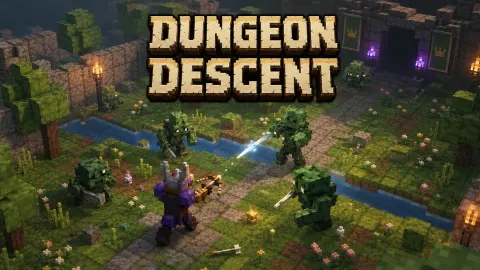
The first time through, Room 1 was a sunny walled garden with a stone path and an iron gate. That was the tutorial. It taught the crossbow, announced "ROOM CLEARED - the gate opens!", then set a new objective, Reach the Gate, with a reminder to grab the chest on the way.
The next times we pressed Enter the Dungeon, Room 1 was The Antechamber: a dark red floor scattered with orange and gold specks, and green, man-shaped monsters at the far corners. After our second death we pressed Try Again and got a different Room 1 again, a green garden with those same monsters waiting near the gate.
So the first room changes from run to run. That matters, because it means you cannot memorise a safe path through the opening, which is exactly how the genre this game belongs to is meant to work.
Why it starts you over: a short history of the descent
The shape of Dungeon Descent is more than forty years old. In 1980 Michael Toy and Glenn Wichman wrote Rogue, a game drawn in letters on a university computer, in which you went down a dungeon one floor at a time and lost everything when you died. Its floors were built fresh for every game, so no two descents matched. Games that copy that recipe are still called roguelikes.
Later games softened one part of it. In what players now call a roguelite, you still lose the run, but something survives the death and makes the next attempt a little easier. Dungeon Descent sits in that second family. The You Died screen counts the emeralds you banked, and its third button is Spend at Camp. Every new attempt we made started again in Room 1, at level 1, with the same sword. The emeralds are the part the game says you keep.
The harder end of the genre has its own word too. Slay the Spire calls its extra difficulty levels Ascension, and Dungeon Descent uses the same name: the profile card carries an ASC badge that starts at zero, and the game's description promises Ascension modes for players who want more.
What is on screen, and what it means
The bottom-left panel is your whole kit. It shows the weapon in your hands, a small icon of the one you would swap to, your level and an experience bar. Every run starts at level 1, so the bar fills from empty each time. On the right sits a green gem counter, the emeralds you are carrying.
A square marked E sits on the right edge of the screen in every room. It stayed empty for us. The game's description talks about artifact powers you can unleash in a fight, and an empty slot with its own key is the likely home for them, but we never found one to check.
The main menu has more doors than we opened. Daily wore a red exclamation mark from the first visit. Ranks and Records, by their names, hold leaderboards and personal bests. Skulls goes with a counter at the top of the menu that read 0 out of 50 next to a countdown just under a day long, which suggests a goal that resets daily. We did not open any of them.
How far we got, honestly
We played one session of about ten minutes on a computer. We finished the tutorial room's lesson, swapped weapons, and saw the gate open, but our knight stalled against the garden wall and never walked through it. We then entered the real dungeon three times and died twice in Room 1, both times with no monsters slain and no emeralds banked, which the game still marked as a new best.
That means we have not seen Room 2, a chest's loot, a boss, armour, an artifact, the camp or the deeper biomes the description promises. Treat everything past the first room as the game's word, not ours. We also did not try it on a phone, even though its listing names Android and iOS in both orientations.
Who it is for
It suits players who like short, punishing runs and learning a room by dying in it. Ten-year-olds can follow it, since every goal is written on screen in plain words. If you want a slow, story-led adventure where you can explore without pressure, this is not it: the first room already bites.
Golem Kin Games built the same chunky voxel look into Big Wild Bucks: Voxel Buck Hunter, a first-person deer hunt, and the studio's Dicey Chickens is a castle defence where the heroes roll their own dice. For another game of rooms full of monsters, try Tiny Arena, and King Dungeon swaps the fighting for mining underground. More are in our adventure games.
Screenshots
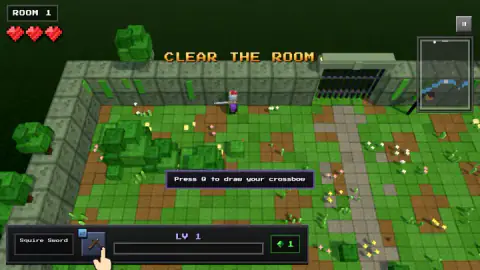
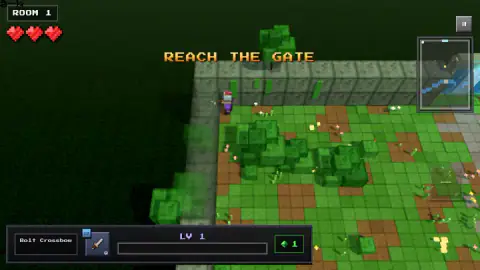
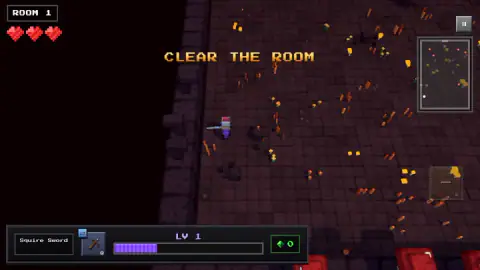
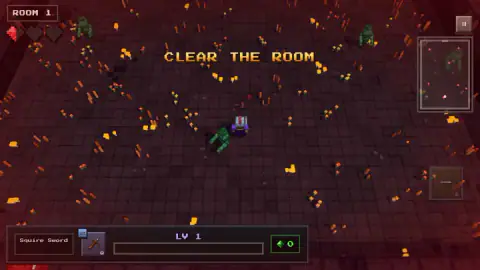
Taken by opening the game ourselves and letting it run — not supplied by the publisher, and not the same picture every other site shows.
How to play Dungeon Descent
- Enter the dungeon. The main menu has one green button, Enter the Dungeon. A profile card on the left keeps your best room, your kills and your emeralds.
- Read the goal. Every room announces a new objective at the top, with the room number and its name underneath. A minimap in the top-right corner shows the shape of the room and where the monsters are.
- Pick your weapon. You start with a Squire Sword. Press Q, or click the weapon slot at the bottom left, to swap to the Bolt Crossbow and back.
- Clear it and descend. When the last monster falls the game says the room is cleared and the gate opens. Grab the chest, then walk through the glowing gate.
- When you die, choose. Revive with an ad, Try Again from Room 1, or Spend at Camp.
Tips from our runs. Do not wade in with the sword. In The Antechamber the green monsters closed the gap quickly, and we went from three hearts to half of one in well under half a minute. The screen took on a red tint as our hearts ran out, which is your cue to back off. The crossbow is the game's own first lesson, before you have seen a single enemy, and that order is a hint: start a fight from range. And if the game stutters on your computer, the pause menu has a Quality switch.
Controls
| Q (or click the weapon slot) | Swaps between the Squire Sword and the Bolt Crossbow; the slot at the bottom left shows which one you hold |
|---|---|
| Movement keys | Walk your knight around the room; A walked us to the left, and we did not confirm the rest of the layout |
| E | Labels an empty square on the right edge of the screen; it stayed empty in all our runs |
| Pause button (top right) | Opens Resume, Music, Sound, Quality and Abandon Run |
| Touch (phone and tablet) | The game is listed for Android and iOS in both orientations; we did not try it on a touch screen |
Features
- Three hearts and no shield bar: a run can end inside the first room
- Two weapons from the start, a Squire Sword and a Bolt Crossbow, swapped on a single key
- Each room states its job in large letters, such as Clear the Room or Reach the Gate
- Emeralds are banked when you die and the death screen sends you to spend them at the camp
- A profile card that counts your best room, monsters slain and emeralds, plus an Ascension badge starting at zero
- Daily, Ranks, Records and Skulls menus, with a skull counter out of 50 on a countdown clock
- A Quality switch in the pause menu for computers that struggle with the 3D
Game details
- Developer
- Golem Kin Games
- Release date
- July 2026
- Last updated
- July 16, 2026
- Added here
- May 2026
- Technology
- HTML5 (3D)
- Platforms
- Browser (desktop, keyboard & mouse), Browser (mobile & tablet, touch)
- Saved progress
- Saving, when available, is managed by this game. Mava cannot confirm your level.
FAQ
How do you play Dungeon Descent?
Press Enter the Dungeon on the main menu and you start in Room 1 with three hearts, a sword and a crossbow. Each room tells you its goal at the top of the screen, usually Clear the Room. Once a room is cleared its gate opens, and stepping through it takes you one floor deeper.
How do you switch weapons in Dungeon Descent?
Press Q, or click the weapon slot in the bottom-left panel. The game teaches this in its first room with the sign Press Q to draw your crossbow. The panel then changes from Squire Sword to Bolt Crossbow, and the small icon on the slot shows the weapon you would swap back to.
What happens when you die in Dungeon Descent?
A You Died screen lists the room you reached, the monsters you slew and the emeralds you banked. It offers three ways on: watch an ad to revive, Try Again from the start, or Spend at Camp. Every new attempt starts again in Room 1 at level 1; the banked emeralds are what you keep for the camp.
What are emeralds for in Dungeon Descent?
Emeralds are the currency you keep between runs. The death screen counts how many you banked and its third button is Spend at Camp, and the main menu shows your emerald total next to a Camp button. We died before earning any, so we cannot list what the camp sells.
Is Dungeon Descent hard?
The start is harsher than it looks. You have three hearts and the first real room, The Antechamber, already has monsters that close in fast. Both of our deaths came inside Room 1, each in under a minute, so expect a few attempts before you learn to keep your distance.
What is Ascension in Dungeon Descent?
Ascension is the harder mode for players who have already beaten the dungeon. The profile card on the main menu carries an ASC badge that starts at 0, and the game's own description says Ascension modes add extra challenge. We never got deep enough to unlock it.
Who made Dungeon Descent and when did it come out?
It is by Golem Kin Games. It was published on 15 July 2026.