






About Minni Family Home - Play House
Most dollhouse games on the web hand you a goal anyway. Tidy eight rooms before the clock runs out, or decorate one to earn coins for the next. Minni Family Home - Play House has no goal at all. There is a family, a living room and a dog, and whatever happens next is up to whoever is holding the mouse.
That is the whole design, and it is a deliberate one. You pick up a child, carry her across the room and put her next to the baby. You turn the lights down to night. You give everyone a new face. Nothing scores it, nothing ends it, and there is no screen that says you did it right.
It comes from a studio called Joyglitch and was published on 24 October 2026, filed under Kids. We played it for ten minutes with a mouse. We spent almost all of that time in one room, so this page tells you exactly what that room holds, and what we did not get to see.
What is in the living room
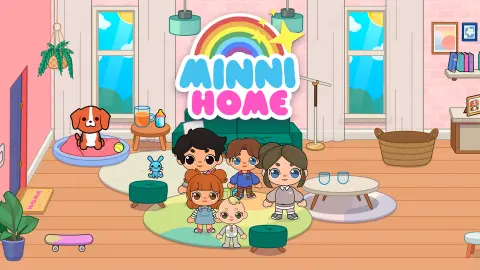
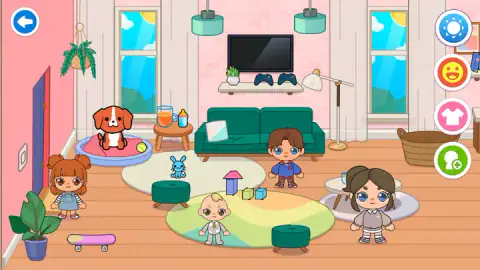
The room is drawn in soft pinks and greens. A teal sofa faces a TV with two game controllers on the shelf below it. There is a lamp, a laundry basket, a rug with toy blocks, a blue toy bunny, a pink skateboard and a dog watching it all from a round bed. The same dog rides that skateboard on the loading screen.
Four of the family are already there when you walk in: a girl with bunches by the door, a boy in a blue jumper, a baby on the rug and an older girl with a ponytail. Open the family tray with the green button and a fifth appears, a black-haired boy who is not in the room at the start. We tapped the tray several times and nobody new walked in, so how he joins the scene is one of the things we did not work out.
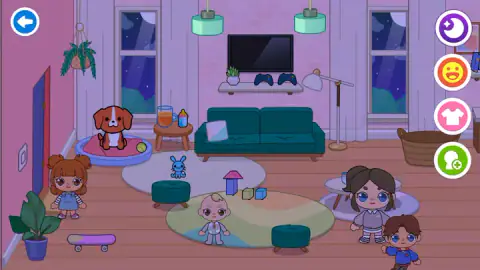
Day and night is the most satisfying button for small children. One tap and the windows fill with a moon and stars, the walls go purple, and the sun on the button becomes a moon. Everything stays exactly where you left it, so bedtime becomes part of the story rather than a reset.
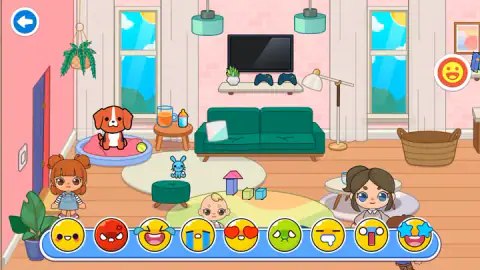
The faces bar has nine expressions: a happy face, an angry red one, laughing tears, crying, heart eyes, a sick green face, one sticking its tongue out, a shocked one and starry eyes. After we picked one, the faces around the room changed from wide eyes to closed-eye grins. A child can make the baby cry, then make everyone happy again, and talk through why.
Why the faces matter: what research says about doll play
The faces bar is more than decoration, and a recent study explains why. In 2026, researchers at Cardiff University published a randomized trial in the journal PLOS ONE. They gave 73 children aged four to eight either dolls or a tablet loaded with open-ended creative games, and asked families to play for about six weeks. Children in the doll group got better at false belief reasoning, the step where a child understands that someone else can believe something different from what they know is true.
The gains were largest in children whose parents reported trouble with friends. And the researchers pointed to a likely reason: with dolls, children used more internal state language, words about what characters think, want and feel, and played more socially.
That is the honest frame for a game like Minni Family Home. It is a screen, and the tablet group in that study did less well than the doll group. Nobody has tested this game. But its best tools point in the same direction as the dolls: nine faces that put feelings on the characters, and a family with no script. Sit next to a child and ask why the girl by the door looks angry, or what the baby wants at night, and you are using it the way the research suggests.
Minni Town: what we saw and what we did not
The map is a whole street. A red school with a clock, a pink hair salon, a café, a park stall with balloons, a house with a girl at the window, a dentist marked with a tooth, a supermarket with a basket, the blue family home and a fenced plot with five stars on its sign. A star counter at the top read zero for our whole session.
Five of those places carry a video badge. The game's listing says one short optional video opens all five for the rest of your session, and that four places are open from the start. We counted three buildings without a badge, so the fourth may be the fenced plot or somewhere else on the map. The listing also mentions cooking a snack, brushing teeth at the dentist, filling a shopping basket, a new haircut and feeding birds in a tree house.
We only went into the blue house, and only into its living room. The right edge of the room hints that it carries on, and the listing says you drag the background to scroll, but we did not. We did not open a wardrobe, the Avatar screen, the Shop or the Prize Pop machine, which the listing says turns free daily tickets into a random outfit. We did not earn a star, and we did not play on a phone.
Who it is for
Minni Family Home is for young children, and for the adult beside them. It needs no reading inside the house and only one skill, dragging, which is easier with a finger on a tablet than with a mouse. There is nothing to lose and nothing to rush. The flip side is that older children who want a goal may tire of one room fast.
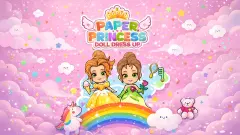
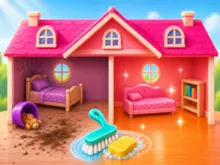
If your child likes arranging rooms rather than inventing stories, Dream Room has you fill an empty pink bedroom with furniture, and Room Makeover: Design And Aesthetic asks you to rebuild a room piece by piece. Tidy Up the Dollhouse is the opposite kind of dollhouse, with eight messy rooms and a time limit, and Paper Princess - Doll Dress Up is all about the outfits. More games for the youngest players are in Kids games.
Screenshots

How to play Minni Family Home - Play House
- Press the green play button. The title screen reads MINNI HOME under a rainbow. Avatar, Shop and Prize Pop sit on the sides; you do not need them to start.
- Pick the blue house on the map. Minni Town opens as a street map. The family home is the blue-roofed house in the middle. Tap it and the screen closes in on it in a shrinking circle.
- Move the family around. Click or touch any family member, hold, and drag them somewhere else. They stay where you drop them.
- Use the four buttons on the right. The sun switches day and night, the smiling face opens a bar of expressions, the T-shirt is for clothes and the green head with a plus shows the family.
- Go back with the blue arrow in the top left corner to return to the map.
Tips from our session:
- The side buttons hide each other. Open the faces bar and the other three disappear until you close it, so tap the face button again to get them back.
- After the T-shirt, tap a person, not the room. The gold outlines are the game waiting for a choice.
- Dragging is the main verb. We moved the boy from in front of the sofa to the bottom corner of the room, and he was still standing there after we switched to night.
- The badges on the map are not part of the house. If a building asks for a video, you can skip it and go back to the blue house.
Controls
| Left click or tap | Picks a building on the map, a button, a character or an object |
|---|---|
| Click and drag | Picks up a family member and drops them anywhere in the room |
| Drag the background | Scrolls around the room, per the game's listing |
| Mouse wheel or swipe a list | Scrolls the outfit and shop lists, per the game's listing |
| Blue arrow, top left | Back to the town map |
Features
- A family of five plus a dog, every one of them a figure you can pick up and drop anywhere in the room
- One button turns day into night: the windows fill with stars and the whole room goes purple
- A bar of nine faces, from happy and angry to crying, sick and starry-eyed, changes the family's expressions
- Tap the T-shirt and every family member lights up with a gold outline, ready to be dressed
- A town map with nine spots, five of them marked with a video badge
- No score, no timer, no way to lose: the only goal is the story the child makes up
Game details
- Developer
- Joyglitch
- Release date
- October 2026
- Last updated
- October 25, 2026
- Added here
- October 2026
- Technology
- HTML5 (2D)
- Platforms
- Browser (desktop), Browser (mobile & tablet, touch)
- Classification
- Fashion & Beauty , Kids
- Saved progress
- Saving, when available, is managed by this game. Mava cannot confirm your level.
FAQ
How do you play Minni Family Home - Play House?
Press the green play button, then tap the blue house on the Minni Town map to go inside. In the living room you pick up any family member with a click or a finger and drop them somewhere else. Four round buttons on the right switch day and night, change faces, open clothes and show the family tray.
Can you win or lose in Minni Family Home?
No. There is no score, no timer and nothing to fail, both in what we played and in the game's own listing. It works like a dollhouse: the goal is whatever story the child invents with the family and the room.
What age is Minni Family Home for?
It is made for young children, roughly preschool and early primary age. Nothing in the rooms we saw needs reading, and dragging a figure is the only skill required. Children around eight or older may find one living room runs out of ideas quickly.
Who is in the Minni family?
The family tray shows five members: an older girl with a ponytail, a black-haired boy, a girl with bunches, a boy in a blue jumper and a baby. Four of them are already in the living room when you arrive, along with a dog in its bed. The black-haired boy only appears in the tray.
How do you change clothes in Minni Family Home?
Tap the pink T-shirt button on the right. Every family member then gets a gold outline, which is the game asking whom you want to dress. The listing says you can change hairstyles, outfits, hats and eyes; in our session we never got as far as the wardrobe itself.
Why are some buildings in Minni Town locked?
Five of the nine spots on the map carry a small video badge. According to the game's listing, one short optional video opens those five places for your play session, while four places are open from the start. A fenced plot with five stars on its sign is also waiting, and the star counter starts at zero.
Who made Minni Family Home - Play House?
It is by Joyglitch and was published on 24 October 2026, where it is listed under Kids. It runs in the browser on computers, and the listing says it also works on phones and tablets with touch.
Is Minni Family Home good for a child's development?
No study has tested this game. A 2026 trial from Cardiff University, published in PLOS ONE, found that six weeks of playing with real dolls improved how children aged 4 to 8 understood other people's beliefs more than open-ended tablet games did. The likely reason is talk: children speak more about characters' thoughts and feelings with dolls, so playing alongside them and asking questions helps.