
About Doodle Halloween Momo Cat : Academy
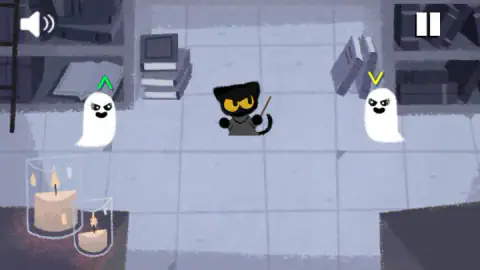
Most games tell you which key to press and then put an enemy in front of you, and joining the two is your problem. This one writes the instruction on the enemy. A ghost drifts in, scowling, with its round bottom trailing off into nothing, and above its head floats a small coloured mark: a flat red dash, a green chevron, a yellow V. That mark is not a health bar and it is not decoration. It is the shape you have to draw.
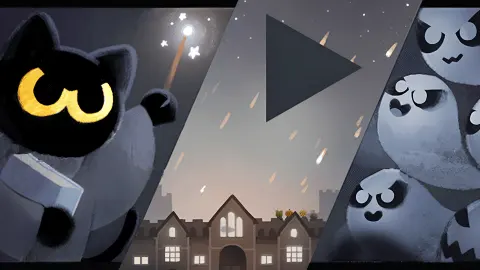
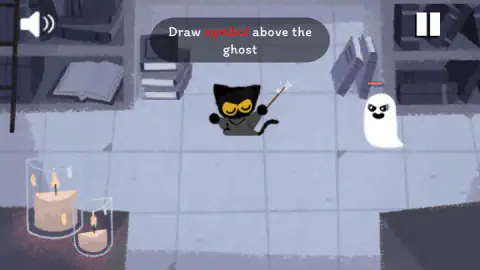
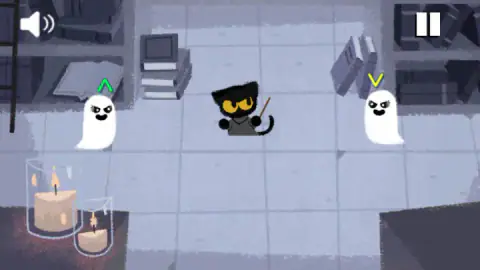
The room it happens in is a single set, and the game trusts it to carry the whole mood. Grey tiles, drawn with the wobble of chalk rather than ruled straight. Shelves with books stacked flat on them, a wooden ladder leaning against the wall, a boxy old monitor sitting on a crate. In the bottom-left corner, two glass jars with candles burning down inside them, which is the only warm colour on the screen. In the middle of all that hangs a black cat in a grey robe with round yellow eyes, holding a wand with a star on the end.
The first thing it tells you is also the last thing it tells you. A banner slides in across the top: Draw symbol above the ghost, with the word symbol picked out in red. There is no control legend, no key chart and no second tutorial step. The game has decided that one sentence is the entire manual, and the remarkable part is that it is right.
A note on the name, because we would rather say this than guess at it. The title gives the cat a name, and the description on the platform repeats it. We never saw that name printed anywhere inside the game itself, so we are not going to treat it as something the game told us. The game is credited to setik, was published in December 2025 with an update logged last August.
A chevron and a V are the same shape turned over, and that is the whole trick
There is a reason a game can ask you to draw and still know what you meant, and it is older than browsers. In 1993, work at Xerox PARC produced an alphabet called Unistrokes, in which every letter was a single unbroken stroke of the pen. The point was not elegance. It was that a machine reading handwriting has a miserable job: it has to guess where one letter stops and the next begins, and it has to recognise a finished picture that every person draws differently. A single stroke removes both problems at once. It starts when the pen goes down, it ends when the pen comes up, and in between it has a direction.
That idea went into pocket handhelds a few years later, in the shape of Graffiti, the input system that shipped on the first Palm devices in 1996 — and the two camps spent the best part of a decade in court over whose idea it had been. What survived all of it is the design lesson, and it is the one this game runs on. A shape judged as a picture is hard. A shape judged as a path, with a beginning and an end, is easy.
Look at what the game puts on screen and you can see it using exactly that. The green chevron and the yellow V are, as pictures, the same two lines meeting at a point. Nothing separates them except where you start and which way you travel. A system reading finished ink would have to work out which way up the drawing is. A system watching the path already knows, because one of them goes up first and the other goes down first.
So when you play, the practical advice falls straight out of the history. Draw the shape as one movement rather than assembling it. Start at the end the shape starts at. And do not fuss over neatness: a wobbly V drawn in the right direction is a better input than a beautiful one drawn backwards.
What we reached, and what we did not
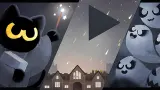
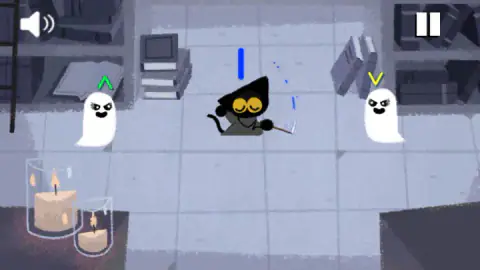
We got through the opening screens and into the room, and we spent our session there with a ghost on either side of us. We drew horizontally, vertically, and in V shapes. One of those strokes is visible in our second picture, hanging in the air beside the cat with its flecks still scattering.
And then we have to be straight with you about where that got us. We never saw a ghost come apart. We never saw a number on the screen — no score, no timer, no row of lives. Nothing in our session announced a hit or a miss, and the room never changed. The two ghosts in our last picture are the two ghosts in our third one, in the same places, still carrying the same marks.
Which is why four things are missing from this page on purpose. We do not know how many rooms there are. We do not know whether the ghosts speed up. We do not know what happens when you clear them, and we never met a boss. The platform's own description promises some of that, and it may well be right, but we did not see it and we are not going to pass it on as though we had. What we can describe is the part we did reach, which is a game that explains itself in one sentence and then gets out of the way.
More games credited to setik
Doodle Boba Bubble Tea is the obvious companion piece, another game in the same Doodle naming family that swaps spellcasting for stacking a drink. Moon Chess goes the other way entirely, trading reflexes for a board and the phases of the moon. Timer Cannon is the one to try if what you liked here was aiming rather than drawing, and Save the Balloon keeps the cartoon look and adds things that chase you. More in action games.
Screenshots
How to play Doodle Halloween Momo Cat : Academy
- Hold the button down and draw. Press, trace, release. The whole control scheme is that one movement, with a mouse on a desktop or one finger on a phone. In our session a plain click, with no drag behind it, produced nothing we could see.
- Read the mark, not the ghost. The symbol floats above the head, slightly clear of it. The ghosts themselves are near enough identical, so the mark is the only thing that distinguishes one from another.
- Draw it where it is. The banner says above the ghost, and that is a position as well as a description: the stroke belongs up where the mark is, not across the ghost's body.
- Do the whole shape in one go. A V is two lines, but it is one movement, down and back up, without lifting. Lift halfway and you have drawn half a symbol.
- Expect two at once. A ghost on each side with different marks is the normal state of play, not a difficulty spike.
What our session taught us:
- Check which way the point faces before you start. The green mark we kept seeing is a chevron pointing up and the yellow one is a V pointing down. They are the same two lines. The direction is the entire difference.
- Your stroke is drawn back to you. It appears as a thick coloured line with flecks coming off it, standing in the air for a moment. That is the game showing you what it read, and it is the fastest way to work out whether a shape failed because you aimed badly or because you drew badly.
- The cat shuts its eyes when a spell goes off. It is a small animation, but in a game with no score and no counter, it is one of the few pieces of feedback you get.
- Nothing hurries you in the opening room. The two ghosts we faced sat where they were, marked and waiting. If the ghosts here get faster, they do it later than we got.
- The sound toggle is top left and the pause is top right. Both are on screen from the tutorial onwards, which is more consideration than most browser games show.
Controls
| Mouse, held down | Draw. You press, trace the shape that is floating above a ghost, and let go. The game's own tutorial banner gives one instruction and only one: Draw symbol above the ghost |
|---|---|
| Finger, on a touchscreen | The same stroke with a fingertip. The game is listed for phones and tablets as well as desktop, and drawing a shape is the rare control that needs no translation between the two |
| Pause bars, top right | Pause. They sit in the corner of every screen we saw, including the tutorial |
| Speaker icon, top left | Sound on and off |
Features
- A control scheme with no buttons in it: the only thing you ever do is draw a shape on the screen
- The instruction is written on the enemy. Each ghost carries its own symbol above its head, so the target and the command are the same object
- Symbols we saw in one short session: a flat red dash, a green chevron pointing up, a yellow V pointing down, and a blue vertical bar
- Two ghosts can stand either side of the cat carrying different symbols at the same time, which is what stops the game being one gesture repeated
- A single room drawn in chalky greys: tiled floor, shelves of books, a wooden ladder and two glass jars with candles burning in them
- Your stroke is drawn back to you as a thick coloured line with flecks coming off it, so you can see what the game thinks you drew
- Credited to setik, with an E age rating
Game details
- Developer
- setik
- Release date
- December 2025
- Last updated
- August 10, 2026
- Added here
- October 2025
- Technology
- HTML5 (2D)
- Platforms
- Browser (desktop), Browser (mobile & tablet, touch)
- Saved progress
- Saving, when available, is managed by this game. Mava cannot confirm your level.
FAQ
What is Doodle Halloween Momo Cat : Academy?
It is a browser game about drawing shapes. You play a black cat with a wand in a candlelit school room, ghosts drift in on either side of you, and each one carries a small coloured symbol above its head. You beat a ghost by tracing that symbol on the screen with the mouse or a fingertip. The game's only written instruction is the line it shows you at the start: Draw symbol above the ghost.
How do you cast a spell in Doodle Halloween Momo Cat : Academy?
You hold the mouse button down, trace the shape, and release. There is no attack key and no fire button, and in our session a plain click did nothing we could see. The shape you draw appears on screen as a thick coloured line with flecks coming off it, which is the game showing you what it read.
What do the symbols above the ghosts mean?
They are the shape you have to draw to beat that particular ghost. We saw four of them in one session: a flat red dash, a green chevron pointing up, a yellow V pointing down, and a blue vertical bar. The colours changed with the shape rather than with the ghost, so read the shape and not the colour.
Why are two ghosts marked with different symbols?
Because that is what makes it a game rather than a single gesture repeated. With a green chevron on your left and a yellow V on your right, you cannot pick a target and then work out the input: the input is the target. The two shapes are also the same pair of lines with the point facing opposite ways, so the only thing that separates them is which way round you draw them.
Can you play it on a phone?
It is listed for desktop, Android and iOS, and the control is a swipe with one finger, which is about as portable as an input gets. It is drawn in landscape, so a phone wants to be held sideways. Our own session was on a desktop with a mouse, so we cannot tell you whether a fingertip is read more generously than a cursor.
Is there a score in Doodle Halloween Momo Cat : Academy?
We never saw one. Through our whole session the screen carried no number at all: no score, no timer and no row of lives, only the tutorial banner and the two corner icons. If the game keeps count of anything, it does it somewhere we did not reach.
How many levels does it have?
We cannot tell you from having played it. We spent our session in one room and never saw it change. The game's description promises five levels through different parts of a school and a boss ghost at the end, and that is the provider talking, not us: we did not get there, so we are not going to describe it.
Who made Doodle Halloween Momo Cat : Academy and when?
It is credited to setik and was published in December 2025, with a last update logged in August 2026. One honest caveat: another game listed under the same name on that platform credits a different studio in its own text, so setik may be the account that publishes rather than the hand that drew it.