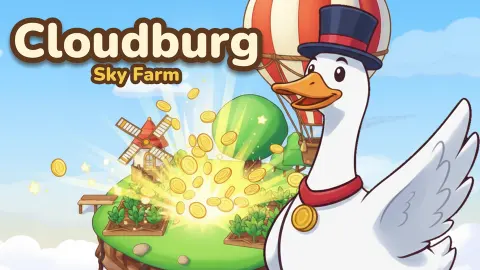







About Cloudburg: Sky Farm
The mini-game paid ninety coins, and then it did the thing that makes this game worth a page. Under the gold figure, in small grey type, it printed what those ninety coins were actually worth: = 12 s of income. Not a well done. A conversion rate.
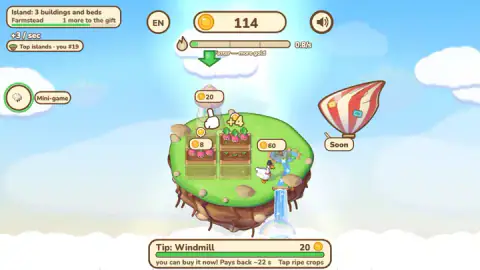
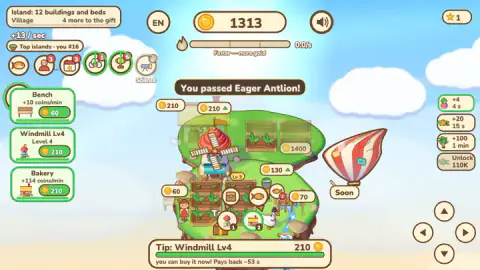
That one line is the whole of Cloudburg: Sky Farm. You tap ripe crops on a small green disc of land floating in a blue sky, a waterfall pours off its rim into nothing, and the coins you shake loose buy plots, seeds, piers and windmills that then earn for you by themselves. Standard enough. What is not standard is the tip bar along the bottom, which never quotes a purchase in money alone. It names the thing, names the price, then tells you how many seconds it needs to repay you — "you can buy it now! Pays back ~22 s".
Once you notice that, the farm stops being decoration and turns into a clock. Crops down the right are sorted by patience. Buildings down the left advertise a yield per minute. The purse reports what the island earns each second, and the tip bar quietly does the division against whatever that rate happens to be when you look.
Everything here comes out of a single session of a little over ten minutes. The island grew from three buildings to thirteen and the rank pill moved from Farmstead to Village, which is far from finished — a crop tier stayed locked behind a price written as 110K, and a panel labelled Science stayed greyed out throughout.
Every price in Cloudburg is a number of seconds
The clearest way to see what the game is doing is to follow one building up its ladder. The windmill is the first thing the tip bar ever suggests, and it climbs four levels, each costing a shade over double the last. Here is what the bar quoted us beside each of them:
| Windmill | Price | Payback printed |
|---|---|---|
| Level 1 | 20 | ~22 s |
| Level 2 | 44 | ~29 s |
| Level 3 | 97 | ~52 s |
| Level 4 | 210 | ~53 s |
Read the two columns against each other and the design shows. The price multiplies by more than ten from top to bottom; the wait to earn it back barely more than doubles. Each upgrade costs far more than the last, but your income has risen in step, so the time before it pays for itself grows slowly and then almost stops growing.
It also means the quoted number is alive. The same Windmill Lv4 at the same price read about 53 seconds in one moment and roughly a minute in another, because our income had dipped. The bar is not reading a fixed table; it divides by whatever the island earns when you glance at it.
There is one honest gap in that, and it is the bar's blind spot rather than ours. When the windmill and the bakery both cost the same, the bar points at the windmill — yet the bakery card advertises +114 coins/min, which by plain arithmetic would take closer to two minutes to repay. The recommendation optimises for the fastest return, not the largest.
The payback question is older than any farm game
It is no coincidence that the first thing Cloudburg asks you to buy is a windmill. For centuries the mill was the single most expensive thing a farming community owned, and it was bought in exactly the frame of mind the tip bar puts you in: not because it was handsome, but because somebody had worked out how long it would take to pay for itself.
The way it did that is the mechanism the game uses. A mill earned by taking a cut of everything that passed through it — the miller kept a fixed share of the grain he ground, a toll the old English records call multure. Grain in, flour out, a portion stayed behind. Which is a yield per minute by another name, measured in sacks.
The sum has a name too, and accountants still use it daily: the payback period. Take what a thing costs, divide by what it earns in a unit of time, and the answer is how long before you are even. It is popular for the same reason the tip bar is readable — it answers in one number anybody can hold in their head.
Its famous weakness is the one the tip bar inherits. Payback says nothing about what happens after you break even. A cheap thing that repays in twenty seconds and then stops is worse than a dear one that repays in two minutes and runs for an hour.
Three hats, a pumpkin cannon, and a goose with opinions
The interruptions are the most charming part of the farm. Twice in ten minutes a Mini-game button lit up on the left and dropped us somewhere else entirely.
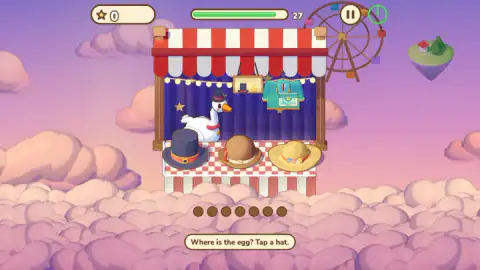
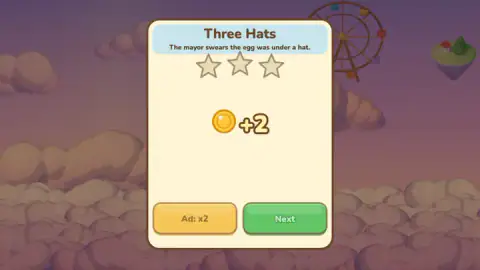
The first was a fairground stall in pink clouds, awning striped red and white, a ferris wheel turning behind it and a goose in a top hat guarding three hats — a black topper, a brown one, a yellow straw. The instruction: Where is the egg? Tap a hat. You get a row of seven guesses and a timer that starts at 27, and a wrong one prints "Nope!" and crosses a dot off the row. The result card is headed Three Hats and carries the best line in the game under its title: The mayor swears the egg was under a hat.
The second swapped clouds for a flat green field, where a farmer in a straw hat stands beside a wooden catapult loaded with a pumpkin while a sad-faced rain cloud drifts overhead trailing drizzle. The instruction was to tap where the cloud was going, not where it was. That is the card that printed the seconds-of-income line, and it also admitted Hits: 0 of 1.
Under all of it runs a voice that comments whether or not anything has happened. One bubble announced: "Grump says thunder isn't music, it's a warning. Fine. Warning received. Listening." Another promised "A gift! Free. I personally checked: no ads." Not quite true — the game does put up its own card reading "Short ad break", with the line "The game is paused for a moment" — but it warns you first and stops the clock while it happens.
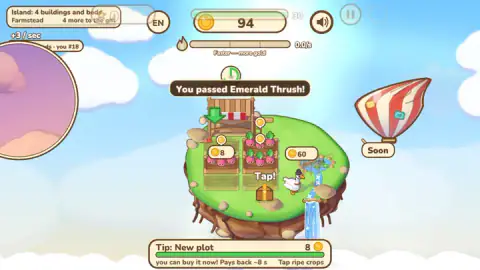
Behind the farm sits a leaderboard with the strangest naming scheme we have met. Passing a rival drops a dark banner across the screen, and the two we overtook were Emerald Thrush and Eager Antlion. We finished sixteenth, and the striped balloon off the island's right edge, tagged "Soon", never once opened.
More farms that run themselves
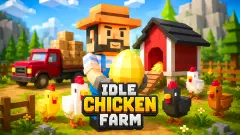
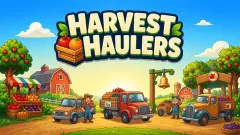
If the island is what drew you, Cozy idle village is our closest neighbour — mills, fishing huts and workshops again, except the villagers have names, families and eventually graves. Harvest Haulers keeps the tapping at the centre, shaking fruit loose onto trucks that pay when full, and Idle Chicken Farm turns the loop into an egg business where the birds get upgraded. Ant Colony Idle swaps sky for soil and asks Cloudburg's question: which chamber pays for itself fastest. The rest are in clicker games.
Screenshots
How to play Cloudburg: Sky Farm
- Click once in the middle to start. There is no menu, no level select and no difficulty — the island is already growing.
- Tap a crate whose crop has ripened. A coin bubble floats over it with the figure it will pay, and tapping collects exactly that.
- Read the bar along the bottom. It names one thing worth buying, its price and how long it takes to repay you; buy it from the card column on the left, or by tapping the price bubble sitting on that spot of the island.
- When a banner reads "Invasion in 4 s", stop farming and tap everything that moves.
- Keep buying. Each building and bed counts towards the rank pill and towards a gift counter that ticks down with every one you add.
What only sitting in front of it teaches:
- The slow crops are the good crops. The right-hand column runs from four coins every four seconds at the top to a hundred a minute at the bottom, and the patient one is worth about two-thirds more per second. Tapping feels productive; waiting pays better.
- Prices can stay still while value climbs. The pumpkin seeds cost sixty coins all session, but the yield on that same card rose from +61 a minute to +102 as the farm grew around them. A card you skipped is a different offer later.
- You never lose an invasion, only some of it. Our first raid ended with the card reading Beaten 0 of 14 (0%) and still handed over a chest, the fine print admitting twenty-eight coins had been stolen. Tapping during a raid limits the theft rather than deciding the outcome.
- Ranks pay a bonus, not a badge. Crossing into the next dropped a banner reading "New rank: Village! +1021", a larger single payment than anything we earned by farming.
- The flame meter is the only thing that rewards speed. Under the purse sits a flame, a bar and a live rate, labelled Faster — more gold. Nothing else on screen cares how fast you click.
Controls
| Click or tap a ripe crop | Harvests it for the coin figure shown in the bubble above its crate. This is the one action the game asks for, and the tip bar repeats it as "Tap ripe crops" |
|---|---|
| Click or tap a growing crop | Per the game's listed instructions, speeds up its growth rather than harvesting it |
| Click or tap repeatedly | Fills the flame meter under the purse, labelled "Faster — more gold", with a live rate printed beside it |
| Click a price bubble or a card in the left column | Buys that building, plot, seed or upgrade. The bubbles sit directly on the spot of island they belong to |
| Drag with the mouse, or the on-screen arrows | Pans the camera around the island. The four arrow buttons appear at the bottom right once the island outgrows the screen |
| W, A, S and D, or the arrow keys | Listed by the game as the way to move around the island on a computer. In our session, pressing them changed nothing we could see on screen |
| Mouse wheel | Zooms in and out, per the game's own listed instructions |
Features
- Every purchase is priced twice: once in coins, and once in how many seconds of your current income it takes to repay, printed live on the bar across the bottom
- The windmill climbs four levels at 20, 44, 97 and 210 coins — roughly a doubling each time — and the game quoted its payback at about 22, 29, 52 and 53 seconds
- Crops are a patience ladder: the quick one pays four coins every four seconds, the slow one pays a hundred coins a minute, and the slow one earns more per second
- Invasions arrive on four seconds' notice and are survived by tapping, not by defences: the card afterwards reports how many you beat, your best combo and how many coins were stolen
- Two mini-games turned up in ten minutes, a hat-and-egg guessing stall and a pumpkin catapult, each paying out in coins and each offering to double it for a video
- Ranks pay a lump sum when you cross them: going from Farmstead to Village printed a banner reading New rank: Village! +1021
- A leaderboard of oddly named rivals sits behind the farm, and passing one drops a banner across the screen — we overtook Emerald Thrush and Eager Antlion
Game details
- Developer
- Partner studio
- Release date
- October 2026
- Last updated
- October 25, 2026
- Added here
- October 2026
- Technology
- HTML5 (2D)
- Platforms
- Browser (desktop), Browser (mobile & tablet, touch)
- Classification
- Casual , Clicker , Simulation , Strategy
- Saved progress
- Saving, when available, is managed by this game. Mava cannot confirm your level.
FAQ
How do you play Cloudburg: Sky Farm?
You tap ripe crops on a small floating island to turn them into coins, then spend those coins on plots, seeds, buildings and upgrades that earn for you on their own. A bar across the bottom always names one thing worth buying and how long it would take to pay for itself. Every so often the farm is interrupted by an invasion you fight off by tapping, or by a mini-game that pays a bonus.
What does Pays back ~22 s mean in Cloudburg: Sky Farm?
It is the game telling you how long that purchase needs to earn back what it costs, at the rate your farm is currently making coins. The first windmill costs twenty coins and the bar quoted it at about twenty-two seconds. The figure is recalculated as your income changes, so the same item can be quoted at fifty-two seconds on one visit and about a minute on another.
Should you buy the windmill or the bakery in Cloudburg: Sky Farm?
At the point where both cost 210 coins, the game's own tip bar recommends the windmill, and it recommends by payback speed rather than by total income. The bakery card advertises a larger figure per minute, so the choice depends on whether you want the money back soonest or the biggest number at the end. We bought along the windmill line and cannot report what the bakery does over a longer session.
What is an invasion in Cloudburg: Sky Farm?
It is a timed raid on your island, announced by a banner counting down from four seconds and a speech bubble reading "Invasion! Tap everyone you see. Elephants take three taps, they are touchy." You fight it off by tapping the intruders before they leave. The card afterwards is headed "Invasion survived" rather than won, and it still pays out a chest even when you beat none of them.
What is the Three Hats mini-game in Cloudburg: Sky Farm?
It is a fairground stall in the clouds where a goose in a top hat hides an egg under one of three hats and the game asks "Where is the egg? Tap a hat." You get a row of seven guesses and a timer of twenty-seven seconds. The result card is headed Three Hats, shows three stars for how well you did, and pays a small handful of coins with an optional video button that doubles it.
Are there ads in Cloudburg: Sky Farm?
Yes. The game puts up a card of its own reading "Short ad break" with the line "The game is paused for a moment", so it tells you an advert is coming and stops the farm while it runs. The other prompts are offers rather than interruptions, since each mini-game result carries a yellow "Ad: x2" button beside a plain green "Next", and declining it simply takes the smaller reward.
Is Cloudburg: Sky Farm free, and who made it?
It is free and runs in a browser with nothing to install. The studio behind it is not recorded anywhere we can check, so this sheet names no author rather than guessing one. It reached our catalogue on 24 October 2026, which makes it a new release at the time of writing rather than a back-catalogue title.
Does Cloudburg: Sky Farm have an ending?
We did not find one. In a session of just over ten minutes the island grew from three buildings to thirteen and the rank pill moved from Farmstead to Village, with a crop tier still locked behind a price of 110K and a research panel labelled Science still greyed out. The game's own description promises a coop, a balloon pier and an observatory, which is its claim and not something we reached.