About Toy Soccer Cup
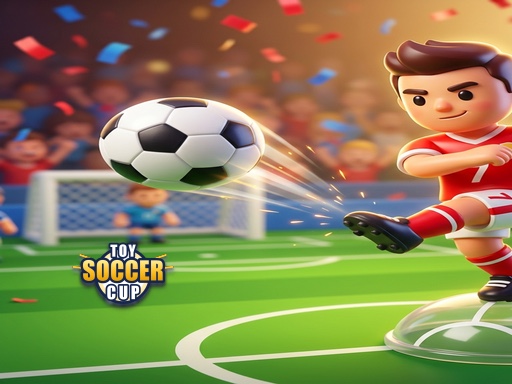
Toy Soccer Cup is tabletop football rebuilt as a browser game, and it starts from a decision most football games never make: you do not steer anybody. There is no joystick, no run button, no player switching. You pick one figure, pull back like a slingshot, and let go. What happens next is physics.
That single gesture is the whole game, so it had to be worth repeating a thousand times. The ball weighs roughly a sixth of what a figure weighs and rolls far longer, which is why a soft touch trickles it into a gap and a full-power strike sends it flying off the boards. The posts are real physical objects with a five-centimetre radius, so hitting the woodwork is a genuine outcome and not an animation. And every collision is resolved at a fixed 120 steps per second, which has a consequence that matters more than it sounds: the same flick always produces the same result.
Around that sits a game with somewhere to go. Winning matches pays coins, coins open sticker packs for a 625-card album, and there are 750 collectable avatars and 57 leagues and cups modelled on competitions from around the world. Five AI levels take you from an opponent designed to be beatable on your first try to a Legend that simulates its candidate shots and thinks a move ahead.
We built it, which is why this page can tell you the actual numbers instead of adjectives.
The physics are deterministic, and that is the whole point
Most casual sports games hide a random number generator somewhere. It smooths out skill, keeps beginners in the match, and quietly decides outcomes. We went the other way.
The match runs on a fixed timestep of 1/120 of a second with continuous collision detection on the ball, which means the simulation never depends on how fast your device happens to be running. A flick of a given strength from a given position produces the same trajectory on a school Chromebook and on a gaming PC, today and next month.
Here is what that buys you as a player. When your shot hits the post, it was your angle. When the ball squeezes between two defenders, it was your line. Nothing in the engine is deciding whether you deserve this goal. Losing is your fault and winning is your doing — and that is the only foundation on which a game of skill can stand.
The numbers behind it, since we can publish them: a playable pitch of 10.5 by 6.8 metres, a goal mouth of 1.5 metres, a maximum flick speed of 13 metres per second — fast enough to cross the whole pitch in about a second — and a bounce coefficient of 0.85 between figure and ball, which is what makes contact feel alive rather than dead.
The fair-play rules, and why each one exists
Every rule below exists for one reason: to stop the match turning into bowling. The referee does not miss much.
- Fouls. Smash into a rival before touching the ball and the opponent gets a free kick, with one of their defenders lining up as a wall. The wall matters — without it a free kick would be a gift goal, and fouling would become a tactic worth its punishment.
- A brush is not a foul. Only impacts above a set speed are punished. Grazing an opponent on your way to the ball is part of the game, and the referee knows it.
- The keeper stays home. The goalkeeper cannot cross the halfway line or score from its own half. Otherwise the optimal strategy would be to send your best defender upfield forever.
- Dead balls reset. A ball stuck in a corner returns to the centre. Nobody enjoys watching two figures poke at a ball wedged against a board.
- The mercy rule. A three-goal lead ends the match early. It exists for the eight-year-old on the losing end, and it is the rule we are most sure about.
What you are actually playing for
- 57 leagues and cups modelled on real competitions around the world, from a free first league to trophies that take a season to reach.
- A 625-sticker album, filled by opening packs bought with coins earned on the pitch.
- 750 collectable avatars, each designed individually.
- Daily challenges and a monthly Cup Pass that add seasonal goals without ever gating anything behind real money.
Nothing on that list can be bought with real currency. Advertising pays for the game, and the ads we prefer are the voluntary kind — you choose to watch one for a reward. On the pitch, fingers decide, not wallets.
Built for a school Chromebook
The players we actually have are between eight and sixteen, and a lot of them are on a school laptop or a cheap phone at break time. That shaped everything: the whole game is about 178 KB of compressed JavaScript, the first playable moment arrives in under two seconds, and it holds 60 frames per second on weak hardware. There is nothing to install and no account to create.
It is also built so a child can play alone and an adult can check it in two minutes. No free chat. Nicknames pass a child-safe filter in every language we support. No personal data is collected. The difficulty curve is designed to support rather than frustrate, and the first AI opponent is deliberately close to impossible to lose against.
The opposite of Soccer Random
We publish Soccer Random and Basket Random on this site, and they are excellent — but they are the exact philosophical opposite of this game. There, the pitch, the ball and the goal change at random after every point, and the joke is that nobody is really in control. Here, nothing changes and everything is in your hands.
Both approaches produce great games. They just answer different questions. If you want chaos with a friend for five minutes, play the Random series. If you want to get measurably better at something, this is the one.
For more football in the catalogue, browse the soccer category, or try 12 MiniBattles if what you really want is two people arguing over one keyboard.
How to play Toy Soccer Cup
A match is three minutes of play, taken in turns. On your turn you have fifteen seconds to pick a figure and flick it.
- Tap one of your figures. Its ring lights up and stays lit.
- Pull back in the opposite direction to where you want it to go. The ring turns green, then yellow, then red as the power climbs.
- Read the guide. The dotted line shows where your figure will travel and, if it will reach the ball, where the ball will go — bounces off the boards included.
- Release. While the ball is rolling, hold your finger on the screen to watch the play at double speed.
The trick that separates good players from beginners: you do not have to drag from behind the figure. Tap a player to select it, then drag from any empty part of the screen. The shot comes out identical. On a phone this is the difference between fighting the controls and playing the game, because your finger never covers the pitch. It also rescues figures pinned against the sideline, where there is no room to pull back.
Three more things worth knowing:
- Changed your mind? Bring your finger back towards the figure and release. The shot cancels and you keep your turn.
- Most goals are yellow, not red. Full power is for clearances and long passes. A yellow-power strike is accurate enough to aim and hard enough to beat the keeper.
- Fifteen seconds is longer than it sounds. It is roughly three times what a good shot needs. Spend two of those seconds reading the guide line, not rushing.
Controls
| Tap / click a figure | Select one of your players (its ring lights up) |
|---|---|
| Drag back & release | Flick the figure like a slingshot — pull further for more power |
| Drag from anywhere | With a player selected, drag from any empty area to shoot without covering the pitch |
| Drag back to the figure | Cancel the shot without losing your turn |
| Hold while the ball rolls | Fast-forward the play at 2× speed |
Features
- Turn-based tabletop football with the classic Subbuteo flick, rebuilt with real, deterministic physics
- 57 leagues and cups from all over the world, a 625-sticker album and 750 collectable avatars
- Five AI difficulty levels, from a first-timer to a Legend that looks two moves ahead
- Play online duels, or two players on the same device passing the phone
- [object Object]
- Free to play, supported only by optional rewarded ads — no pay-to-win
Game details
- Developer
- Mava Games
- Release date
- July 2026
- Last updated
- September 3, 2026
- Added here
- July 2026
- Technology
- HTML5 · WebGL (Angular + Three.js, custom deterministic 2D physics)
- Platforms
- Browser (desktop, tablet, mobile), Android (Google Play)
- Classification
- Kids , Multiplayer , Soccer , Sports
FAQ
Is Toy Soccer Cup free?
Yes. The full game is free in the browser. Optional rewarded ads give coins for the shop and album, and nothing on the pitch can be bought with real money.
Can I play Toy Soccer Cup with a friend?
Yes. Choose 2 Players to share a device turn by turn, or Online to be matched against another player in real time.
Does it work on my phone?
It does. The game is touch-first, runs in Safari and Chrome on iOS and Android, and is also available as an Android app.
How long is a match?
A match lasts three minutes of play with a 15-second limit per shot, so a full game takes about five minutes.
Is it safe for kids?
Toy Soccer Cup was designed so a child can play alone. There is no open chat, nicknames are filtered in every language, and the referee enforces fair play.
Is there any randomness in Toy Soccer Cup?
No. The physics run at a fixed 120 steps per second and the same flick always produces the same result. Nothing in the engine decides whether a shot deserves to go in, which is why the game rewards practice.
Does Toy Soccer Cup work on a school Chromebook?
Yes. The whole game is around 178 KB of compressed JavaScript with nothing to install, it reaches the first playable moment in under two seconds and holds 60 frames per second on weak hardware.
How do I shoot without my finger covering the pitch?
Tap a figure to select it, then drag from any empty area of the screen. The shot comes out exactly the same, and it also lets you play figures pinned against the sideline.