


About Merge Guns
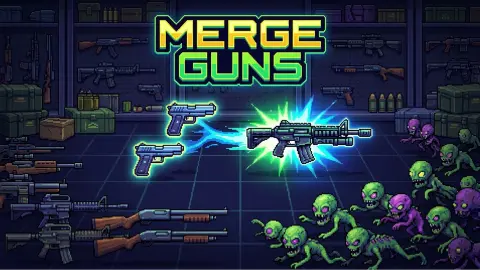
Most defence games open with a shelf. An arrow tower, a cannon, a frost tower, a price under each, and a decision about which one to buy. Merge Guns opens with one button that sells one thing. It is a pistol, it costs fifteen scrap, and there is nothing else for sale — not now, not in the third wave, not ever as far as we got. If you want something better than a pistol you have to make it, and the only raw material is more pistols.
The making happens on the board, a block of twenty dark cells on the left of the screen, and the game tells you what to do with them in small grey letters that never leave the bottom corner: drag onto a matching gun to merge. Two pistols dragged together become a second-tier gun; two of those a third. Everything you own is something you built out of the thing in the shop.
The shop knows it, too. The price on the BUY GUN button goes up by a single scrap every time you press it. That sounds like a brake until you see what a kill pays: the gold numbers come up over the bodies while you are still deciding what to do, and ours read ten and thirteen.
So the ladder loses. By the last wave of a node we had better than four hundred scrap banked and a gun on sale for nineteen. Money is not the thing that stops you here.
The game is credited to Game Factory.
Our own session lasted about four minutes across two attempts at the same opening node, and we never finished it. Enough to describe the machine honestly, nowhere near enough to say how deep it goes. The rest of this page is careful about which is which.
The wall is drawn as people
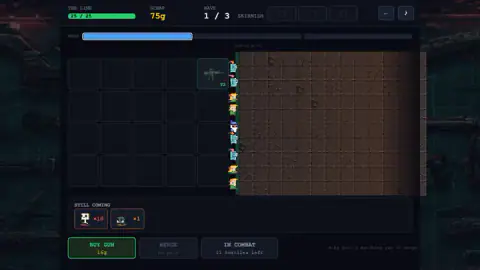
The counter at the top left says THE LINE and a number out of 25. Most games would leave it at that. This one draws it.
Run your eye down the left edge of the brown field and there is a vertical green strip with small figures standing on it, shoulder to shoulder, facing out. Hooded archers in pale blue with arrows already nocked. Blonde villagers in green tunics. A wizard in a blue pointed hat with a white beard. They are not doing anything — no animation we caught, no shots from them, nothing on the scoreboard that belongs to them. They are what the number means.
And the game dresses the number as it falls. At full health the strip is a deep forest green. In the capture where the counter read twelve it had gone olive-brown, there were fewer figures on it, and a red -1 HP was floating up beside one of them. You can read your own health without looking at the top of the screen, which matters in a game where the top of the screen is also where the money, the wave count and the loadout live.
The ground they are defending has a name, printed in faint grey above it: Ashfen Mire. That is the node, and the node is labelled SKIRMISH.
Why merging gets harder exactly as it gets better
This is the part the game never explains, and it is the whole shape of the difficulty.
Merging consumes a pair to make a single gun, so the count you need doubles at every step up: a second-tier gun is two purchases, a third is four, a fourth is eight. Climb one more rung and you need as many pistols as every tier below it put together.
Now put the price ladder next to it, because the pistols are not the same price — each costs a scrap more than the last. Four pistols bought off the bottom of that ladder come to sixty-six scrap between them — and that is one third-tier gun. The next tier up needs twice as many, bought at the rungs above. A tier therefore costs more than double the one below: the quantity doubles and the unit price rises at the same time.
Here is the consequence, and it is why we sat on hundreds of unspent scrap. The constraint is never the money. It is the odd gun. Every tier you climb leaves you holding something with no twin, and the button in the middle of the screen says so in grey: no pair.
That is a defence game where the losing move is buying at the wrong moment, not buying too little. Press BUY GUN twice and you have a pair. Press it three times and you have a pair and a liability.
A node, four waves, and a card in between
The bar under the readouts is labelled NODE, and it is cut into segments. We counted three segments on our first attempt, lit one at a time as the waves went by. On our second attempt, at the same node with the same name and the same SKIRMISH label, the bar had four. So the segments are waves, and the node did not hand us the same fight twice.
Before a wave, two things appear. The first is an INCOMING panel listing exactly what is coming and how many: a bone-white blocky head on a red base and a squat green armoured one on an amber base, each with a multiplier beside it. On the wave we read most closely: thirteen of the light ones and a single heavy. Once fighting starts the same panel becomes STILL COMING and counts down.
The second is a screen headed CHOOSE ONE, with three numbered cards and a SKIP button under them. The header above the cards read INCOMING — WAVE 1 · ACT I, which is the only hint we have that there is a layer above the node.
The cards we can put names to are Pierce Rounds, which hits 3 in a line; Overclock, fast, weak shots; Bounty Board, 2.2x on heavies; and Cryo Rounds, which hits slow enemies. Whichever you keep drops into one of the empty rings at the top right, and the box at the bottom of the screen — headed ACTIVE LOADOUT, and reading no tools yet before you have taken anything — lists what you are carrying.
Three rings, three cards per screen, and a SKIP button that exists for a reason. We never got far enough to find out what that reason is.
More walls worth defending
If the merge half is what you came for, Merge Elementals Castle Defense runs the same bargain with fighters instead of firearms. If it is the defending, Tower Defense and Kingdom Tower Defense give you a shelf of different towers rather than one button pressed over and over. And Game Factory's other game on our shelf, Cozy Idle Village, could not be further from this one: no wall, no wave, nothing shooting. We have not played any of those three as far as we played this one, so read them as signposts and nothing firmer. The rest of the shelf is in strategy games.
Screenshots
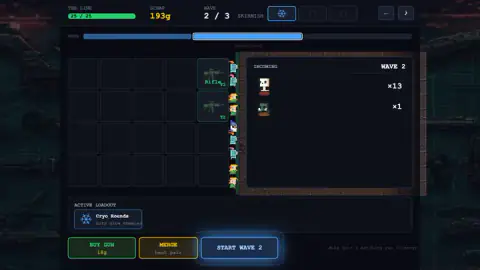
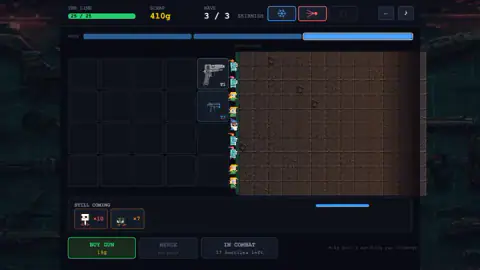
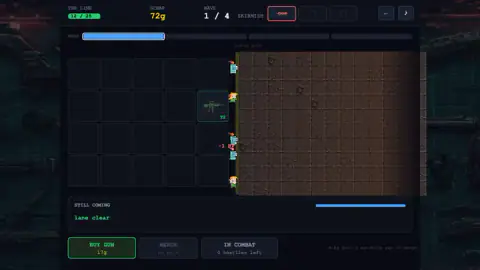
How to play Merge Guns
- Press BUY GUN. You start a node with ninety scrap and the first pistol costs fifteen, so you can afford several before the first wave even arrives.
- Drag one gun onto another of the same tier to merge them. The tier is written in the corner of each gun — T1, T2, T3 — and the gun's picture and colour change with it, from a grey pistol to a green rifle to a blue submachine gun.
- Press START WAVE when you are ready, or do nothing: a blue timer bar fills on its own and the wave comes anyway.
- Watch the counter at the top left. That is the wall, it starts at 25, and it drops by one every time something walks past your guns.
- When a CHOOSE ONE screen appears, take one of the three cards or press SKIP. Whatever you take goes into one of the three slots at the top of the screen and stays there for the rest of the run.
What we only learned by being there:
- You cannot fight. The guns do. Once a wave is running there is no aiming and no firing. Your hands are for buying and merging; the shooting happens without you.
- Every gun we bought landed in the same column. The one touching the wall, never out in the empty board. We tried repeatedly to drag one into the open cells on the left and never managed it, so treat those twenty cells as scenery until someone shows you otherwise.
- The MERGE button is a hint, not a move. It lights up yellow and says best pair when something matches, and greys out to no pair when nothing does. You still have to do the dragging.
- A clear lane is not a win. In one of our captures the panel read lane clear and 0 hostiles left while the wall sat at 12 of 25. The wave was over because it had got through.
Controls
| Click or tap BUY GUN | Adds one gun to the board. It costs scrap, and the price on the button goes up by one every time you press it |
|---|---|
| Drag one gun onto another of the same tier | Merges the pair into a single gun one tier higher. This is the only way we found to get anything better than the pistol you start with |
| Click or tap MERGE | Highlights the best pair on the board. It greys out and reads "no pair" whenever nothing on the board matches |
| Click or tap START WAVE | Sends the next wave in early. Leave it alone and the wave starts on its own when the blue timer bar runs out |
| Click or tap a card on the CHOOSE ONE screen | Takes that card into one of the three slots at the top of the screen. A SKIP button under the cards lets you take none of them |
| The music-note button, top right | Audio. We can see the button in every frame; we did not get a reading on what it does, so we will not describe it |
| The left-arrow button, top right | Unconfirmed. By position it is the way back out of a run, but we never pressed it and we are not going to guess |
| Keyboard | Nothing we could confirm. The four arrow keys, A and Enter were all tried and none of them produced a response we could verify. That is not the same as proving they are dead |
Features
- One shop button, one product: BUY GUN sells a pistol, and the price climbs by a single scrap with every purchase — 15, 16, 17, 18, 19 across one run
- Every upgrade is a merge. Two guns of the same tier dragged together become one of the next tier, so a third-tier gun is four purchases and a fourth would be eight
- The wall you defend is drawn as people: a green strip with archers, villagers and a wizard standing on it, and a counter reading 25 that drops by one each time something gets through
- A run is a chain of named nodes. Ours was called Ashfen Mire and flagged SKIRMISH, and the bar under the readouts has one segment per wave of it
- Between waves a CHOOSE ONE screen offers three cards and a SKIP. We saw Pierce Rounds (hits 3 in a line), Overclock (fast, weak shots), Bounty Board (2.2x on heavies) and Cryo Rounds (hits slow enemies)
- Guns fire by themselves once a wave is running. Every kill drops scrap and prints the amount in gold over the body — ten for one of the light ones, thirteen for another
- The same opening node did not give us the same fight twice: three waves on our first attempt and four on our second
Game details
- Developer
- Game Factory
- Release date
- July 2026
- Last updated
- October 24, 2026
- Added here
- June 2026
- Technology
- HTML5
- Platforms
- Browser (desktop), Browser (mobile & tablet, touch)
- Saved progress
- Saving, when available, is managed by this game. Mava cannot confirm your level.
FAQ
What kind of game is Merge Guns?
It is a free browser wave defence with a merge board bolted to it. Enemies walk in from the right across a tiled field and try to reach a wall on the left; guns you place on a five-by-four board shoot them automatically. The twist is the shop, which sells exactly one thing — a pistol — so every better gun has to be built by dragging two matching ones together.
How do you merge guns in Merge Guns?
You drag one gun on top of another of the same tier and the two become one gun a tier higher. The game says so itself in small grey letters at the bottom of the screen: drag onto a matching gun to merge. There is also a MERGE button that highlights the best pair for you, and it greys out and reads no pair whenever nothing on the board matches.
Why does the MERGE button keep saying no pair?
Because merging halves your count every time. Two pistols make one second-tier gun, so a third-tier gun is four pistols and a fourth-tier would be eight. The higher you climb the longer you have to sit on an odd gun waiting for its twin, and in most of our captures the button was greyed out for exactly that reason. Scrap is rarely what holds you up: a pistol starts at 15 and rises by one with every purchase, while a single kill pays ten or more.
What is THE LINE in Merge Guns?
It is the wall on the left of the field and the counter above it, and in our session it started every attempt at 25. It is drawn as a vertical green strip with small pixel people standing on it — hooded archers with arrows nocked, villagers in green, a wizard in a blue pointed hat. When something gets through, a red -1 HP floats up beside it. By the time ours read 12 the strip had turned from green to olive.
Does Merge Guns have levels or is it one endless run?
Neither, as far as we got. A run is a chain of named nodes — ours was called Ashfen Mire and labelled SKIRMISH — and each node holds a set number of waves, shown as a segmented bar under the readouts. The screen between waves is headed ACT I, so there is more structure above the node. We never finished a node, so we cannot tell you what the next one looks like.
What are the cards you pick between waves?
A screen headed CHOOSE ONE drops in before a wave and offers three numbered cards plus a SKIP button. Each one you take fills one of the three slots in the top-right corner, which the game calls your active loadout. The four we can vouch for are Pierce Rounds, which hits 3 in a line; Overclock, fast, weak shots; Bounty Board, 2.2x on heavies; and Cryo Rounds, hits slow enemies.
Who made Merge Guns and when did it come out?
It is credited to Game Factory, who have five games on the same platform. The listing gives July 2026 for the release and September 2026 for the most recent update, and only the months are published anywhere we could find, which is why this page does not claim a precise date.
Can you play Merge Guns on a phone?
It is free, it runs in the browser on this page with nothing to install, and it is listed for desktop, mobile and tablet in both landscape and portrait, with an E10+ age rating and English and Russian text. Every action is a tap or a drag on a panel built for a thumb. We played with a mouse, so how the drag-to-merge reads under a thumb is the listing's claim rather than ours.