
About Bounce TD
In almost every tower defense game ever made, a tower shoots by itself. You pay for it, you put it somewhere sensible, and from then on it works to its own clock while you worry about the next one. The cheapest thing you can buy in Bounce TD costs four coins and has no gun on it anywhere. It is a plain white triangle.
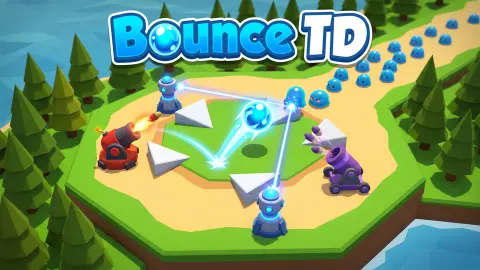
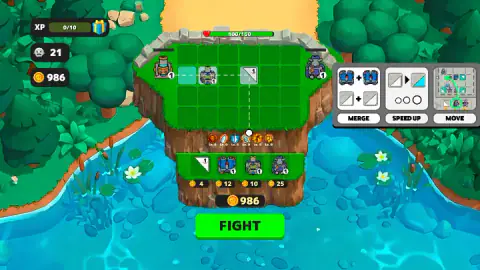
What it is for is drawn on the board before you press a thing. A dashed white line comes out of the tower at the left edge, runs along its row, passes through a second tower standing in the way, reaches the triangle four squares on — and turns a clean right angle, heading down off the bottom of the grid to a small white ball waiting there. The triangle is a mirror. The dashed line is the route. Every decision in the preparation phase is really a decision about that line.
The board itself is a lump of rock and earth sitting in a river, its grass top cut into six columns and four rows of rounded squares. A sand road comes down out of a pine forest to its edge, which is where the creatures will arrive too. Across the top of the grass runs a red bar with a heart on it. Ours read 100/100, and it did not stay there.
Yodco is the name on it. This one went up in May 2026. Our session was about four minutes with a mouse: one preparation phase, one wave, then a reward screen that would not let go — which is the part of this page to read before you sit down with it.
The cheapest piece on the board does not shoot
Reflection is the oldest trick in geometry and the easiest to feel: a ball coming in at an angle leaves at the same angle, measured the other way off the surface. Put that surface at forty-five degrees to the direction of travel and the two angles add up to a right angle, which is why a line going sideways comes out going straight down. It is why pool players talk about the cushion the way they do.
Bounce TD puts that idea on a square grid, where forty-five degrees is simply the diagonal of a tile. The white triangle's long edge runs corner to corner across its square, so anything arriving along a row leaves along a column. On our board the line left the tower at the left edge, crossed four squares of grass, met the triangle and dropped — a row and a column covered by a piece costing less than a sixth of the dearest tower in the tray.
That is the trade the game is built on. A tower is expensive and does one job in one direction. A mirror is cheap and does no damage at all, but it decides where the damage goes — and because merging works on mirrors too, a crowded board does not only get stronger, it gets a longer route.
What a wave actually costs you
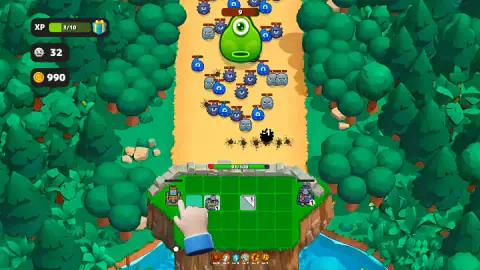
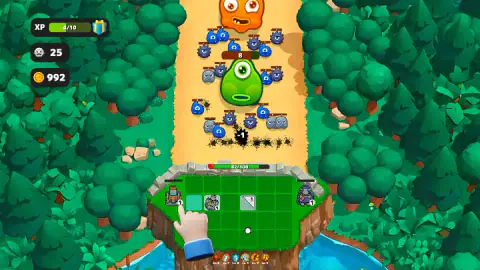
The counter with the bug's head does not count down tidily. Ours stood at 21 while we were still arranging pieces, climbed to 32 once the road filled up, and only then began to fall: it is not a budget, it is a crowd, and it grows before it shrinks. The reward screen arrived the moment it hit zero.
Underneath it, two slower numbers tell you how the fight is really going. The coins crept from 986 to 997 across the wave — two or three cheap triangles' worth of income for a whole wave's work, so this game pays in small change rather than windfalls. The XP bar beside the little wrapped gift moved further and faster, from empty to eight tenths of full.
The red bar on the grass is the honest one. It read 100/100 when we started, 91 partway through the wave and 82 a few seconds later: two identical nine-point steps. Whatever gets past your line takes a fixed bite, and at that rate a board left alone is gone in a shade over ten of them.
The creatures carry their own numbers too. The small ones — grey scowling pebbles, purple spiky things with one eye, blue teardrops — walk under a little brown plaque with a figure on it, and the big pear-shaped green one has a plaque of its own. We watched that one read 9, then 8, while a black splatter on the sand nearby carried the figure -1. Everything here is counted in whole numbers, which makes the fight unusually readable.
The reward screen, and the part where it stopped
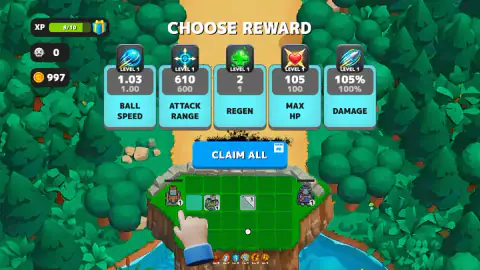
Clear the wave and five cards replace the board under the words CHOOSE REWARD, each marked LEVEL 1 and each showing its new value in white above the old one in grey.
| Card | Was | Becomes |
|---|---|---|
| Ball speed | 1.00 | 1.03 |
| Attack range | 600 | 610 |
| Regen | 1 | 2 |
| Max HP | 100 | 105 |
| Damage | 100% | 105% |
Read down that column and the long game shows itself. Four of the five move by a few per cent, the arithmetic of a hundred small wins. Regen is the odd one out: the only card that doubles what it touches, and the only one that repairs the red bar we just watched fall. On a board that loses nine points at a time, the card most people will skip past is arguably the heaviest one there.
The first card gives the game away, though. Ball speed sits at the front of the row, ahead of damage and range. In a normal tower defense nobody would know what that meant: towers fire on their own timers and no single object crosses the board. Here it is a stat on the same footing as damage, which tells you where this game keeps its weapon.
Now the honest part: we never got to keep any of it. The blue CLAIM ALL button carries a small white sticker marked AD, which means the rewards sit behind a video. We pressed it several times. Three of those times the screen dimmed, the game went looking for its advert, and came back with a line reading "Oops! No ads available right now" over a Continue playing button — and CHOOSE REWARD sat exactly where it had been. Our run ended there: nothing claimed, the coins frozen at 997.
So take this page as one wave's worth of certainty. What the board does, what the pieces cost, how the line bends and what the counters mean, we watched. How many boards there are, what the dearest tower does that the cheap one does not, and how the difficulty moves afterwards, we cannot say: we never got past a screen that would not let us leave.
More to defend, and more to bounce
Hero Defense King is the straightforward version of this idea: waves, a lane, and towers that get on with their own shooting while you spend. Limited Defense squeezes what you are allowed to build instead, so the decision becomes which pieces to go without. Zombies ate my Castle swaps the grid for one strip of ground and a bar of cards that refills by itself — a useful contrast, because it shows what a defense game feels like with the geometry taken out. And if it was the bounce that pulled you in rather than the towers, Bricks Buster is the pure form: one ball, one angle, the whole board as the target. The rest are in strategy games.
Screenshots
How to play Bounce TD
- Read the dashed line first. It is drawn across the board during preparation and already tells you where your shot goes. Nothing moves until you are ready.
- Drag a piece out of the tray onto a green square. Each carries its price underneath, from four coins for the triangle up to twenty-five for the dark blue tower, and the cost comes straight off the total below the tray.
- Put the triangles where you want the line to turn. A tower covers the row it stands in; a triangle sends that same line down a column as well. One ball, two directions.
- Press the green FIGHT button. The camera pulls back and the creatures start down the sand road towards your grass.
- Watch the counter with the bug's head on it. That is how many are left; at zero the wave ends and the CHOOSE REWARD screen arrives.
Things we only found out by being there:
- Merging works on the mirrors, not just the towers. The card in the right-hand panel shows it twice over: two blue towers becoming one, and two blank white triangles becoming one. Most games of this shape only merge the things that shoot.
- Moving a piece is free. The third card, MOVE, is a drag from one square to another, so there is no reason to live with a bad angle.
- The six round icons under the board stayed at Lv. 0 throughout. Whatever they are, nothing we did in four minutes touched them, and the game never pointed at them.
- The keyboard does nothing we could detect. Letters, Enter and Escape all went unanswered. This is a game for one pointer.
Controls
| Drag a piece from the tray onto a green square | Puts it on the board and takes its price out of your coins. The tray shows each price under the piece |
|---|---|
| Drop a piece onto an identical one already on the board | Merges the two into one. The game's own card shows this working on towers and on the white triangles alike |
| Drag a piece already on the board to another square | Moves it. The card labelled MOVE shows the gesture, and it costs nothing |
| The green FIGHT button | Starts the wave. Nothing comes down the road until you press it, so the preparation phase is as long as you want |
| The dashed white line across the board | Not a control, but read it before pressing anything. It is the route, and it bends where your triangles are |
| Keyboard | Nothing we could detect. We tried letter keys, Enter and Escape, and the board did not answer any of them |
Features
- The cheapest thing in the tray costs 4 coins and has no gun on it at all — it is a white triangle, and the dashed line on the board turns a right angle where it sits
- Four pieces to buy in the stage we played, priced 4, 12, 10 and 25, so a tower costs a handful of kills rather than a whole wave
- Merging works on the triangles too, not only on the towers: the game's own illustration shows both
- A counter at the top counts the enemies left in the wave. Ours climbed from 21 to 32 as they poured in, then fell to 0 — and the reward screen arrived the moment it did
- Five reward cards between waves — ball speed, attack range, regeneration, maximum health and damage — and four of them move by a few per cent while one quietly doubles
- Our base bar fell from 100 to 91 and then to 82 across one wave, in two identical nine-point steps
- Claiming the rewards is gated behind a video. Three times in our run the game answered: Oops! No ads available right now
Game details
- Developer
- Yodco
- Release date
- May 2026
- Last updated
- October 23, 2026
- Added here
- March 2026
- Technology
- HTML5
- Platforms
- Browser (desktop), Browser (mobile & tablet, touch)
- Classification
- Strategy
- Saved progress
- Saving, when available, is managed by this game. Mava cannot confirm your level.
FAQ
What kind of game is Bounce TD?
It is a tower defense played on a small grid, with a twist you can see before the fighting starts: a dashed line is drawn across the board showing a route, and that route bends wherever you have placed a white triangular tile. A ball travels it. You spend coins on pieces, arrange them on the grid, then press FIGHT and watch a wave of creatures come down a sand road towards your base.
What is the white triangle in Bounce TD for?
It is the cheapest piece in the tray, at four coins, and it has no gun on it. It is a mirror. On our board the dashed line ran out of a tower along its row, hit the triangle and turned ninety degrees downward, so one shot covered a row and a column instead of just a row. It is the piece that makes the game a puzzle rather than a shooting gallery.
How do you merge towers in Bounce TD?
Drop a piece onto an identical piece already on the board. The game explains it on a card in the right-hand panel labelled MERGE, and that card shows the trick working two ways: two of the blue towers become one, and two of the plain white triangles become one as well. Every piece we placed carried a small badge reading 1, which is its level.
What do the CHOOSE REWARD cards do in Bounce TD?
After a wave is cleared the game offers five of them, each showing the new value above the old one: ball speed, attack range, regeneration, maximum health and damage. Four move by a few per cent — damage from 100% to 105%, attack range from 600 to 610. Regeneration is the odd one, going from 1 to 2, which is the only card on the screen that doubles what it touches.
Does Bounce TD have ads?
Yes, and at the point that matters. The CLAIM ALL button on the reward screen carries a small sticker marked AD, so taking your upgrades means watching a video first. We pressed it several times in one session; three of those times the screen dimmed and came back with the line Oops! No ads available right now over a Continue playing button, and the reward screen was still sitting there afterwards. We never managed to claim a reward.
Who made Bounce TD and when did it come out?
The credit on record is Yodco. It was published in May 2026 and was updated in August of the same year. That date is a listing date rather than a studio announcement, so treat it as when the game reached this shelf.
Is Bounce TD free to play in a browser?
It is free, it runs on this page with nothing to install, and there is no account to make before you start. The only thing it ever asked us for was our attention for a video, on the reward screen between waves, and even that it could not deliver on the day we played.
Can you play Bounce TD on a phone?
It is listed for desktop, mobile and tablet alike, and every action we found is a drag or a single press — pull a piece out of the tray, drop it on a square, hit the green button. That travels to a touchscreen in principle. We played with a mouse, though, so how the drag feels under a thumb is the listing's claim and not ours.