






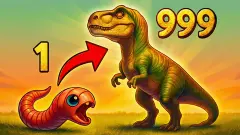



About Jurassic Merge: Dino Evolution
The title says Jurassic. The first dinosaur the game puts in your hand, the Coelophysis, lived in the Triassic. One of the enemies is named after a creature that walked upright in Ethiopia long after the last dinosaur was gone. Nobody should come to Jurassic Merge: Dino Evolution for a tidy lesson in natural history.
What it offers instead is a loop with one firm rule: everything you decide, you decide before the fighting starts. On a small pink board set in a lava cave you spend gold to summon creatures from the cards along the bottom, then drag pairs of identical ones together so two weak units become one stronger one. Then you press a red button with crossed swords and watch them settle it. That is an auto-battler: the fighting runs itself, and the skill is all in the army you sent.
It is credited to DudaGames and lists it for desktop, phones and tablets. It was published in June 2026, so it is recent and lightly played.
We went back through it on 21 October: the whole tutorial, two wins, the Bestiary browsed, and a normal level of our own. We never lost a fight, so what a defeat costs is the one thing we still cannot tell you.
Two of a kind, and something new from level three
The merge rule is the whole game, and it fits in a line: two identical units at the same level make one at the next. The drawings say it out loud, since one Coelophysis becomes two becomes a herd as the badge counts up. That picture is also the price list. Every step eats two units of the step below, so a level 3 is four summons and a level 4 would be eight. When gold is short, that doubling is the thing to keep in mind: one high unit costs what a crowd of low ones costs.
Then the tutorial changes the rules on you. A card reads "Starting from level 3, you can mix different creatures to get new ones! Try it!", and the hand drags a Coelophysis herd onto a quite different level-3 creature. Below level 3 that same drag does something duller, which we found by accident long before the card appeared: the two units swap squares. That is the only way we found to move a unit onto an occupied square. The red and black swirl that sits on a square through the early tutorial, by contrast, is never explained, and we are no wiser than you.
The Bestiary is where the game shows its hand
A red book icon in the top corner opens a window called Bestiary, and it answers questions the board never does. Inside is a scrolling grid of cards, each with a creature's name, a small role icon, the level it stands for, and two buttons: one gold, one in pink crystals. Creatures you have not unlocked are flat black silhouettes, which makes the catalogue read as a collection to fill rather than a shop.
The role icons are the quiet part: a shield on Ankylosaurus, a bow on Ardipithecus, a set of jaws on Coelophysis. That is the game telling you who tanks, who shoots and who bites, on a board where none of them will take an order later.
The prices climb the way the merges do, and every one of them is quoted twice, so you can pay in whichever currency you have:
| Coelophysis card | Gold | Crystals |
|---|---|---|
| Level 1 | 100 | 40 |
| Level 2 | 200 | 75 |
| Level 3 | 400 | 145 |
Open a card and it fills the window with the artwork and a line reading "Combinations:", followed by a sum in pictures: one creature plus the same creature equals the next one up. Four names came past while we scrolled: Coelophysis, Ankylosaurus, Ardipithecus and Raptor.
What a victory pays
The first fight ends with a wooden VICTORY sign, a crystal glinting over it, the words "YOU EARN +400" and an orange button reading COLLECT 400. Our second win paid 250 instead, so the purse is not fixed.
Do the arithmetic on that first prize and it looks deliberate: it buys four summons at a hundred each, and four level-1 units are one level 3. We doubt that is an accident.
Crystals are the second currency and far harder to come by. Their counter sits under the gold one with a plus sign beside it, and across a whole session ours crawled from zero to ten, a quarter of what the cheapest Bestiary card asks. Gold arrives by winning, and a treasure chest at the left of the board hands out more on a timer; crystals, by the look of that plus button, mostly do not.
Coelophysis, Ankylosaurus and Ardipithecus are all real animals
The names on those cards are not invented, and the better you know them the stranger the board looks.
Coelophysis, the little two-legged runner you start with, was named by Edward Drinker Cope in 1889, from Greek roots meaning roughly "hollow form", after the hollow bones in its legs. It is one of the earliest dinosaurs we know well: a slight Late Triassic animal about three metres long, most of that neck and tail.
Here is the part that fits almost too neatly. Nearly everything known about Coelophysis comes from one quarry at Ghost Ranch in New Mexico, dug from 1947 by a crew under Edwin Colbert, where hundreds of skeletons lie tangled together in a single bed. The standard picture of this animal, the one in every museum, is a crowd. So is the level-3 card.
Ankylosaurus, the armoured one with the club on its tail, was named by Barnum Brown in 1908. The Greek behind it means bent or crooked lizard, after the way many of the animal's bones had grown together into one stiff piece; it is often rendered "fused lizard". A game whose single verb is fusing two things into one could not have picked a better mascot.
Ardipithecus is the odd one out, and the game does not flag it. The club-carrying figure in the enemy line is no dinosaur but a real genus of early hominin, named by Tim White and his colleagues in the mid-1990s from fossils in Ethiopia's Afar region, and famous since 2009 for a partial skeleton nicknamed Ardi.
Line the three up and the board holds worlds that never touched. Coelophysis was gone long before Ankylosaurus appeared, Ankylosaurus died out about 66 million years ago, and Ardipithecus turned up some sixty million years later. A fine fight; a terrible timeline.
Is Jurassic Merge: Dino Evolution for you?
It is if you prefer preparing to reacting. Nothing asks for quick hands, and the pleasure is in watching a plan you finished a minute ago work out on its own. It is less for anyone who wants to steer: once the swords button is pressed you are a spectator with a fast-forward button, and the opening is heavily guided.
One practical note. The board is built tall and narrow for a phone, so in a wide desktop window the playing area takes the middle third of the screen and the rest is lava. That is how we played it, with a mouse.
More merge and dinosaur games
For merging with an army to defend, Merge Elementals: Castle Defense and Chicken Merge are the closest things we have. If it is the dinosaurs you came for, Dinosaur Shifting Run is a running game with them, and Animal Evolution Simulator grows one creature instead of an army. The rest are under strategy games.
Screenshots
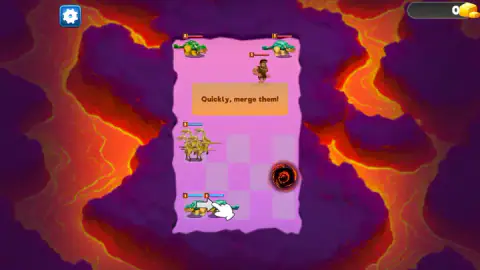
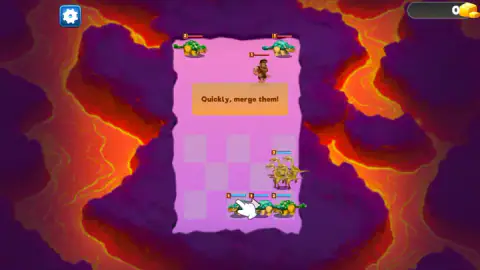
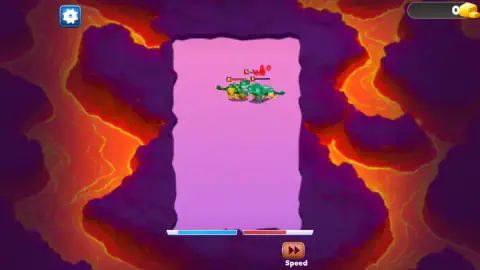

Taken by opening the game ourselves and letting it run — not supplied by the publisher, and not the same picture every other site shows.
How to play Jurassic Merge: Dino Evolution
- Summon. Cards sit under the board, each with a creature's head and a price. Every one we saw cost 100 gold a click, and each click drops a level-1 creature onto a free square.
- Merge. Drag a creature and let go on top of an identical one at the same level. The pair becomes one unit with the next number on the small orange badge over its head.
- Keep merging. Two level-2 units make a level 3, with a white hand showing each drag and a card nudging you along: "Quickly, merge them!"
- Mix, once you are allowed. A later card states it outright: "Starting from level 3, you can mix different creatures to get new ones." Below that level, dropping a creature on a different one only trades their squares.
- Fight. Press the red button with the crossed swords at the board's right edge. From there you watch, and the only control left is a Speed button marked with a double arrow.
A few things our own session taught us:
- The drop has to land on the other creature. Several of our drags fell short and nothing happened: no merge, no message, no shake of the board. Aim for the middle of the target.
- Read the badge, not the picture. Two units merge only when species and number both match, and at a glance the drawings make that easy to misjudge.
- Blue is yours, red is theirs. Every unit carries a short bar, blue above yours and red above the enemy's, and in the fight those colours become long bars under the board.
- The Bestiary window is sticky. Clicking the X in its corner did nothing for us, several times over. What worked was the line printed inside it: "Tap anywhere to continue."
Controls
| Click one of the cards under the board | Spends gold to put one new level-1 creature on the board; every card we saw cost 100 gold |
|---|---|
| Drag a creature onto an identical one of the same level | Merges the two into a single unit one level higher |
| Drag a creature onto a different one | Below level 3 the two simply trade squares; from level 3 the game says different creatures can be mixed |
| Red button with crossed swords | Starts the fight, which then plays out without you |
| Speed button (during a fight) | Marked with a double arrow; we did not press it |
| Red book icon, top left | Opens the Bestiary, the catalogue of creatures with their levels and prices |
Features
- Two-step rounds, first a board where you summon and merge, then a fight you only watch
- Merging by dragging one creature onto its twin, with the level on a small orange badge above each unit
- A stated rule that from level 3 you can mix different creatures into new ones
- Three summon cards under the board in a normal level, every one of them 100 gold a click
- A first win that pays 400 gold, exactly four summons
- A Bestiary that prices each creature twice, in gold or in crystals, from 100 or 40 at level 1 to 400 or 145 at level 3
- Enemy line-ups that mix armoured dinosaurs with a club-carrying Ardipithecus
- Made by DudaGames
Game details
- Developer
- DudaGames
- Release date
- June 2026
- Last updated
- June 17, 2026
- Added here
- April 2026
- Technology
- HTML5 (2D)
- Platforms
- Browser (desktop, mouse), Browser (mobile & tablet)
- Saved progress
- Saving, when available, is managed by this game. Mava cannot confirm your level.
FAQ
How do you play Jurassic Merge: Dino Evolution?
Click the cards under the board to summon creatures with gold, then drag one onto an identical one to merge them into a stronger unit. When the army is ready, press the red button with the crossed swords at the edge of the board. The fight runs by itself and you watch the result.
How do you merge dinosaurs in Jurassic Merge: Dino Evolution?
Drag a dinosaur and let go when it is on top of another of the same kind and the same level. The two become one unit a level higher, shown on the small orange badge above its head. If the drop lands short of the other unit, nothing happens at all.
Can you mix different dinosaurs in Jurassic Merge: Dino Evolution?
The game says so itself on a tutorial card: starting from level 3, different creatures can be mixed to get new ones. Below level 3 that does not work, and dropping one creature on a different one only makes the two trade squares.
What is the Bestiary in Jurassic Merge: Dino Evolution?
It is the catalogue behind the red book icon in the top corner. Every creature has a card with its level, a role icon and two prices, one in gold and one in crystals. Open a card and it shows the creature's artwork and a Combinations line drawing which two units make it.
How much does it cost to summon a dinosaur?
Each summon card under the board cost 100 gold a click in every level we played. The Bestiary charges separately to unlock a creature at a given level: 100 gold or 40 crystals for a level 1, and 400 gold or 145 crystals for a level 3.
Do you control the dinosaurs during a fight?
No. Once the fight starts the board squares disappear, both armies walk into each other and the damage numbers come up without any input from you. The only control left on screen is a button marked Speed with a double arrow on it.
Which dinosaurs are in Jurassic Merge: Dino Evolution?
The Bestiary named four creatures while we browsed it: Coelophysis, the small two-legged runner you start with, Ankylosaurus, the armoured one with the tail club, Raptor, and Ardipithecus, which is the club-carrying human figure rather than a dinosaur at all.
Did dinosaurs and cavemen really live at the same time?
No. Ankylosaurus died out about 66 million years ago, and Ardipithecus, the real animal the game's caveman is named after, lived about 4.4 million years ago in what is now Ethiopia. Some sixty million years separate them.