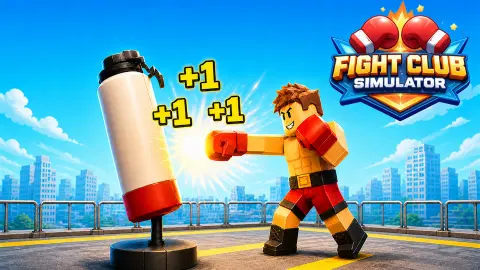





About Fight Club Simulator
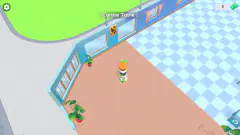
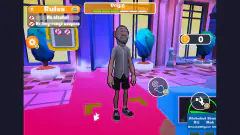
The listing talks about a neon future and cyber boxing. The first thing Fight Club Simulator actually shows you is a gym with a tiled floor, a pool table and a row of weight posts, and a counter in the corner that says your strength is zero.
That is the real game. Before any fight, it is about numbers on labels. Every rival standing around the gym has a strength figure over his head, and every machine has one too. Yours has to climb past theirs. The fists come later.
We played one session of about four minutes on a desktop and never left that first room. We did not throw a punch at a rival, earn a coin or finish the first tutorial step. What follows is what the gym showed us in that time, and what we would do differently.
The game is credited to Fly Troll Studio and has been available since August 2026.
The corner of the screen reads ver.2.89, a high version number for a game that is new on that portal. We read it as a sign that the game had a life somewhere else before it arrived here, though we could not confirm where.
Every rival and every machine wears a number
The gym is laid out like a waiting room. Fighters stand on their own squares, and each has a small label over his head with a flexed arm and a number. That is his strength.
The first one, Slippery Jim, is labelled 20. Next to him stands Jake Paper Fist at 500, and further back a fighter in a red suit carries 10.00k. The ladder does not climb gently: the second rival is many times stronger than the first.
The same logic runs through the machines. The first weight post was outlined in green, the next ones in red, and the signs around them read Need 100 and, on one poster, Need 20.00k. Nothing in the gym opens because you found it. It opens because your number is high enough.
That is why the sign at the top of the screen matters. It reads TRAIN 20 and it was there in every screen we took, from the first second to the last. Slippery Jim is at 20. We take it as the game's first instruction: get to his number, then go and see him.
The labels also carry two smaller figures, one beside a red glove and one beside a tiny boxer, and they rise along with the strength numbers. The game does not say what they count, and we did not fight anyone, so we will not guess.
Train first, fight later: the oldest rule in the gym
The ancient Greeks had a story for this. Milo of Croton, a wrestler from southern Italy, is said to have carried a newborn calf on his shoulders every day until it was a full-grown bull. The weight grew slowly, and so did he.
It is a legend, but the idea behind it is real. In the 1940s an American army doctor, Thomas DeLorme, wrote it up as progressive resistance exercise: lift a little more than you could last time, and your body adapts to the new load. Strength coaches still build training plans that way today.
Fight Club Simulator turns that rule into a door with a number on it. You cannot use the post marked 100 until your strength says 100, and you cannot sensibly fight a rival labelled 500 at 20. The game will not let you skip ahead, which is the whole point of the green and red squares.
For you, it means the early game is patience, not reflexes. The interesting choices come once the number moves: which machine next, which rival next, and what to spend gems on.
The upgrades tree: six moves, paid in gems
The UPGRADES button opens a tree of six cards in three rows of two, joined by lines. The pictures show punches in the upper rows and kicks against a heavy bag in the bottom row.
When we opened it, the first card was already lit in green: that is the punch you start with. Two of the others had prices under them, 3 gems and 2 gems, each with a plus button. We had no gems, so we could not buy either.
Gems are their own currency, separate from coins. A sign near the top left of the gym advertises a gems shop with a counter at 0/11. We did not find out how that counter fills.
Next to UPGRADES sit four more buttons: PROFILE, ABILITIES, SKINS and PETS. We did not get far enough to use them, so we cannot tell you what a pet does for a boxer here.
Where the neon is
The arenas from the description were not in our session. The only hint of them was a sign at the right edge of the gym, partly hidden behind the menu, reading Teleport and Synthwave beside a price of 800 coins.
So the sci-fi stages appear to sit behind a coin price, past the first gym. If you came for neon, budget for a stretch of plain training first.
Who it is for, and what we did not see
It suits players who like simulator games where the fun is watching a number grow and spending it well, more than fast reflexes. The look is friendly and blocky, with no blood that we saw. Younger players may need help with the opening, because it explains itself with arrows rather than words.
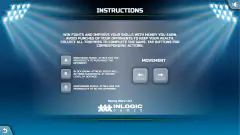
Be clear about how little we saw. We never raised our strength, never fought, never won or lost, never opened the abilities, skins or pets, and never reached another arena. The listing's controls are WASD to move and Space to fight, use and buy, with a joystick on phones. We could not match a key to a clear result and did not play on a phone.
More boxing and gym games
If the training half is what draws you, Gym Simulator Online, Escape is a strength clicker with bosses guarding the exit. MergeMMA puts a whole gym of boxers to work for you. For the fighting without the gym, Boxing Stars has timed bouts and a career ladder, and Drunken Boxing is two wobbly boxers on one keyboard. The rest are under action games.
Screenshots
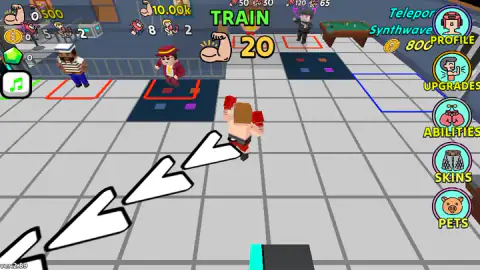
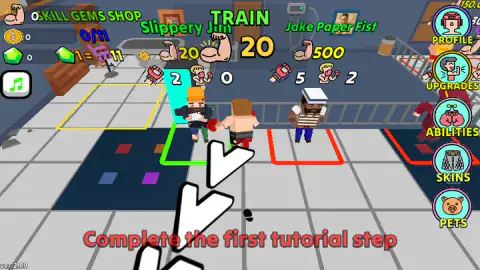
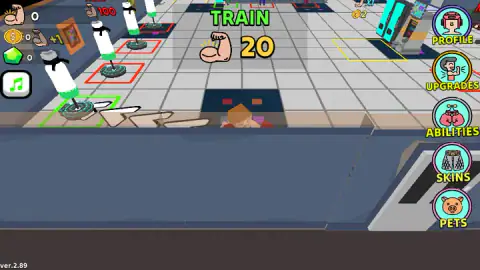
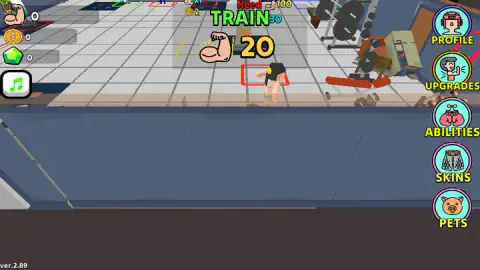
Taken by opening the game ourselves and letting it run — not supplied by the publisher, and not the same picture every other site shows.
How to play Fight Club Simulator
- Start the game. You are dropped into the gym as a blocky boxer in red gloves, with strength, coins and gems all at zero in the top left.
- Follow the giant white arrows painted on the floor. They point at the next thing the game wants from you.
- Train on a weight post outlined in green. Red outlines mean the post or the square needs more strength than you have.
- When your strength matches a rival's label, step onto the square in front of him to fight. The listing gives Space for fight, use and buy.
- Spend gems in UPGRADES on new punches and kicks. The red X closes any panel.
What our four minutes taught us:
- The arrows are the tutorial. There is no text box explaining things, only one red line: Complete the first tutorial step. The arrows show what that step is. In our session they ended up pointing at the first weight post, the green one.
- Do not wander to the bottom of the gym. The camera follows you behind the front wall, and in most of our later screens we could see little more than the top of our boxer's head.
- Close panels before you move. The UPGRADES window covers the right half of the screen. We lost time trying to walk with it open.
- Ignore the far rivals for now. Their labels read in the hundreds and thousands. The one that matters at the start is the first.
Controls
| W, A, S, D | Listed for walking round the gym; we could not tie a clear result to a key in our session |
|---|---|
| Space | Listed as fight, use and buy |
| On-screen joystick | Listed for phones and tablets; we did not play on one |
| Click the buttons on the right | Opens PROFILE, UPGRADES, ABILITIES, SKINS or PETS; the red X closes the panel |
Features
- A starting gym with a row of weight posts, each outlined green when you can use it and red when you cannot yet
- Rivals waiting on marked squares, each labelled with a strength number, from 20 for the first up to 10.00k
- A TRAIN sign at the top of the screen that stays at 20 until you reach the first goal
- An upgrades tree of six punches and kicks, paid for in gems
- Separate buttons for abilities, skins and pets
- Giant arrows painted on the floor that point at the next thing to do
Game details
- Developer
- Fly Troll Studio
- Release date
- August 2026
- Last updated
- August 31, 2026
- Added here
- August 2026
- Technology
- HTML5 (WebGL, 3D)
- Platforms
- Browser (desktop)
- Classification
- Action , Fighting , Simulation , Sports
- Saved progress
- Saving, when available, is managed by this game. Mava cannot confirm your level.
FAQ
How do you play Fight Club Simulator?
You start in a gym with a strength counter at zero. Weight posts and rivals stand on marked squares, and each one shows a strength number. You train on the posts that are open to you to raise your strength, then fight rivals whose number you can match. Gems buy new punches and kicks in the upgrades tree.
What does TRAIN 20 mean in Fight Club Simulator?
It is the first goal, and it sits at the top of the screen from the start. The first rival, Slippery Jim, is labelled with 20 strength, so we read it as the strength you need before he is worth fighting. It stayed at 20 for our whole session because we never got off zero.
Why are some squares green and some red in Fight Club Simulator?
In our session the first weight post and the square beside the first rival were outlined in green, and everything further on was red, with signs such as Need 100 nearby. Green marks what you can use now, red what is locked behind a higher strength number.
Who are the rivals in Fight Club Simulator?
The ones we could read were Slippery Jim at 20 strength and Jake Paper Fist at 500, with another fighter further back at 10.00k. Each label also carries two smaller numbers beside a glove and a small figure, which the game does not explain on screen.
Are there sci-fi arenas in Fight Club Simulator?
The listing promises neon arenas. All we saw was the starting gym, plus a sign at its edge reading Teleport and Synthwave beside a price of 800 coins. We had no coins, so we did not go through.
How long does Fight Club Simulator take to get going?
Longer than four minutes, in our case. We spent a full session in the first gym without finishing the first tutorial step or earning a single point of strength, so expect the opening to ask for patience and a careful look at the floor arrows.
Who made Fight Club Simulator?
The game's listing credits Fly Troll Studio. It was published on 30 August 2026, last updated the next day.