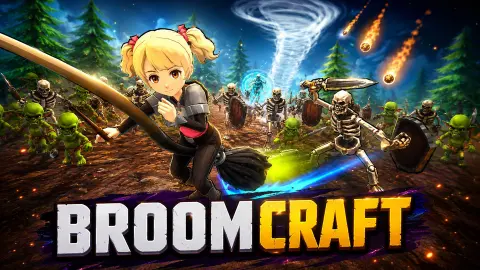





About Broomcraft Mystic Evasion
Orange capitals burn across the dirt at the start of a stage: EVADE AND VANQUISH ALL FOES! That reads like two jobs. It is one. Broomcraft Mystic Evasion gives you a direction to walk in and a button to dodge with, and nothing anywhere on the screen that fires. The damage is done by a spell that hangs around the sorceress like a coat, so the only question the game ever asks you is where you are standing.
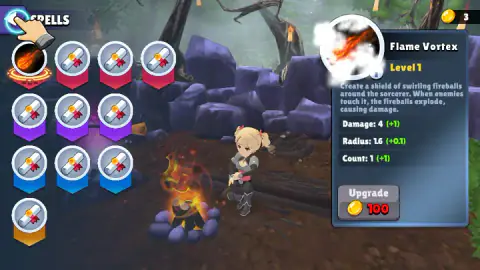
The spell is called Flame Vortex, and the game explains it without fuss: a shield of swirling fireballs around the sorcerer, which explode when enemies touch them. Its three lines of numbers are the whole design in miniature — damage 4, radius 1.6, count 1. Only the first behaves like a weapon statistic. The other two are geometry. They describe how wide the coat is and how many fireballs are stitched into it, which is another way of saying they describe how close you have to walk.
Kirill made it: one of four games on his page, and the only one that is not about going fast. It has been listed since October 2024, was last touched in August 2026. We played it on a desktop on 23 October 2026, for about four minutes, and cleared two stages — enough to see the loop whole, nowhere near enough to see the end of it. Everything below says which is which.
Radius is the statistic that changes how you walk
Look at what an upgrade actually buys. The panel prints each increment in green next to its line: damage goes up by one, the count of fireballs goes up by one, and the radius goes up by a tenth. A tenth sounds like rounding error. It is not, because radius is the only number on that panel that you feel with your hands.
Think about what the ring is. It is a circle with you at the centre, and the thing it hurts is whatever the circle overlaps. Make it wider and every pass you make past an enemy lasts longer and starts sooner, which means you can take a line that keeps more distance between you and the thing you are killing. Add a second fireball and the circle stops being a thin hoop with gaps in it. Raise the damage instead and nothing about your movement changes at all; you simply need fewer passes.
That is the choice the camp is really offering, and it is why the spell screen is worth reading rather than clicking through. One of those three lines buys you safety. The other buys you speed.
The money is blunt about the exchange rate. The Stage Clear we photographed paid 100 coins. The upgrade waiting for us in the camp cost 100. One cleared stage, one improvement — which tells you the shape of the whole game before you have played a third of it.
Eleven slots, one of them lit
The spell screen is a tree rather than a list: eleven round slots running down the left, four in the top row, then three, then three, then one on its own. The colours band them — red, then purple, then blue, then a single amber slot at the bottom, which reads as four tiers of something.
Exactly one of ours was lit. Flame Vortex sat in the top-left corner on a black disc inside a gold ring. The other ten showed a rolled scroll tied with a red seal, and stayed that way for our whole session. We cannot tell you what is in them, and we would rather say so than guess.
One detail is worth passing on because it is easy to miss. With the coin counter at 3, not one slot carried a marker. Later, with the counter at 108, four of the eleven had sprouted a small green arrow above them. Whether that arrow means you can afford this now or merely this is available we did not establish, because we never pressed one. But the screen is clearly telling you something changed, and it only started telling us once we had money.
Nobody presses fire any more
The thing this game does — a character who attacks by herself while you handle nothing but position — is barely five years old as a mainstream idea, and it is possible to point at where it came from.
Vampire Survivors, by Luca Galante working as poncle, went into early access in December 2021 and released in full on 20 October 2022. Its central joke was that it took away the part everyone assumed was the game. Your weapons swing on their own. You move. The genre it kicked open got the name bullet heaven, the mirror image of the bullet-hell shooters where the screen fills with enemy fire and you thread it: here the screen fills with your fire, and the enemies thread it badly. It was itself built after Magic Survival, a mobile game from 2019 that already had a character who attacked by herself.
What makes Broomcraft Mystic Evasion worth looking at inside that lineage is which weapon it hands you first. Vampire Survivors starts its default character with a whip that lashes outward, away from the body. This one opens you on an orbiting ring — the shape that makes the idea impossible to ignore, because the weapon has no reach of its own at all. It goes exactly where you go. Your body is the handle.
And that is the honest answer to why a game called Evasion also asks you to vanquish everything. In a bullet heaven the two verbs collapse into each other. The route that keeps you alive and the route that clears the field are the same line drawn across the dirt, and the only skill the game can test is how well you draw it.
More games like this one
Hook Arena 3D is the other side of the same developer: no spells, no hordes, just a grappling hook and other people. Pixel Hero Survivor runs the same survive-and-upgrade loop in pixel art, with runs long enough to build a real set of weapons. Zombie Monster Survivors flattens it to two dimensions and leans harder on the card draws between levels. 12 minutes to survive is the closest relative here, a wizard in an arena with a clock that tells you exactly how much is left. The rest are in action games.
Screenshots
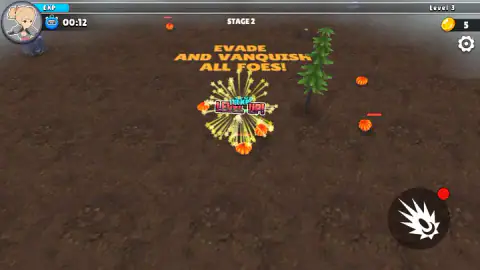

How to play Broomcraft Mystic Evasion
- Click into the game and answer the tutorial card. Ours asked in plain English whether we wanted to skip the tutorial, and the answer you give decides how much hand-holding follows.
- In the camp, press the yellow Play panel in the bottom-right corner. The stage number is printed under the word.
- Move with W A S D or the arrow keys. There is no aiming and nothing to fire. You walk your spell into things.
- When a level-up freezes the stage, take a card with Z, X or C — left, middle, right.
- Clear the stage, take the reward, and spend it back at the camp behind the purple Spells button.
Things you only learn by being there:
- The clock counts up, not down. The Stage Clear we reached read twenty-three seconds. Treat a stage as something you finish, not something you endure.
- Levels arrive absurdly fast. We were level 1 at six seconds in and level 4 by the end of that same stage, which is four card offers inside half a minute. Decide quickly or the game waits on you with the enemies frozen.
- A black banner reading Click to keep playing is the game, not an advert. Click away from the tab and it stops itself; click the middle of the screen and it carries on.
- The camp is the shop, and the only shop. Nothing is bought mid-stage. Coins you pick up off the dirt matter later, not now.
- It is landscape or nothing. The game is built wide and does not turn.
Controls
| W A S D, or the arrow keys | Moves the sorceress across the stage. This is the whole of your attacking, because the spell damages whatever your body passes close to |
|---|---|
| Z, X and C | Takes the first, second or third card when a level-up stops the stage and offers you spells |
| Mouse click | Everything in the camp — the Play panel, the Spells button, an orb in the tree, the Upgrade button, the MENU button on the end-of-stage screen |
| Space, or the round button in the bottom-right corner | The broom leap, the game's one dodge. It is the only other control on screen; we never pressed it, so this one is the game's word rather than ours |
| Clicking the middle of the screen | Resumes play after the black Click to keep playing banner, which the game puts up by itself whenever the tab loses focus |
Features
- No attack button and no aiming: a ring of fireballs orbits the sorceress and damages anything that touches it, so walking is how you fight
- The first spell, Flame Vortex, upgrades along three lines — damage, radius and the number of fireballs — and two of the three change the shape of your body rather than its strength
- A tree of eleven spell slots banded in four colours. One was lit when we played; the other ten were sealed scrolls
- Stages are short and the clock counts up: our second one ended at twenty-three seconds on the timer
- Level-ups arrive every few seconds, each one freezing the stage to offer spell cards on Z, X and C
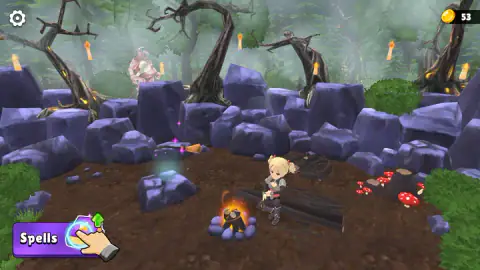
- A camp between stages with a campfire, a floating broom and a shop: nothing is bought mid-stage
- Clearing the stage we photographed paid 100 coins, and the upgrade waiting in the camp cost exactly 100
- Runs in the browser with nothing to install, in landscape, on desktop, phone and tablet alike
Game details
- Developer
- Kirill
- Release date
- October 2024
- Last updated
- October 23, 2026
- Added here
- March 2025
- Technology
- HTML5 (Unity WebGL)
- Platforms
- Browser (desktop), Browser (mobile & tablet, touch)
- Saved progress
- Saving, when available, is managed by this game. Mava cannot confirm your level.
FAQ
What kind of game is Broomcraft Mystic Evasion?
It is a horde-survival game in 3D, seen from high above, in which a sorceress is dropped onto an open plain full of enemies and survives by moving. There is no fire button: a spell orbits her and hurts whatever touches it. Stages are measured in seconds rather than minutes, and between them you spend coins on the spell tree in a forest camp.
How do you attack in Broomcraft Mystic Evasion?
You do not, at least not directly. The starting spell, Flame Vortex, is described by the game as a shield of swirling fireballs around the sorcerer that explode when enemies touch them. So attacking and dodging are the same action performed with the same keys, and the skill is in choosing how close to pass.
What are the controls?
W A S D or the arrow keys move the sorceress, and Z, X or C take the first, second or third card whenever a level-up stops the stage to offer you spells. Everything in the camp is a mouse click. There is also a leap on the spacebar, which appears on screen as the round button in the bottom-right corner, and that is the only other control the game shows you.
What does upgrading Flame Vortex actually do?
Its panel shows three lines with their increments in green: damage rises by one, the number of fireballs rises by one, and the radius rises by a tenth. Damage makes the ring hit harder; the other two make it bigger and busier, which changes how near you have to walk to kill something and how safely you can do it.
How many spells are there?
The tree holds eleven slots, arranged in rows of four, three, three and one and banded in four colours. Exactly one of ours was lit — Flame Vortex — and the other ten showed sealed scrolls. We never unlocked a second one in our session, so what is inside them is the game's secret rather than something we can tell you.
Who made Broomcraft Mystic Evasion and when did it come out?
A developer credited simply as Kirill; the other three are driving and arena games. This one has been available since October 2024 and was last updated in August 2026. There is no studio website to point at, only the author page.
Is Broomcraft Mystic Evasion free, and does it work on a phone?
It is free and it runs in this page with nothing to install. It is built for a wide screen and runs in landscape only, and the publisher lists it for desktop, mobile and tablet alike. We played it with a keyboard and mouse, so how it steers under a thumb is the publisher's claim rather than ours.
How long does a stage take?
Short. The clock counts upwards, and the one Stage Clear screen we captured arrived at twenty-three seconds. What takes time is everything around it — the spell tree, the coins, the ten locked slots — which is built to be returned to rather than finished in a sitting.