










About Falling Dummy
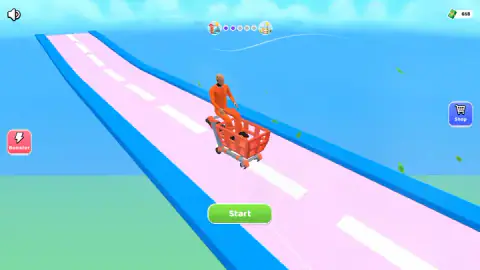
Ragdoll games usually start you at the top of something. Falling Dummy makes you earn the drop. Each level opens with the dummy sitting in a red shopping cart on a pink-and-blue track suspended over open water, and nothing happens until you launch it.
The launch is a small game of its own. The cart rolls to the lip of a ramp and a gauge headed Start Power appears underneath, red at both ends, yellow inside that, green in the middle, with a white marker sweeping across. One tap stops it. The cart goes over, the dummy leaves it somewhere in the first second, and from there the level is a fall through a construction site: timber floors, steel beams, scaffolding towers, the lattice boom of a yellow crane, a wrecking ball, a bomb with a skull on the side.
What turns that fall into a game is the counting. A meter across the top carries the level number, a distance and a chequered flag, and the distance runs down: 150m when the cart lets go, 21m with the ground coming up fast. Down the left edge a second meter fills with points and collects small red badges, one for each part of the dummy that has given way. Stickers reading "Blow Up!" and "Cool!" pop up on the good hits. When the dummy lands, all of it is added up on a card.
The game is credited to Mirra Games and has been available since November 2025. Our own run lasted about four minutes on a desktop and covered levels 2 to 6, four of which we finished. Everything below is what those levels showed us.
The number at the top is how far you have left to fall
The screen holds four readouts and no clock. The top meter carries the level number, the metres and the chequered flag. The left rail is the points meter, with three star marks up its length and a running total underneath; inside one level-2 fall ours went from 6,311 to 11,510. The coin counter sits top right and moves during a fall as well as after one, fed by banknotes stacked in the cart and floating between the floors.
The fourth readout is the row of small red badges that stacks up at the top of that rail. Each marks a part of the dummy that has broken, and they appear the instant it happens rather than at the end, which is what makes a long fall feel like it is going somewhere.
What is not there matters too. In five levels we never saw a failure screen, a life counter or a timer. Every fall we took ended on a COMPLETED card, however badly it went. This is a game about how much of the fall you use, not about surviving it.
Two gauges, and both of them are the same trick
Falling Dummy asks for exactly two precise inputs per level, and they are the same input twice.
The first is Start Power before the ramp. The second arrives on the end card, under a skeleton in a shower of confetti: a base figure labelled Reward, and a bar of five slots reading x2, x3, x4, x3, x2 with a white arrow sweeping across it. Stop the arrow, and the green button pays the base times whatever you landed on. We watched that arithmetic three times: 96 became 192, 117 became 234, and 283 became 849 on an x3.
The shape of the bar tells you the rest. The two x2 slots at its ends are the widest strips on it, and the x4 is a narrow band dead centre, which is the oldest way in games to make a good stop feel earned. The reason for both is the same: a falling ragdoll cannot be steered precisely, so the two moments you do control are compressed into a tap each, and the long middle stays loose.
Why a crash test dummy gets counted bone by bone
The end card does something that looks like a joke and is actually accurate. Down its right side runs a column of seven small body parts, each with a number beside it. Our best level read 6, 13, 11, 5, 11, 12 and 7, which is 65 breaks in one drop. Not a score. A tally, part by part.
That is what a real crash test dummy is for. A dummy is not there to be damaged; it is there to be measured. The first one, Sierra Sam, was built in 1949 to ride ejection seats for the US Air Force, and the whole family since has been stuffed with instruments: accelerometers in the head and chest, load cells in the neck and the thigh bones, dozens of channels on a modern Hybrid III, the standard for frontal tests since the 1970s. What comes out of a crash is not a verdict but a sheet of numbers, broken down by body part, exactly like the column on this card.
The joints explain the other half. A real dummy's shoulders, elbows, hips and knees are set with a calibrated friction, tight enough that a limb just holds its own weight and loose enough that a known force moves it. That is a deliberate setting, and it is why a dummy in a crash film flails rather than falls in one piece.
Watch this dummy go through a timber floor and you are watching a cartoon of the same idea. The arms trail behind the body, a leg catches a beam and spins the rest around it, and the fall is worked out as it happens rather than played back as an animation: we dropped through two floors of the same kind on different levels and never got the same tangle twice. It is also why the game can stay light-hearted: the thing coming apart is an articulated test device, the one object designed for precisely this.
What it asks you to watch, and what it does not
After one of the levels, a panel headed Super Offer turned up over the menu, offering a free skin behind a purple button with a video icon on it. Under it sat a plain No, Thanks line, which closed the panel and left our coins alone.
That was the only interruption in the session: levels 2 through 6 opened one after another with nothing to watch between them, and the multiplier at the end of each is free to stop. The one other pause comes from the page itself — click away and a line reading "Click to keep playing" sits over a loading screen until you click back in.
Where to go after the drop
If it was the physics that kept you here, Hero Rescue works the same way from the other end: you pull pins in the right order and let gravity carry out the plan. Ladder to Brainhot: Climb Obby puts the same height in front of you and asks you to climb it on a stamina bar instead of falling down it, and +1 Speed: Escape Prison turns an obby into a run that gets faster with every step. Pixel Hero Survivor swaps gravity for waves of monsters in a fenced yard. The rest are in action games.
Screenshots
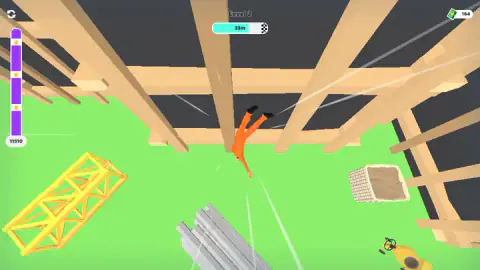
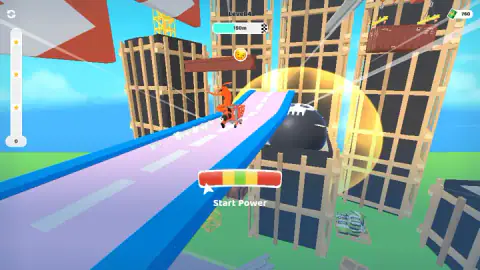
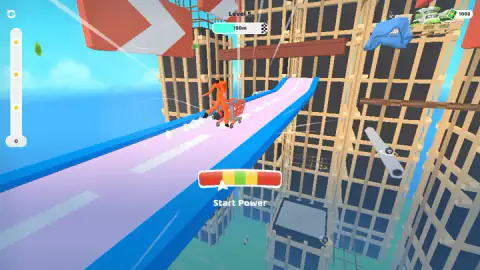
Taken by opening the game ourselves and letting it run — not supplied by the publisher, and not the same picture every other site shows.
How to play Falling Dummy
- Press the green Start under the cart. The menu around it holds a Shop on the right, a Booster on the left, and a row of progress dots along the top that ends in a chest.
- Let the cart roll until the Start Power gauge appears in front of the ramp, then click or tap once to stop the sweeping marker. The green strip in the middle is the clean launch; the red ends are not.
- Once the dummy is in the air, drag to steer. The game says so itself in the middle of a fall: "Use drag - to move", with a curved arrow next to it.
- Steer into the structure, not through the gaps. Beams, scaffolding and the crane are what raise the points meter on the left and add badges to it; clean air adds nothing.
- On the COMPLETED card, stop the arrow on the multiplier bar, take the green button, and tap once more to continue to the next track.
What our run taught us:
- The metres count down, not up. It looks like a distance travelled and it is a distance remaining. Once you read it that way, you know exactly how much fall you have left to spend.
- Drag across, not down. Gravity already supplies the down. A drag is for crossing the shaft to reach the beam on the other side.
- The launch is part of the score. Our first badges of a level appeared while the dummy was still coming out of the cart, before it had fallen a metre.
- A clean drop through open space is a wasted one. The timber floors are the opposite: they stop the dummy, turn it, and send it into the next one.
- The arrow at the end is worth as much as the fall. A reward of 283 paid 849 on x3. The same reward on x2 would have paid 566.
Controls
| Click or tap | Press Start in the menu, stop the Start Power marker, stop the reward arrow, continue past a card |
|---|---|
| Drag (mouse or finger) | Steers the dummy while it falls; the game says so mid-fall with "Use drag - to move" |
| No keyboard shortcut we could find | Every action that worked for us was a click, a tap or a drag |
Features
- Each level starts with the dummy in a red shopping cart on a pink-and-blue track hung over open water
- A Start Power gauge with a sweeping marker decides how hard the cart goes over the ramp
- The fall runs through a construction site of timber floors, steel beams, scaffolding towers, a crane boom and a wrecking ball
- The meter at the top counts metres down to the ground, with a chequered flag at the end of it
- An end-of-level card tallies the breaks across seven body parts and pays a reward you multiply yourself
- A multiplier bar of x2, x3, x4, x3, x2 that turned a reward of 283 into 849 on our best stop
- Available since November 2025
Game details
- Developer
- Mirra Games
- Release date
- November 2025
- Last updated
- October 16, 2026
- Added here
- September 2025
- Technology
- HTML5 (3D ragdoll physics)
- Platforms
- Browser (desktop), Browser (mobile & tablet, touch)
- Classification
- Action
- Saved progress
- Saving, when available, is managed by this game. Mava cannot confirm your level.
FAQ
How do you play Falling Dummy?
You press Start, let the shopping cart roll along an elevated track, and stop a sweeping marker on the Start Power gauge to launch it off a ramp. The dummy comes out of the cart and the rest of the level is a fall through a construction site, which you steer by dragging. The level ends when it reaches the ground and the game tallies up the damage.
How do you steer the dummy while it is falling?
By dragging, with the mouse on a desktop or a finger on a phone. The game spells it out in the middle of a fall with the line "Use drag - to move" and a curved arrow. Gravity supplies the downward speed, so a drag is mostly about moving the body sideways into something solid.
What does the number at the top of the screen mean?
It is how far the dummy still has to fall, not how far it has fallen. The meter opens at 150m with a chequered flag at its end and empties as you drop, reading 33m or 21m just before the ground arrives. There is no clock anywhere on the screen.
What is the bar with x2, x3 and x4 at the end of a level?
It is a reward multiplier you stop yourself. The card shows a base figure next to the word Reward, an arrow sweeps across five slots reading x2, x3, x4, x3, x2, and wherever you stop it multiplies that base. A reward of 283 paid out 849 when we stopped on x3, and one of 96 paid 192 on x2.
How many levels does Falling Dummy have?
We do not know. Our session ran from level 2 to level 6 without reaching an end or finding a level list, and each one was a fresh track and a fresh fall. The menu shows a row of progress dots with a chest at the end, which suggests rewards at milestones rather than a fixed finish.
Who made Falling Dummy?
It is credited to Mirra Games, who also made Zombie Stars: Survival Shooter, Idle Mutation Tower Defense, Hidden Objects: Island and Deep Drill Run. The game has been available since November 2025.
Can you play Falling Dummy on a phone?
It is listed for desktop and mobile web as well as Android and iOS, and the controls point the same way: everything is a tap or a drag, with no keys involved. We played it on a desktop with the mouse, so we cannot report on how a touch screen feels in the air.
Does Falling Dummy make you watch video ads?
It did not make us. After one level a panel headed Super Offer appeared, offering a free skin behind a video icon, with a plain "No, Thanks" underneath that closed it. We played five levels end to end without watching anything, and the reward multiplier at the end of each one is free.