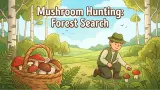





About Mushroom Hunting: Forest Search
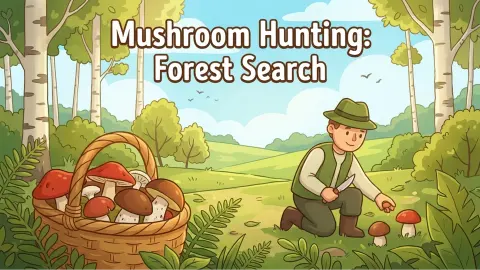
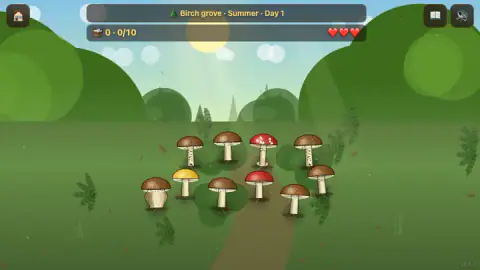
A hidden object game usually hides the object. This one hides nothing. You arrive in a glade of green hills under a soft sun, and ten mushrooms stand there in the open grass, drawn large enough to count from across the screen: seven brown, one yellow, two red with white speckles. Nothing to scrub the screen for. What is hidden is not where they are. It is what they are.
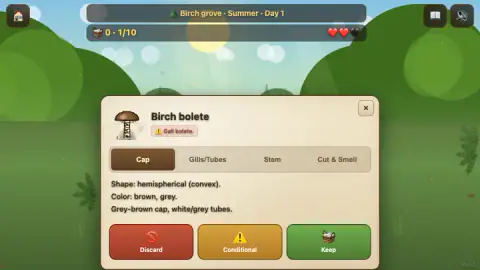
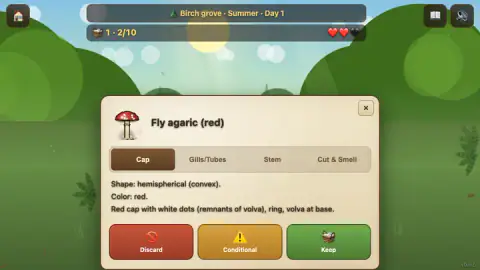
Tap one and the glade stops. A cream card slides up with the species name on it — Birch bolete, say — and a row of four tabs underneath: Cap, Gills/Tubes, Stem, Cut & Smell, each holding a couple of lines of plain description. Three buttons close the card and there is no fourth: a red Discard, an amber Conditional, a green Keep. You answer, the card goes, and one mushroom disappears from the grass.
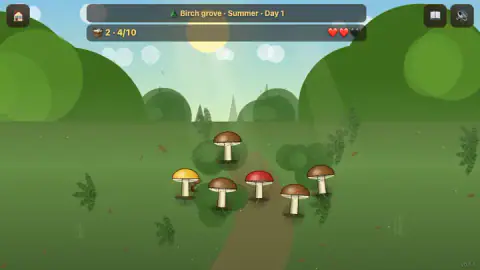
Two numbers track the day beside a little wicker basket. The first is what you have taken home, the second is how many of the ten you have ruled on, and they drift apart the moment you turn something down. Ours went 0 · 0/10, then 1 · 2/10, on to 3 · 6/10. Beside them sit three hearts, and the hearts are the part nobody warns you about.
The game says what it wants on the fourth of five tutorial cards: save ₽100,000, find all 63 species in the atlas, befriend all ten villagers, and you open your own mushroom shop. The home screen boils that down to one percentage, and on our second day it read 3 per cent. We played one morning in one birch grove and came home sick, so what follows is a morning's worth of certainty.
Ten mushrooms, three hearts, and a counter that moves twice
Your basket and your progress are two different numbers; in most collecting games they are one. Refusing a mushroom still advances the day: the right-hand figure goes up, the glade thins by one, your basket does not. A cautious forager finishes with an honest, empty basket and nothing to sell.
That is the pressure, and the hearts are the counterweight. They are not a clock: ours went down when we made calls, not while we stood still. The first went on our very first decision, a hedge on a birch bolete the card had flagged; the second five mushrooms later, on another hedge. At one heart left, with four of the ten still standing, the game stopped us with a card saying we felt unwell and should go home and rest, and the next screen read DAY 2.
So a day is not lost or won, it is cut short: you keep what is in the basket and forfeit the rest of the glade. That is a gentler loss than most games of this shape hand out, and it is why this one reads as calm while it punishes you.
The four tabs are a real field key
The order on that card is not decoration. Cap, gills or tubes, stem, cut and smell is roughly the sequence any field guide walks you through, and it runs weakest evidence first, because that is the order a beginner's eye works in.
Take the two species the game showed us first. A fly agaric is the famous red cap with white flecks, and the Cap tab says exactly that. But the cap is the part that lies: rain washes the flecks off, and plenty of harmless mushrooms are red. Those flecks are the remains of a veil that wrapped the whole young mushroom like an egg, and that veil leaves two other marks — a skirt-like ring on the stem and a swollen cup, the volva, at the base. In a wood, the base is the piece beginners leave in the ground, which is exactly how people get poisoned.
Then the birch bolete, which arrived with a warning printed on it: Gall bolete. That is not a death threat, it is a dinner threat. The gall bolete is a real impostor that grows beside the edible boletes and ruins food rather than people — bitter enough that one cap can spoil a whole pan. Telling it from a porcini is a stem job again: a dark coarse net on the impostor, and pores that blush pink with age where a porcini's stay white and then olive. Cut & Smell is the last court of appeal for the same reason foragers slice a mushroom in the field: flesh that changes colour, or a smell of aniseed or radish, settles cases the cap cannot.
One more thing hides in the biome list. Most of those nine places are named after a tree — birch, pine, spruce, aspen, oak — and that is not scenery. Boletes of this kind live tangled into tree roots, trading minerals for sugar, each loyal to its partner. The birch bolete is a birch specialist, and the game puts it in a birch grove for the reason you would find it there.
Why there is an amber button between keep and throw away
Most games would give you two choices. This one insists on three, and the middle one is a translation rather than a design decision.
In Russian and Eastern European mushroom books there is a shelf between edible and poisonous: conditionally edible. It covers species that are good food after boiling, soaking or salting and a bad idea without that work — milk caps above all, which bleed a white latex when cut and are salted by the bucket in that cuisine. We met a yellow one in the birch grove. The game counts money in roubles, and its three buttons are that three-way sorting, not a two-way one with a maybe bolted on. Which is why the amber button is a decision and not a shrug, and why the hearts seem to notice.
What waits outside the glade
The home screen is a village square at dusk with seven doors, and after one morning we had used one. Pantry sorts the basket, Kitchen cooks, Market sells, Village holds the quests — ours said three were ready to turn in — and there are an Atlas, a Skills panel with a point waiting and an Achievements page at none of 31. Money stood at 500 ₽, because we never sold a thing.
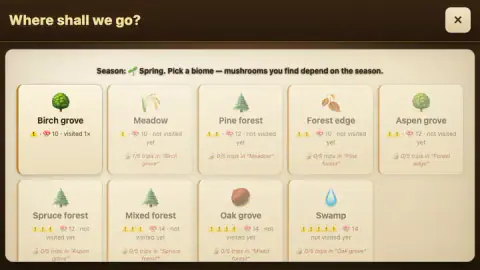
The biome picker is the clearest map of the long game: nine places, each with a mushroom count — 10 in the easiest, 14 in the Oak grove and the Swamp — and one to three warning markers, so the richer the ground, the more on it that can hurt you. Each opens after five trips to the one before.
Two honest notes. The corner of the screen carries a small v0.5.5, and the game shows its age: our forest header said Summer while the home screen and the picker both said Spring. And the advertising is a question mark rather than a complaint — every break we hit replied "We skipped the ad this time – enjoy the game!" over a Continue playing button, which tells you where the breaks sit and nothing about how often they land.
If you like being asked to look properly
Hidden Object Clues and Mysteries is the classic shape this game argues with: crowded scenes, a list of things to find, the difficulty in the clutter rather than the decision. Hidden Objects Island Secrets does the same with an island to work through, and Find the Frog Hidden Objects is the short version — one thing to spot, over and over. Tiny Fishing is the nearest neighbour in rhythm rather than genre: a quiet gathering loop where the haul turns into money. The rest are in arcade games.
Screenshots
How to play Mushroom Hunting: Forest Search
- Click through the five welcome cards, then press Forest · Go foraging on the home screen.
- Pick a biome from the Where shall we go? panel. Only the Birch grove is open at first; the others want five trips to the place before them.
- Tap any mushroom in the glade. Read the card, use the tabs, and answer with Keep, Conditional or Discard. The glade is over when the ten are gone, or when you are.
- Watch the basket counter: the left number is your haul, the right one is how far through the glade you are.
- Go home and the day rolls over. The village is where baskets turn into money, and money is the only thing that moves that percentage.
What a morning in the birch grove taught us:
- The glade is a closed set of ten. We counted: ten standing at 0/10, seven at 3/10, five at 5/10. Each decision takes one out of the grass whichever button you press, so turning something down is not free — it spends the glade.
- Conditional is not a hedge. It looks like the button for "I am not sure", and it is not: both times we used it a heart went dark, while three Keeps and one Discard cost us nothing.
- The Cap tab opens by default and is the weakest evidence. Shape and colour are what every poisonous lookalike copies. What convicts a fly agaric lives under Stem.
- Each first sighting stops the game. A black banner reading "NEW MUSHROOM!" is a catalogue entry, not a prize — you still have to be right.
- The keyboard is dead weight. Arrows and the space bar got no response at all; one pointer does everything.
Controls
| Tap or click a mushroom | Opens its identification card. The card names the species and stops the glade until you decide |
|---|---|
| The four tabs on the card | Cap, Gills/Tubes, Stem and Cut & Smell. The Cap tab is open by default and is rarely the one that settles it |
| Keep, the green button | Into the basket. The left-hand number on the counter goes up by one |
| Conditional, the amber button | Takes the mushroom as a doubtful one. It still counts as resolved, and both times we used it a heart went dark |
| Discard, the red button | Leaves it in the grass. The mushroom is gone from the glade all the same |
| The cross at the card's corner | Closes the card without deciding. The mushroom stays where it was |
| The book and the speaker, top right | The atlas of what you have found, and the sound |
| Arrow keys, space bar | Nothing we could detect. One pointer is the whole control scheme |
Features
- Nothing is concealed: the glade holds exactly ten mushrooms in plain view, and the day asks you to pass judgement on all ten
- Each mushroom opens a four-tab card — cap, gills or tubes, stem, cut and smell — which is the order a real forager works in
- Three answers, not two: Keep, Discard, and an amber Conditional in between that has a meaning outside the game
- Three hearts sit beside the basket. Ours went to two on the first decision and to one by the sixth, and the day ended early
- Nine biomes to choose from, most of them named after a tree, each needing five trips to the one before it
- The game states its own ending: ₽100,000 saved, all 63 species in the atlas, all ten villagers befriended. Our home screen read 3 per cent
- Species identified in a single birch grove morning: birch bolete, fly agaric, porcini, birch porcini, bay bolete and a yellow milk cap
Game details
- Developer
- stHashirama
- Release date
- June 2026
- Last updated
- October 23, 2026
- Added here
- May 2026
- Technology
- HTML5
- Platforms
- Browser (desktop), Browser (mobile & tablet, touch)
- Saved progress
- Saving, when available, is managed by this game. Mava cannot confirm your level.
FAQ
What do you do in Mushroom Hunting: Forest Search?
You pick a patch of forest, and the game shows you a glade with ten mushrooms standing in the open. Tapping one opens a card with its name and a four-page description, and you answer with one of three buttons: Keep, Conditional or Discard. Nothing is hidden from you — the difficulty is in telling an edible species from the one that imitates it.
What do the two numbers next to the basket mean?
The left-hand number is what is actually in your basket and the right-hand one is how many of the glade's ten mushrooms you have dealt with. They move apart, because a mushroom you discard or mark as doubtful still counts as resolved. Ours read 0 · 1/10 after the first decision and 3 · 6/10 by the time the day ended.
What are the three hearts for?
They sit at the right of the basket bar and they are the price of being wrong. Ours started at three, dropped to two after our first judgement call and to one by the sixth mushroom, and we never saw one come back during the day. When they run low a card appears telling you that you feel unwell and should go home and rest, which ends the trip early.
Should you press Conditional when you are unsure?
It is not a safe middle, in our experience. The amber button is the game's way of saying conditionally edible — a real category for mushrooms that are fine after boiling or soaking and unwise otherwise — not a way of saying you do not know. Both times we pressed it a heart went dark, while three Keeps and one Discard cost us nothing. Two cases are not a rule, but they are what our day drew.
How many mushroom species are in the game?
The game's own tutorial says 63, and it treats collecting them as the long goal: every species you meet for the first time stops the screen with a NEW MUSHROOM banner and goes into an atlas you can open from the top right. They are sorted into four rarity tiers, from common ones in every glade up to legendary finds such as porcini, truffle and morel. We met six species in one morning in a single birch grove.
How do you unlock the other forests?
The biome picker lists nine places — Birch grove, Meadow, Pine forest, Forest edge, Aspen grove, Spruce forest, Mixed forest, Oak grove and Swamp — and each one is opened by making five trips to the place before it. Each card also shows how many mushrooms that biome holds, from 10 up to 14, and one to three warning markers for how dangerous it is. A line at the top reminds you that what grows there depends on the season.
How does the game end?
It tells you itself on the fourth tutorial card: save up ₽100,000, find all 63 species in the atlas and befriend all ten villagers, and you open your own mushroom shop. The home screen tracks that as a single percentage; ours read 3 per cent on the second day. We did not get near it, so what the shop actually looks like is the game's claim rather than ours.
Is Mushroom Hunting: Forest Search free, and does it have ads?
It is free and runs in the browser on this page with nothing to install. There are advertising breaks built into it, but every one we reached answered with the line We skipped the ad this time and a Continue playing button, so we cannot tell you how often a real advert lands. A version marker in the corner of the screen reads v0.5.5, which is the clearest sign that this is a game still being worked on.